

SELECTED WORK / PRODUCTION
Honda Accord ‘Dreams’
- Studio
- Arts & Sciences
- Released
- October 3, 2015
- SCANable role
- 3D Scanning
- Director
- Michael Spiccia
- VFX vendor
- a52
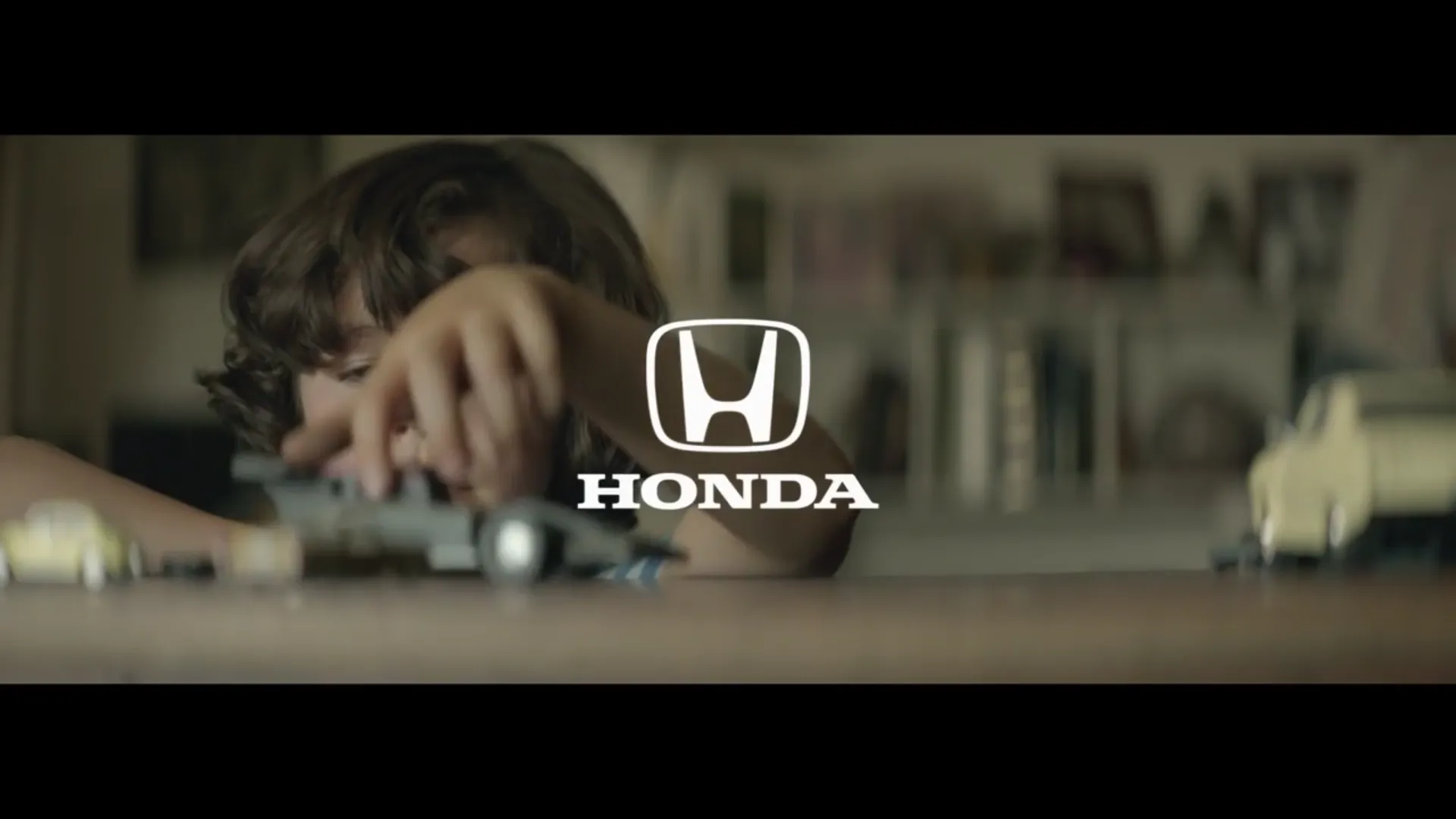
‘Dreams’ is Honda’s 2015 Accord commercial from Arts & Sciences, directed by Michael Spiccia, in which a boy’s toy cars spring to life. The boy watches his father wash a plain-looking sedan and imagines a glamorous dragster; at night he dreams his toy cars come beaming to life, racing around his room with horns and sirens blaring. His remote-control car becomes an enormous race car, and his go-kart turns into a pursuit vehicle in a cops-and-robbers chase. Years later — grown, in a tie, his daydreaming seemingly gone — he spots the 2016 Honda Accord across the street, and the dreams of his youth come rushing back in a wave of nostalgia. The spot is set to Ben Folds’ “Cologne (Piano Orchestra Version).”
SCANable 3D scanned all of the toy cars that come to life in the campaign, delivering detailed photogrammetric models that a52 used to animate the vehicles as photoreal CG assets.
Measured, not modelled from photographs
A vehicle built by eye from reference images will be wrong in ways that are hard to name and easy to see. Cars are designed objects, and their surfaces are continuous curves tuned by people whose entire job was that continuity.
An artist reproducing those curves from photographs is fighting lens distortion, unknown camera distances and their own assumptions about what the shape should be. The result usually looks like the car without being the car.
Photogrammetric capture skips the interpretation. The surface comes from measurement, so the highlight that runs down a flank breaks exactly where it breaks on the real object — the detail nobody consciously notices and everybody registers.
Gloss, chrome, and glass
Vehicles are the hardest common subject in 3D scanning, because their defining surfaces are the ones that refuse to be photographed. Gloss paint reflects the environment instead of showing its own form. Chrome shows only what is around it. Glass shows both what is behind it and what is in front.
Handling this is a capture problem before it is a processing one: controlled lighting to suppress moving reflections, cross-polarization to separate the paint colour from the shine on top of it, and enough camera positions that no part of the form is described only by a reflection.
Done properly, the output is a surface that can be re-lit convincingly rather than one carrying the capture environment permanently baked into it.
Scale is the whole idea
The spot’s premise is a change of size — hand-held objects becoming full-size vehicles moving through a real room. That gag only lands if the geometry is dimensionally honest at both ends.
A toy is not a miniature of a real car; it has thickened panels, simplified detail and moulding artefacts that a real vehicle does not. When it is enlarged, those characteristics have to remain deliberate rather than accidental, which requires knowing the true dimensions of what was captured.
Scanning at correct real-world scale, then delivering through retopology and render-ready builds, keeps that control in the artist’s hands. See the full service list for the rest.
Browse more vehicle and product work.
SELECTED WORK / GALLERY