

← Back to all work
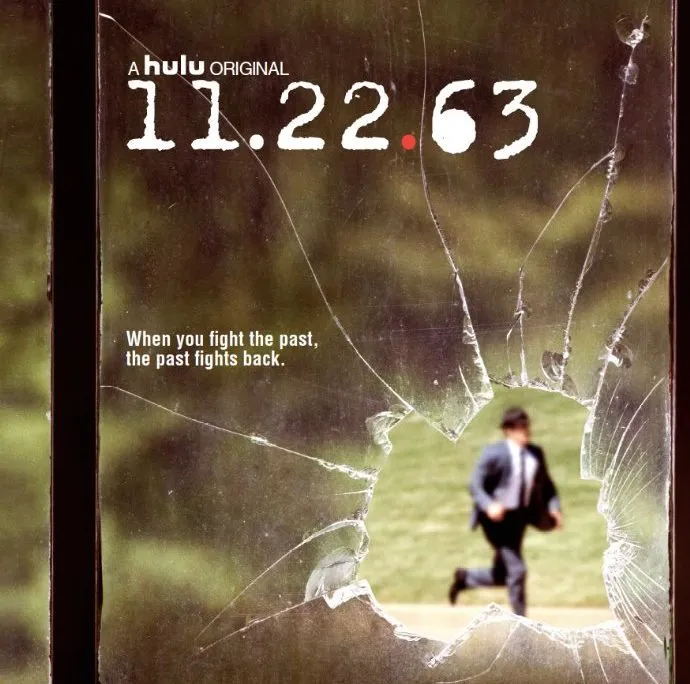
Official poster for 11.22.63 (2016), Hulu’s Stephen King event series starring James Franco

SELECTED WORK / PRODUCTION

Hulu Original Series 11.22.63

Studio
Hulu
Released
February 14, 2016
SCANable role
3D Scanning
  • CG
  • Props
  • Television
  • VFX

11.22.63 is Hulu’s 2016 eight-part event series starring James Franco as a teacher who travels back in time to stop the assassination of President John F. Kennedy. Based on Stephen King’s New York Times best-selling 2011 novel, the thriller follows high school English teacher Jake Epping, whose mission is threatened by Lee Harvey Oswald, falling in love and the past itself — which doesn’t want to be changed. Chris Cooper, Josh Duhamel, T.R. Knight, Cherry Jones, Sarah Gadon, Lucy Fry, George MacKay and Daniel Webber co-star. J.J. Abrams, Stephen King, Bridget Carpenter and Bryan Burk served as executive producers, with Academy Award-winning director Kevin Macdonald directing the first two hours. The series premiered on Presidents Day, February 15, 2016.

SCANable provided 3D scanning for this phenomenal eight-part series, capturing props and other production elements as accurate, measured digital assets for the show’s visual effects.

Recreating what no longer exists

Period drama is the one genre where the audience can check the work against the historical record. Photographs of the era are widely published, and a recognisable object rendered slightly wrong is more damaging than one left out.

That places unusual weight on the physical builds. Art departments source, restore or fabricate objects to a documented standard, and every digital version of those objects has to meet the same standard.

3D scanning for film is how the physical research reaches the visual effects team intact. It transfers the accuracy the art department already paid for, rather than asking a modeller to re-derive it from reference photographs.

The built prop is the reference standard

When a practical object exists, it is the ground truth. It is what the actor handles, what the camera sees in coverage, and what any CG duplicate, extension or destruction has to match.

Prop scanning captures that object as it actually is, including the asymmetries and small deviations that make a real thing look real. Modelled-from-photos versions tend to be too clean and too regular, and they read as manufactured in a way the original does not.

Everything ships after retopology, UV layout and render-ready builds so the digital object drops into a shot at the correct scale.

Wear and patina are part of the data

For period material, surface tells as much of the story as shape. Paint that has dulled, edges rubbed back to metal, printed labels that have yellowed — these are the details that place an object in a decade.

Capturing that means treating colour and shine as separate problems. Cross-polarized photography records the diffuse surface without the highlights baked into it, which is what allows the asset to be lit convincingly later instead of carrying the capture lighting into every shot. Our photometric capture work covers that discipline.

The result is an asset that matches the practical prop under any lighting the show later puts it in.

Browse more series and television work, or see what we do.