← Back to all work
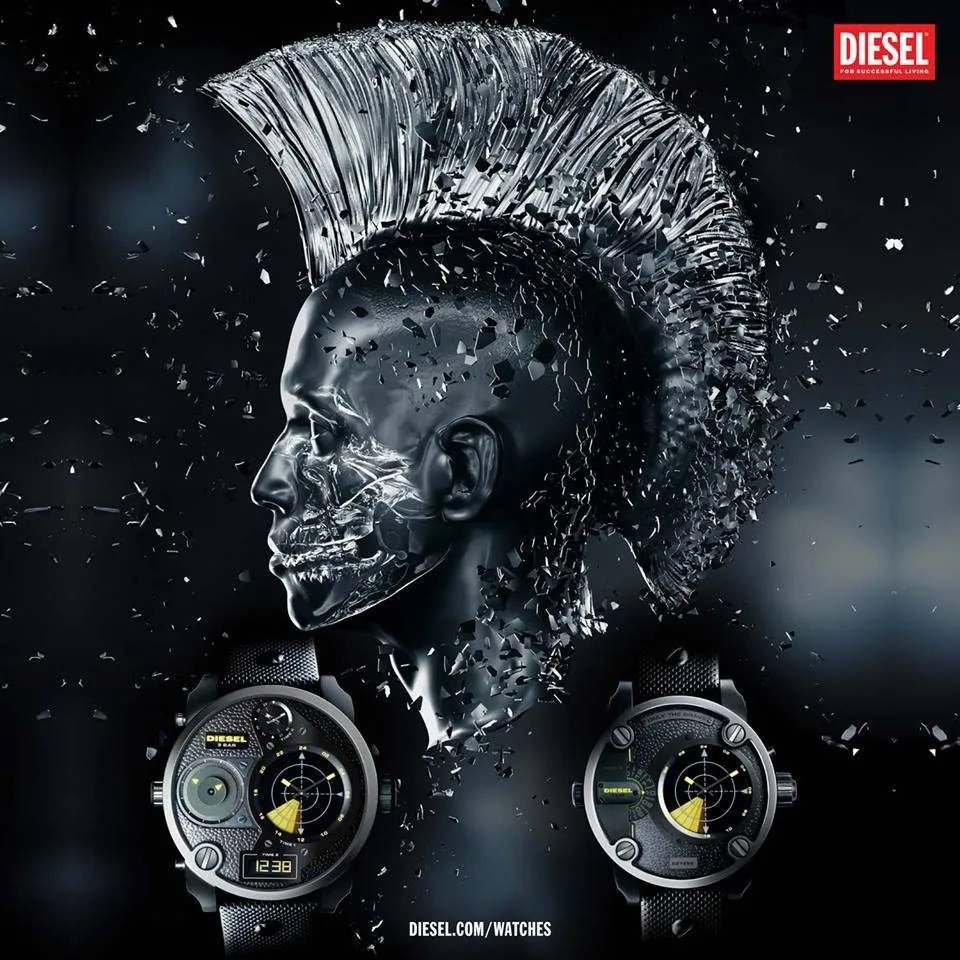
Still from the Diesel Watches “Mohican” TV ad (2013) with the sculpted 3D Diesel logo

SELECTED WORK / PRODUCTION

Diesel Watches: “Mohican”

Released
December 9, 2013
SCANable role
Cyber Scanning
Director
Tim Richardson
VFX vendor
The Mill
  • Body Scanning
  • CG
  • VFX

Diesel Watches’ “Mohican” is a 2013 TV ad for the autumn/winter Timeframe Collection, directed by Tim Richardson with visual effects by The Mill. Created with the Diesel Creative Team, the spot is set to “C B Robo” by New York electropop duo The Black Soft, from the band’s Dynasty single.

SCANable provided a full-color, high-resolution CyberSCAN™ of a model’s head, which was slightly modified to create the 3D version of the Diesel logo seen in the ad. Before this campaign, the Diesel logo had existed only as 2D line art — our head scanning brought it into dimensional form for the first time.

A stylized mark built on a real head

Brand marks drawn as line art carry an idealized geometry. They are symmetrical, simplified, and designed to read flat at any size.

A human head is none of those things. Building the dimensional version on top of a measured head is what keeps the result from looking like clip art extruded into space — it inherits real proportion, real bone structure, and real surface behavior under light.

The trade is control. The scan supplies truth; the brief supplies intent. Getting a mark that is recognizably the logo and recognizably a head means starting from measurement and editing toward the drawing, rather than sculpting toward a photograph and hoping.

Skin only behaves if diffuse and specular are separated

Skin is not one surface. It has color underneath and a thin, highly directional reflection on top, and the two do completely different things as a light moves across a face.

A single photographed texture bakes both together. The moment a CG lighting rig changes, that baked highlight sits in the wrong place and the face turns to plastic or to paint.

Cross-polarized photography at capture time separates them, producing a clean diffuse map alongside a specular record that can be reconstructed rather than invented. That separation is what makes photometric capture relightable, and it is the difference between a head that can be lit for any shot and one that only works under the lighting it was shot in.

Where measurement stops and art direction starts

Not every scan is meant to stay faithful. Some exist as a starting point a designer will deliberately push away from.

That changes what a good deliverable looks like. Clean topology matters more than usual, because the mesh is going to be edited hard — mirrored, simplified, proportionally adjusted — and a dense, unstructured raw scan fights every one of those operations.

Delivering after retopology and UV layout keeps the geometry editable. The measured version stays available underneath as the reference of record, so the team can always check how far the stylized version has traveled from the real thing. Cyberscanning covers how the underlying capture works.

More commercial work, or the full service list.