

← Back to all work
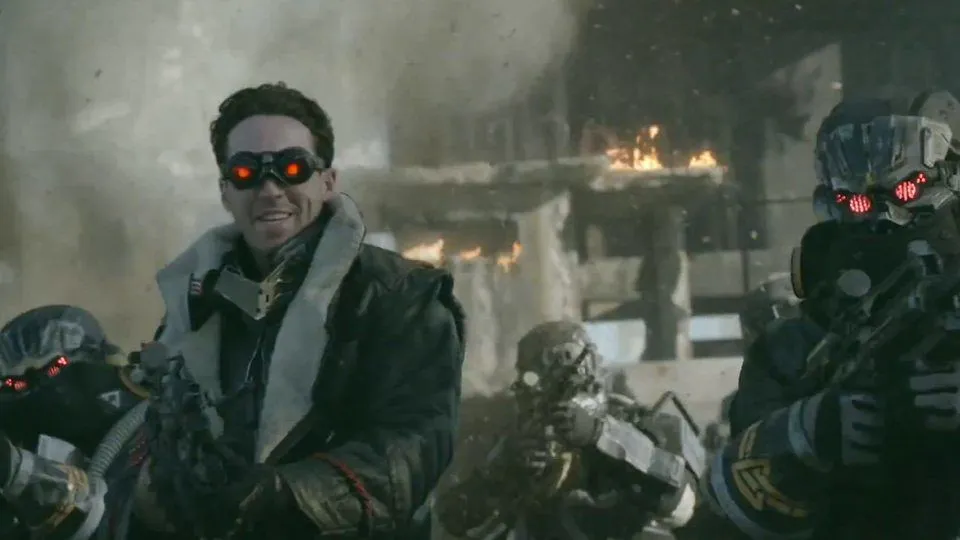
Poster for Sony PlayStation 4 ‘Perfect Day’ commercial (2013) — MJZ

SELECTED WORK / PRODUCTION

Sony PlayStation 4: “Perfect Day”

Studio
MJZ
Released
October 14, 2013
SCANable role
LiDAR Scanning/Modeling
Director
Matthijs van Heijningen Jr.
VFX vendor
The Mill
  • Architecture
  • Backgrounds
  • CG
  • Commercial/Advert
  • Environments
  • VFX
  • Vehicles
  • Video Games

‘Perfect Day’ is Sony’s 2013 PlayStation 4 launch spot from MJZ and agency BBH, with visual effects by The Mill. The follow-up to ‘Greatness Awaits’ tracks gamers through worlds of sword fighting, car racing, and spaceships blowing each other up as players serenely sing in the style of Lou Reed — each character grinning through the chaos because there is no place they would rather be than sharing an epic experience with friends. Shot in Prague, the spot’s most ambitious sequence was its ending: originally planned as CG elements over a live-action plate, the finale was instead rebuilt entirely in CG.

That full-CG rebuild relied on LiDAR scans captured on set, which allowed The Mill to recreate an extremely accurate layout of the environment. SCANable’s LiDAR scanning and modeling gave the VFX team precise real-world geometry to anchor the spot’s computer-generated finale.

When the plate gets thrown away

Plans change in post. A sequence conceived as CG elements over live action becomes a fully computer-generated shot, and the plate demotes itself from picture to reference image.

At that point the only thing standing between a team and rebuilding a location from memory is whatever was measured while they were standing in it.

A scan does not care what the plan was on the shoot day. It records the space at full accuracy, so a decision taken weeks later costs modeling time rather than a reshoot.

Reference data is the unglamorous half of the job

Not every scan becomes a hero asset, and most do not.

The larger share of what a capture team delivers is reference — layout geometry, scale, sightlines, the position of one thing relative to another. None of it appears on screen. All of it determines whether what does appear sits correctly.

Reference is also the cheapest insurance available on a production. Capturing a location while the crew is already standing in it costs almost nothing against a shot that cannot be built because a dimension was never recorded.

How an environment rebuild is approached now

The measurement principle has not changed. The reconstruction tools have.

Where a full CG rebuild once meant modeling every surface by hand from a point cloud, Gaussian splatting can now reproduce a captured space directly, including the awkward material behavior, soft edges, and depth cues a polygon mesh describes badly.

It does not replace measured geometry — a splat is not something you can collide simulation against or hand a modeler as a specification. It sits alongside it, and neural rendering is increasingly where the two meet. Conventional render-ready builds still ship in parallel.

The portfolio holds further commercial and advertising work; the full service list sets out what else we do.