

SELECTED WORK / PRODUCTION
Secret Level
- Studio
- Amazon MGM Studios
- Released
- December 9, 2024
- SCANable role
- 3D Scanning
- Director
- Dave Wilson
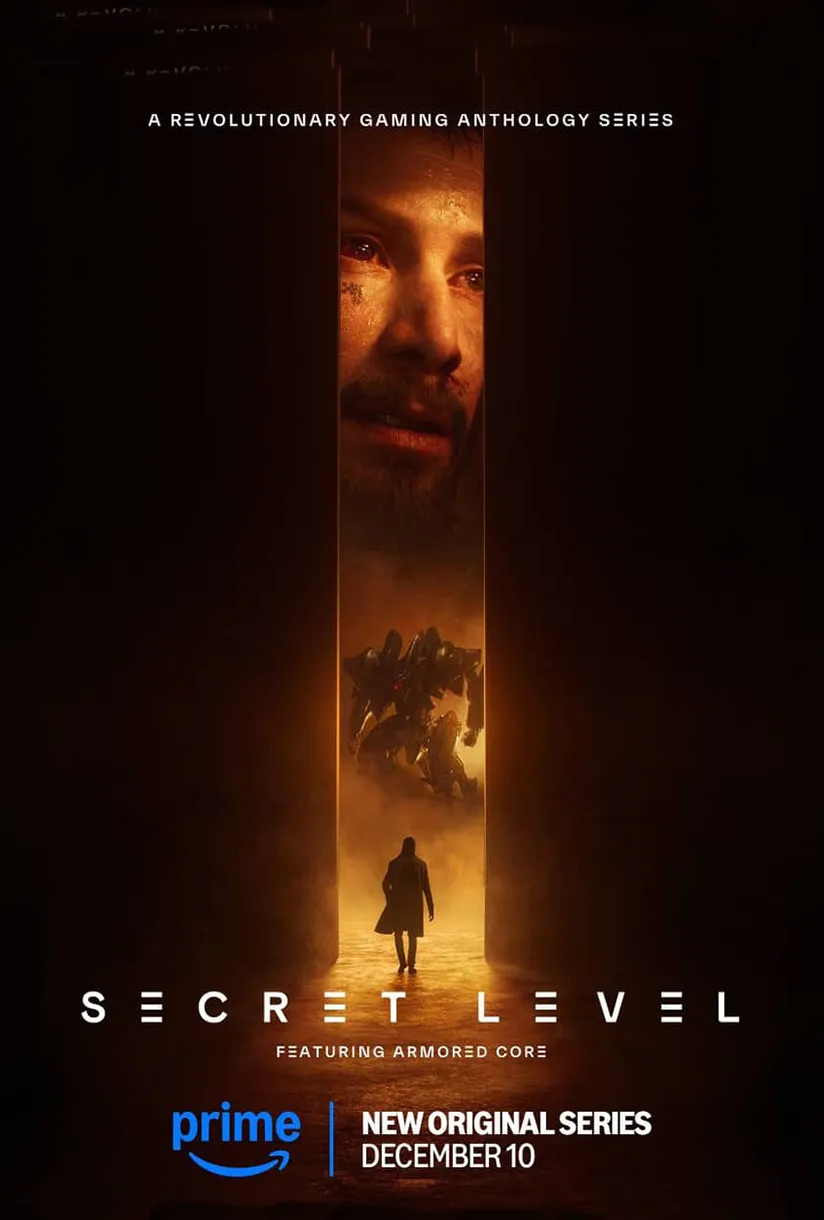
Secret Level is an adult animated anthology series created by Tim Miller for Prime Video, produced by Miller’s Blur Studio with Amazon MGM Studios, which premiered on December 10, 2024. From the team behind Love, Death + Robots, the first season comprises fifteen self-contained shorts set inside the worlds of established video games — among them Armored Core, Dungeons & Dragons, Warhammer 40,000, Unreal Tournament, Mega Man, The Outer Worlds, Sifu, and Pac-Man — each told in its own visual register and carrying a star voice cast. Dave Wilson served as supervising director and executive producer.
SCANable provided 3D scanning services for the production, delivering point-cloud data and digital reference in support of the series’ computer-generated imagery.
Stylization is a departure from something
Every one of these shorts is stylized, and none of them is arbitrary. A design language reads as deliberate only when the audience can sense the real proportions it is pushing against.
That is the argument for measured reference in animation. A body, an object, or a space that has been recorded accurately gives the design team a known baseline — this is what the true shape is, and here is exactly how far we are choosing to move away from it.
Working without that baseline, exaggeration is guesswork, and errors accumulate rather than reading as style.
Reference in an all-digital pipeline
A fully animated production has no plate to match, which is sometimes taken to mean it has no need for real-world measurement. The opposite tends to be true: everything must be authored, so everything is an opportunity for the world to go subtly wrong.
Point-cloud and photogrammetric reference gives the artists building those worlds something checkable — real dimensions for architecture, real proportions for hardware, real surface behavior for materials. Photometric capture does the same job for how a surface responds to light, separating what a material is from how it happened to be lit.
None of this appears on screen directly. It shows up as work that does not have to be revised twice.
Anthology schedules compress everything
Fifteen shorts is fifteen productions. Each one has its own look, its own asset list, and a window measured in weeks rather than months.
Capture work has to fit inside that. In practice, this means arriving with a plan, working quickly on the day, and turning data around fast enough that it is still relevant to the department that asked for it.
Short-window capture is a discipline of its own, and it rewards crews who have done it before. Photogrammetric capture is only useful at speed if the processing behind it is equally fast.
Delivering into a games-adjacent pipeline
Studios working in this space tend to have exacting requirements, often inherited from real-time engines: polygon budgets, clean quad topology, non-overlapping UVs, sensible LODs, and naming that survives an import.
Meeting those requirements is a delivery discipline rather than a scanning one, and it is where a lot of raw scan data falls down. Ours goes out after retopology, UV layout, and render-ready preparation.
Further TV scanning work is worth a look, as is the full service list.
SELECTED WORK / GALLERY