

← Back to all work
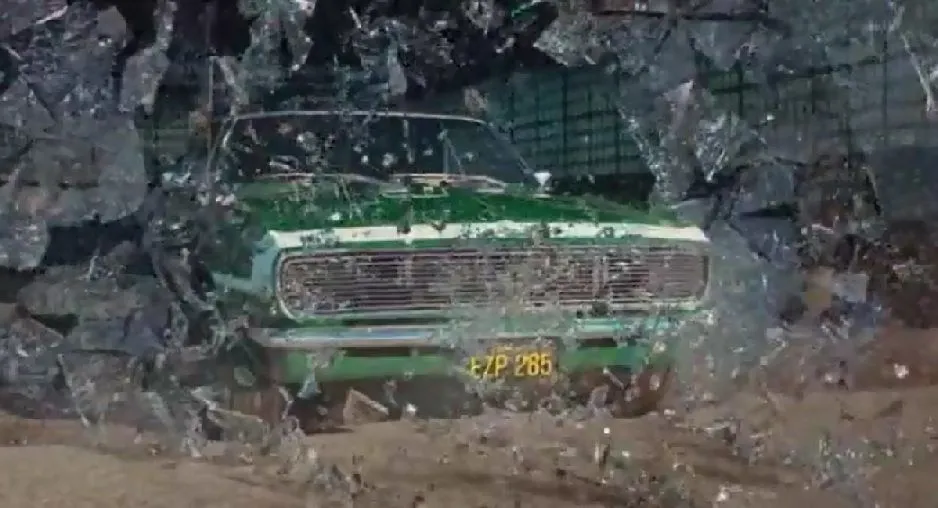
Still of the 1969 Chevrolet Camaro SS from the Turtle Wax “Break Out” commercial — Mill+

SELECTED WORK / PRODUCTION

Turtle Wax – Break Out “Free the Soul”

Studio
Mill+
Released
April 1, 2015
SCANable role
Vehicle Scan
VFX vendor
The Mill
  • CG
  • Commercial/Advert
  • VFX
  • Vehicles

Turtle Wax’s “Break Out — Free the Soul” commercial launched alongside Furious 7, freeing a vintage 1969 Camaro SS from a collectible car museum. Developed by Chicago agency O’Keefe, Reinhard & Paul for Turtle Wax Ice under the tagline “protect the body, free the soul,” the spot features a leather-clad woman breaking the green Camaro out of the museum and roaring onto the open road. It premiered ahead of Furious 7 screenings in more than 2,000 theaters across the country — the company’s first big-screen campaign — before moving quickly to television and online.

SCANable performed a 3D vehicle scan of the 1969 Chevrolet Camaro SS seen in the commercial and in banner advertisements on the TurtleWax.com website, supplying measured vehicle geometry for the campaign’s CG work.

Gloss, chrome and glass are hostile to scanners

Scanning assumes a surface returns light in a predictable way. Automotive finishes are engineered to do the opposite.

Show-quality paint behaves as a mirror, so the instrument sees the environment rather than the panel. Chrome trim reflects almost everything that reaches it. Glass transmits instead of returning. A naive capture of a well-detailed car comes back with holes in exactly the places where the body is smoothest, largest and most visible.

Getting a clean result is a matter of controlling what the surface has to reflect, and of choosing the right approach per material rather than one setting for the whole vehicle. Our scanning services are built around that kind of problem.

A hero car has to survive the close-up

An advertisement for a car-care product is, by definition, going to look closely at paint.

That rules out a generic body shape. The audience is being shown one specific vehicle, and the digital version has to carry the same panel gaps, the same badge placement, the same trim, and the same subtly imperfect proportions of a car built in 1969 and maintained ever since.

Measured geometry provides all of that without anyone deciding on it. A modelled interpretation of a classic silhouette gets the overall shape roughly right and the details wrong — and on this kind of spot, the details are the entire frame.

One capture, several downstream uses

Campaign assets rarely stay in one medium. The spot cuts at broadcast resolution, web banners are stills at other aspect ratios, and social versions get recropped again for placements nobody specified at the outset.

A scanned vehicle serves all of them from a single source, because it is a model rather than a photograph — relightable, re-posable, and renderable at whatever size a placement demands.

That is the practical case for scanning a hero product early. The capture is a one-time cost, and every execution afterwards draws on it instead of restaging a shoot.

See more advertising and brand work, or read how 3D scanning and modeling turn a real object into a usable asset.