

← Back to all work
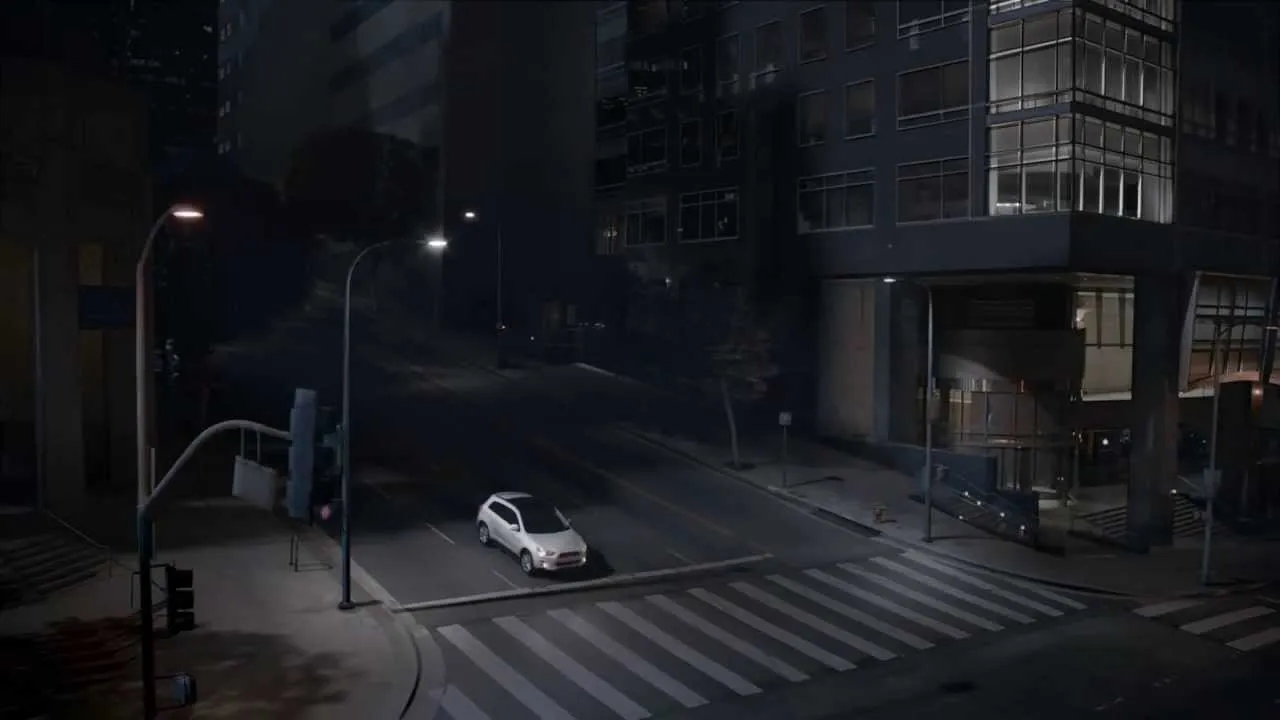
Poster for Mitsubishi’s 2014 Outlander Sport “New Beauty” commercial (2013) — Biscuit Filmworks

SELECTED WORK / PRODUCTION

2014 Mitsubishi Outlander Sport: “New Beauty”

Studio
Biscuit Filmworks
Released
October 20, 2013
SCANable role
LiDAR Scanning/Modeling
Director
Philippe Andre
VFX vendor
a52
  • Architecture
  • Backgrounds
  • CG
  • Camera Tracking
  • Commercial/Advert
  • Environments
  • Point Cloud
  • Shadows
  • VFX
  • Vehicles

“New Beauty” is Mitsubishi’s 2013 commercial for the 2014 Outlander Sport crossover, directed by Philippe Andre of Biscuit Filmworks for agency 180LA. Set to Bobby Caldwell’s “What You Won’t Do For Love,” the poetic spot follows a young woman whose Outlander Sport captivates the moon itself — a CG creation by a52 — as it trails her through the city from evening until sunrise. Highlighting the crossover’s panoramic glass roof, which gives every passenger a front-row view of the night sky, the :30 debuted on national cable on October 21, 2013, with the full-length :60 living online.

SCANable provided LiDAR scanning and 3D modeling for the campaign, capturing the spot’s environments and architecture as accurate point-cloud data. These 3D scans supported a52’s camera tracking, shadow and lighting work, helping the visual effects team composite the photoreal CG moon convincingly into every shot.

An element that was never on set

The moon in this spot is a computer-generated object with no physical counterpart anywhere in the production. Nothing on the shoot cast its light, occluded it, or reacted to it.

Everything that sells it therefore has to come from the real half of the frame. The buildings it passes behind, the street it hangs over, and the surfaces its light would fall across all have to exist as measured geometry before an artist can place it convincingly.

An invented element is only as believable as the measured world it is placed into. Set and location scanning supplies that world.

Night exteriors are the hard case

Scanning a city street after dark removes most of what photogrammetry depends on. Surface detail falls away, contrast collapses, and anything moving through frame during a capture becomes noise.

Terrestrial LiDAR is largely indifferent to that. It carries its own source and measures range rather than reading an image, which is why laser scanning does the structural work on night exteriors while photogrammetric capture is reserved for what it is genuinely better at.

Knowing which instrument answers which question is most of the job. Registered properly, the two occupy one coordinate space regardless of how they were acquired.

From point cloud to something a vendor can work in

A raw cloud is a measurement, not a model. Somewhere between the two, decisions get made about what becomes geometry and what stays as data.

Surfaces that will catch a CG shadow or bounce CG light need to be built — clean, closed, sensibly dense. Surfaces that only need to be measured against can stay as points, and leaving them as points saves the vendor from carrying geometry nobody will ever render.

Making those calls well is what modeling actually delivers, and it is where a scan turns into a usable asset. The full service list covers the rest.

See more commercial and advertising work.