

SELECTED WORK / PRODUCTION
Away
- Studio
- Netflix
- Released
- September 3, 2020
- SCANable role
- 3D LiDAR Scanning
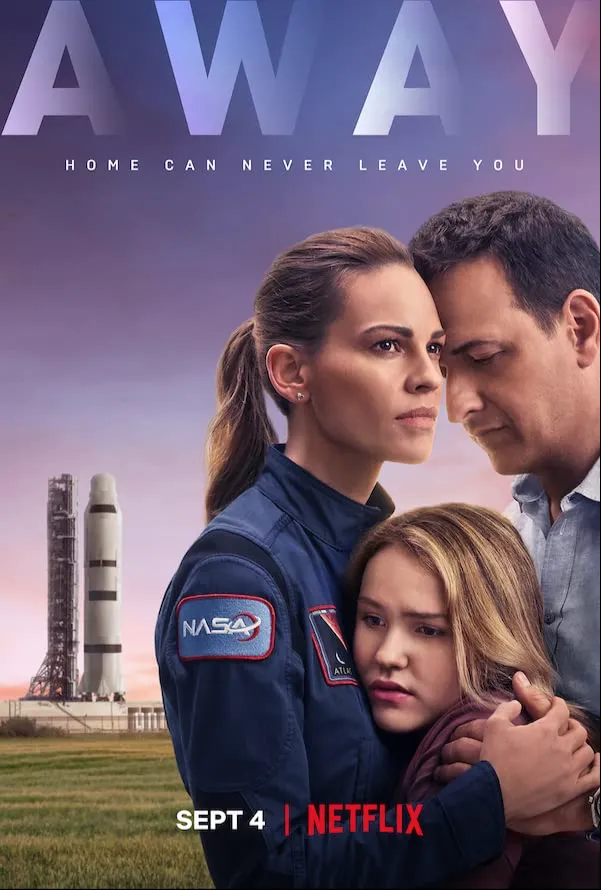
Away is Netflix’s 2020 space drama following the first crewed expedition to Mars, commanded by American astronaut Emma Green, played by Hilary Swank. The international Joint Mars Initiative crew — a Chinese chemist, a veteran Russian cosmonaut with more time in space than anyone alive, an Indian medical officer serving as second in command, and a British African botanist on his first spaceflight — launches on the three-year mission from the Moon. As crewmates question Emma’s ability to command after a fire during pre-launch preparation, she also balances the mission against a husband and teenage daughter back home. The series is described as being “about hope, humanity and how ultimately, we need one another if we are to achieve impossible things.”
SCANable provided 3D LiDAR scanning for season one of the series, capturing sets and props as registered point-cloud data — measured spatial reference for the show’s visual effects and set extension work.
Where the practical build stops
A spacecraft interior is built out to the edge of what the camera needs and no further. Past that edge, the vehicle has to continue in CG.
That join is the only place the illusion can fail, and it holds when the digital continuation is modeled outward from the measured geometry of the practical set rather than from a construction drawing. Built sets never match their drawings exactly. Walls shift during the build, panels get moved for camera access, and a floor ends up a few centimeters off where it was designed to be.
Terrestrial LiDAR records what was actually built, at the dimensions it was actually built to. That is what set and location scanning delivers, and it is what makes the seam stop reading as a seam.
Capsule interiors are difficult rooms to measure
A module set is small, densely dressed, and full of surfaces that scanners find awkward — brushed metal, gloss white, glass, and cabling that occludes everything behind it.
Coverage of a volume like that is a planning problem before it is a capture problem. Scan positions have to be chosen so that every recess is seen from more than one station, and registration has to hold across a chain of tight setups where there is no long sightline to tie them together.
The payoff is a point cloud in which the room’s true dimensions survive, rather than a cloud that looks convincing and drifts by an inch across its length.
Props that have to survive their own duplication
Anything a CG department has to multiply, float, damage, or replace outright needs a source of truth, and the practical build is that source.
A scanned prop carries the exact profile, thickness, and wear of the object the audience already saw in a close-up. Modelled from photographs alone, the same object comes back subtly wrong in silhouette, and the mismatch is visible the moment both versions appear in the same sequence.
Captured geometry goes through retopology, texturing, and render-ready builds before it reaches a shot, so what arrives is a clean, correctly scaled asset rather than raw scan data.
See more episodic television work, or read through the full range of services.
SELECTED WORK / GALLERY