

SELECTED WORK / PRODUCTION
Society6 All Over Print T-Shirts
- Studio
- Society6
- Released
- June 18, 2015
- SCANable role
- 3D Modeling
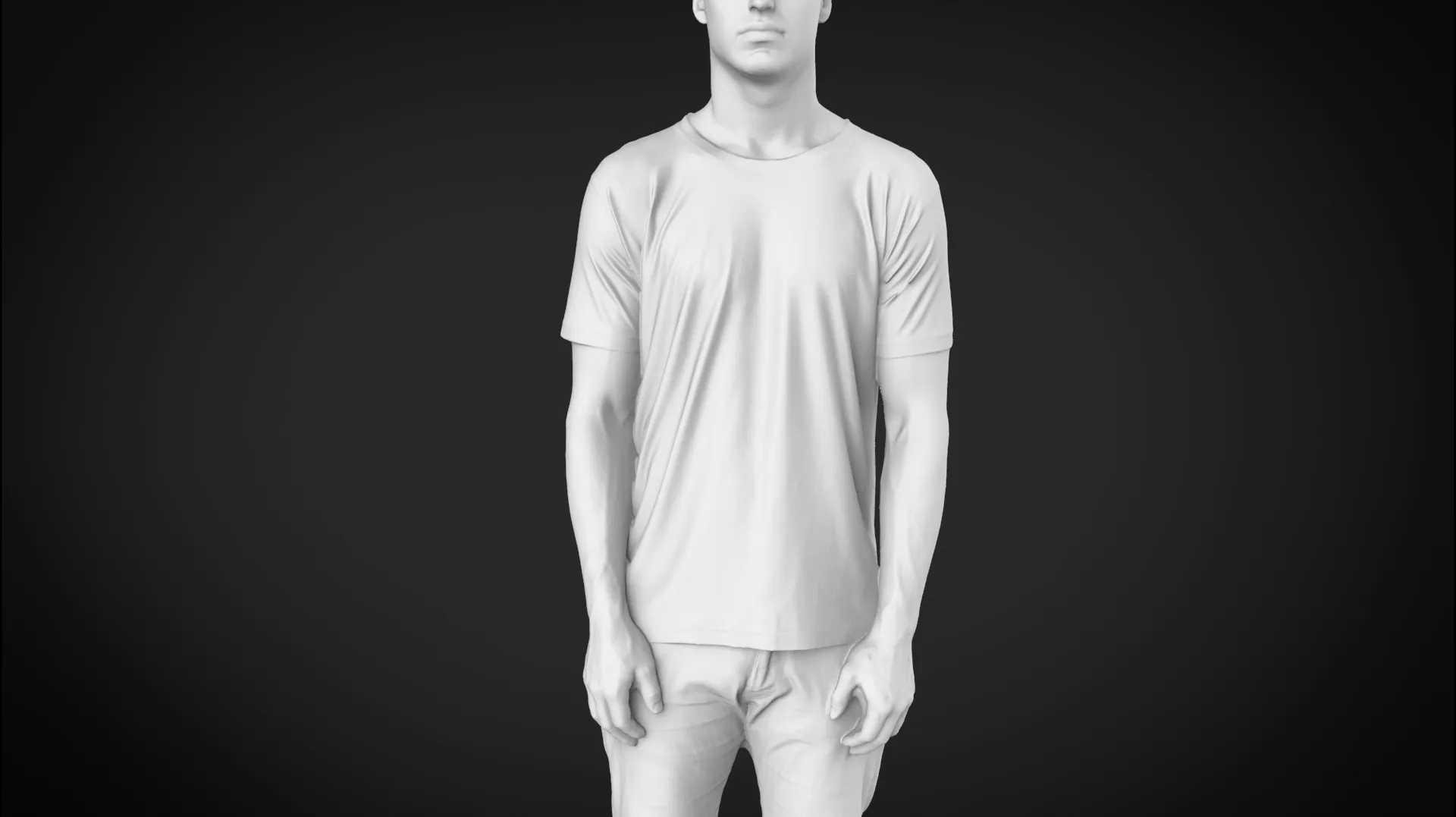
Society6 enlisted SCANable to create the 3D models and cloth simulation behind its all-over print t-shirts, letting artists preview their artwork instantly. Founded in 2009, Society6 is one of the most active artist communities in the world, empowering hundreds of thousands of artists to sell their work as a variety of products without giving up control of their rights. Every item is produced on demand when ordered — using only the highest-quality materials to avoid waste and keep the business sustainable — then packaged and shipped worldwide on the artist’s behalf.
For the 2015 all-over print t-shirt launch, SCANable built digital 3D garment models with physically based cloth simulation for both men’s and women’s styles. The result lets artists upload images and artwork and instantly visualize how a design will look on an actual shirt — folds, wrap-around, creases and all.
Cloth is geometry before it is texture
A shirt in a product image is usually a photograph with artwork warped onto it. That works until the garment folds, and then it stops working — the print slides across the crease instead of following it around.
Treating the garment as geometry solves the problem at its root. Folds, gathers and the wrap around a shoulder become surface, and anything printed onto that surface deforms the way real fabric would, because it is riding on real curvature.
It is the same reasoning behind treating costume and wardrobe as geometry on film work. Cloth carries information a flat texture cannot hold.
One garment model, every artwork
Product visualisation carries a constraint that hero VFX assets do not. The asset is not built for one shot. It is built to be reused indefinitely, by people who will never see it, carrying artwork nobody has drawn yet.
That pushes all the difficulty into the UV layout. The map has to accept an arbitrary image, place it predictably across the panels, and hold registration around seams and hems — in every size, in both cuts, without supervision.
Get that right once and the system runs on its own. Get it wrong and every upload needs a human.
Built to be rendered, not admired
Raw modelling and simulation data is dense, uneven, and unsuited to production use.
The work that makes it usable is the unglamorous half: retopology, UV layout and render-ready builds — clean quad flow that deforms sensibly under simulation, sane polygon budgets, and materials that respond correctly to the lighting rig they will actually be lit with.
A model that renders beautifully once is a portfolio piece. A model that renders correctly ten thousand times, on demand, from artwork it has never seen, is a product. The second is considerably harder to build and considerably more valuable to own.
The portfolio holds further commercial work; the full service list sets out what else we do.
SELECTED WORK / GALLERY