SELECTED WORK / PRODUCTION
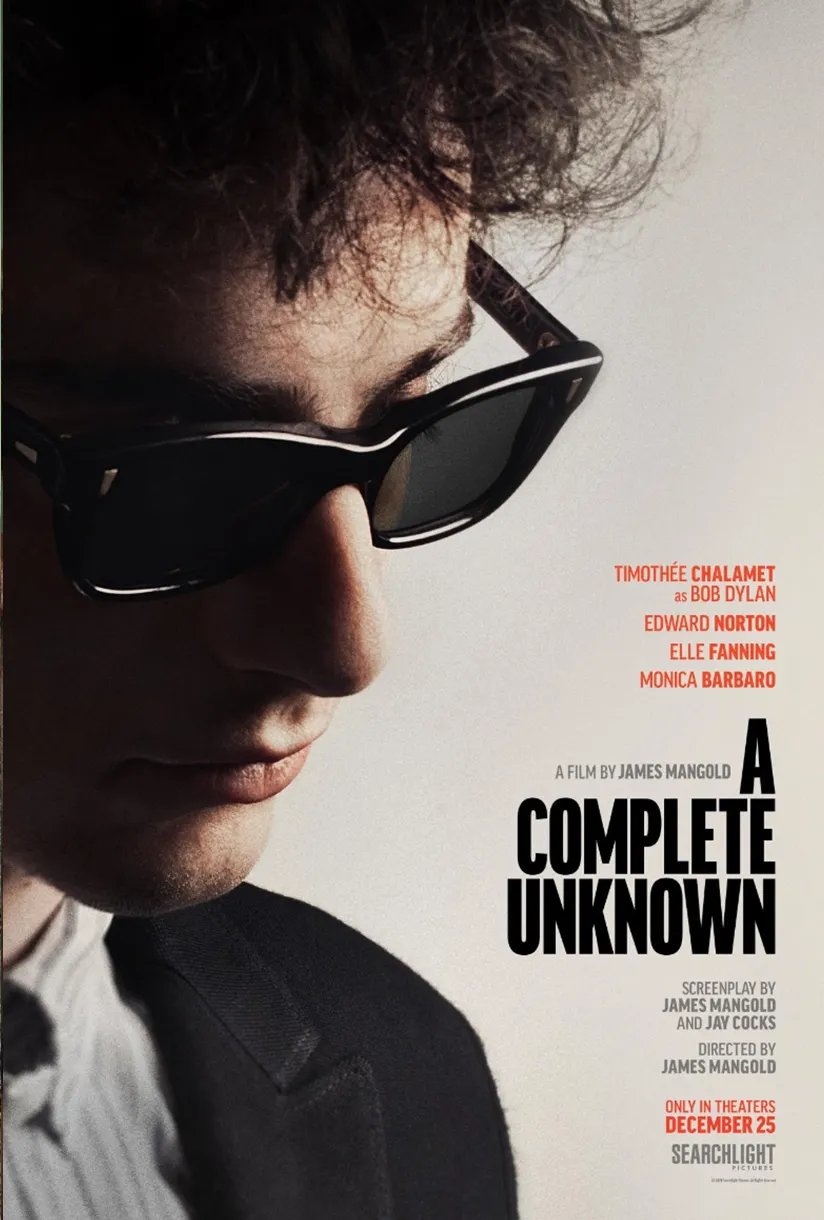
A Complete Unknown
- Studio
- Veritas Entertainment
- Released
- December 24, 2024
- SCANable role
- 3D Scanning
- Director
- James Mangold
A Complete Unknown is James Mangold’s 2024 biographical drama starring Timothée Chalamet as Bob Dylan during his controversial switch to electric. Co-written by Mangold and Jay Cocks and based on Elijah Wald’s 2015 book Dylan Goes Electric!, the film chronicles the controversy surrounding Dylan’s move to electrically amplified instrumentation. Chalamet also serves as producer, with Edward Norton, Elle Fanning and Monica Barbaro co-starring. The film opened in theaters in December 2024.
SCANable provided 3D scanning for the production, capturing full-body cast scans, environments, backgrounds and props as photogrammetric and point-cloud data to support the film’s visual effects and camera tracking work.

Removing what does not belong to 1965
Recreating a recent period is a subtraction problem more than an addition one. The buildings are still standing; it is the air conditioners, the signage, the road markings, the light fittings, and the parked cars that betray the decade.
Every one of those removals is a paint fix that has to hold while the camera moves. A patch that works on a single frame breaks the moment perspective changes, unless the artist has the actual surface behind it described in three dimensions.
A registered point cloud of the location gives that surface. The wall continues where the wall continues, at the correct angle, so the repair travels with the shot instead of sliding across it. That is a routine use of set and location scanning on period material.
One shooting schedule, many locations, one library
Biographical films move constantly — clubs, streets, studios, halls, interiors dressed to stand in for somewhere else. Sequences shot weeks apart are cut together as continuous scenes.
Handled ad hoc, each location generates its own reference in its own format, with its own idea of scale and orientation. The assets then refuse to sit together when the edit assembles them into one place.
Handled as a single capture program, every location enters the same library under the same conventions. What the edit joins together, the data already agrees with.
Scale and orientation are decisions, not defaults
Every scan has to answer three boring questions before it is useful: what are the units, which way is up, and where is the origin.
Answer them differently on different days and the consequences show up much later — a set that imports at a hundredth of its size, a tracked camera that solves at the wrong distance, a prop that is subtly too large in a hand.
Fixing that downstream is possible and expensive. Agreeing on the convention at the start of a schedule and holding it across every capture costs nothing at all, and it is one of the clearest markers of scan data that has been produced by people who deliver to VFX regularly.
Instruments, amplifiers, and objects the film is about
Some props are set dressing. In a film about a musician going electric, the instruments and amplifiers are close to being characters, and the camera treats them accordingly.
Objects at that level of attention are worth capturing rather than modeling — correct proportions, correct hardware, correct finish and wear. Delivery follows the usual route through retopology, texturing, and render-ready builds, scaled to match the practical item exactly.
See more feature-film capture work, or read about what we capture for productions.
SELECTED WORK / GALLERY