SELECTED WORK / PRODUCTION
All New 2018 Lexus NX
- Studio
- Glass World
- Released
- September 19, 2017
- SCANable role
- LiDAR/3D Scanning and Modeling
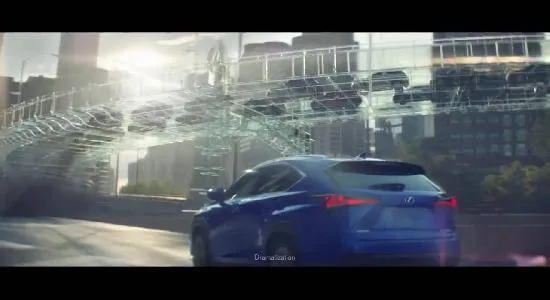
The all-new 2018 Lexus NX commercial (2017) transforms the city around the vehicle — a building, delivery truck, bridge and city bus — into gleaming glass. Produced with Glass World, the spot spotlights the redesigned NX by rendering the everyday urban world as translucent CG sculpture.
SCANable provided the 3D scans and modeling behind the effect, LiDAR scanning the building, delivery truck, bridge/overpass and city bus. The team then delivered clean 3D models of each element, all of which were rendered as glass in the finished commercial.

Glass is the surface that punishes approximation
Most CG materials forgive imperfect geometry. Paint, fabric, concrete and skin all scatter light in ways that hide a few millimetres of error.
Glass does the opposite. A refractive material transmits the shape it is given straight through to the viewer, magnified and doubled. A panel that is subtly out of true, a bus roof that bows where the real one is flat, a bridge deck built to a guessed thickness — all of it becomes visible the moment the surface turns transparent.
Measuring the real object first removes the guesswork. The refraction is then a rendering problem rather than a modelling one.
Hero objects in advertising get product-level scrutiny
A vehicle, a bus, a building facade — in a thirty-second spot these are not background. They are the composition, held on screen long enough for a viewer to study them, often in slow motion and often from angles a real camera never occupied.
That is a different bar from a set dressing asset. Advertising audiences look directly at the thing being sold and at everything the film puts next to it. Prop and hero-object capture is how those elements arrive already correct rather than being corrected in review.
Four subjects at four different scales
An overpass, a commercial building, a bus and a delivery truck do not belong to the same capture problem. One is infrastructure measured in tens of metres, another is a manufactured object with panel gaps and badge detail.
They still have to share one coordinate space and one real-world scale, because the finished frame puts them in the same shot. Capturing each to its own convenient scale and reconciling later is where errors enter. Registering everything into a single survey-grade reference at capture time is what lets a bus sit correctly beside a building without anyone nudging numbers in comp.
Larger structures fall closer to our enterprise survey and as-built discipline than to character work, and the tolerance expectations follow from that.
Clean topology is what makes it renderable
Raw point cloud is a measurement, not an asset. A hundred million points describes a bus accurately and is useless to a lighting artist.
The delivery is a retopologised mesh with even quads, sane UVs, and a surface a shader can actually behave on. Our modeling and retopology stage is where measured data becomes something that can be lit, refracted, and pushed through a spot’s turnaround without the render falling over.
See more commercial and advertising work, or read about the services behind it.
SELECTED WORK / GALLERY