

SELECTED WORK / PRODUCTION
AutoZone Duralast Batteries “Walk the Walk” Featuring Chuck Liddell
- Studio
- MPG
- Released
- March 30, 2014
- SCANable role
- Cyber Scanning/LiDAR Scanning
- VFX vendor
- The Mill
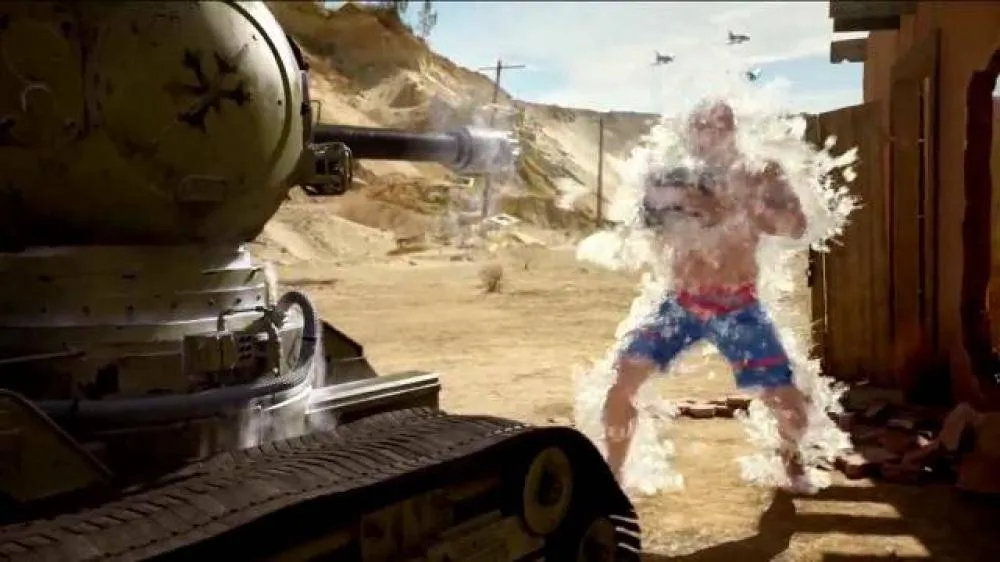
AutoZone’s “Walk the Walk” (2014) puts former UFC Light Heavyweight Champion Chuck Liddell to work proving Duralast Batteries are built tough. “The Iceman” is still doing his thing, hitting stuff hard — real hard — shrugging off a rhinoceros and a military tank before riding off into the sunset, trademark painted toenails and all, leaving a swath of animated, exaggerated destruction in his wake. Proven tough!
SCANable provided cyber scanning and LiDAR set scanning on location in a Southern California rock quarry. A detailed, full-color cyber scan of Chuck Liddell was performed in a tent on set, while 3D laser scans of the surrounding quarry were captured for camera tracking use in PFTrack. A 3D wrapped mesh was also delivered for shadow casting, lighting calculation and other computer-generated visual effects by The Mill.
Matchmove needs the space, not just the plate
A tracking solve derived only from footage has to infer the world from parallax. That works until a shot has few reliable features, a fast-moving camera, or a subject that dominates the frame.
Terrestrial LiDAR hands the tracking team the site itself — measured, in real-world units, independent of what any single lens saw. Solving against known geometry turns estimation into a fit, and survey points can be constrained directly in packages such as PFTrack.
A quarry is a good illustration of why this matters. It is large, irregular, and offers none of the straight edges or right angles a tracker would normally lean on. Set and location scanning supplies the reference the plate cannot.
Practical stunts and exaggerated destruction in one frame
Comic effects work is not forgiving. Once an audience is asked to accept an impact that could not have happened, everything around it has to behave correctly.
That means shadows falling on real ground, debris colliding with real surfaces, and dust settling into the real contour of the site. Each of those needs geometry, not a photograph.
A measured mesh of the location lets a lighting artist cast and receive shadow against the ground that was actually filmed, so the invented half of the frame inherits the credibility of the half that was shot.
Delivering geometry a vendor can use on arrival
Scan data is only useful in the form the receiving facility works in.
That means correct units and a stated coordinate origin, a wrapped mesh where a mesh is wanted and raw point cloud where density matters, sensible decimation for shot work, and file naming that follows the vendor’s convention rather than ours.
Our modeling and scan cleanup exists for that hand-off. Measurement is the straightforward part; delivering it so nobody downstream has to rebuild it is the part that protects a schedule. The full service list covers the rest.
More advertising and brand work is in the portfolio.
SELECTED WORK / GALLERY