

← Back to all work
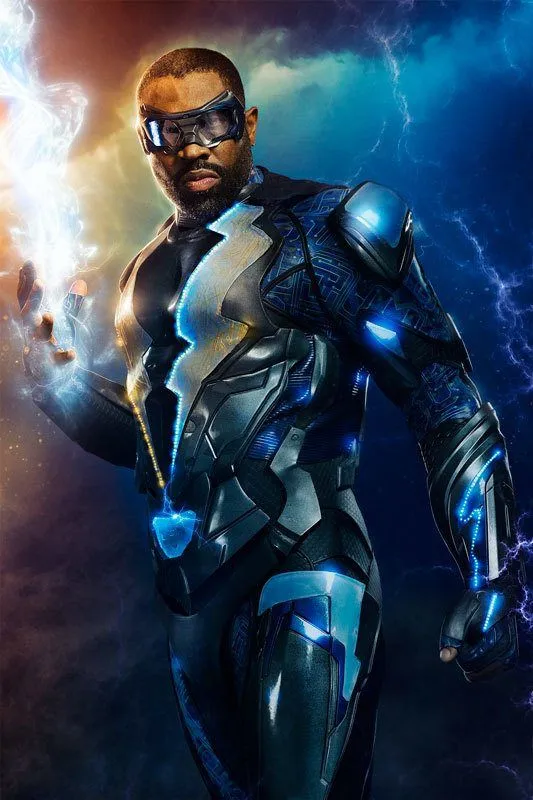
Official poster for Black Lightning, The CW superhero series — Warner Bros. Television

SELECTED WORK / PRODUCTION

Black Lightning

Studio
Warner Bros. Television
Released
January 15, 2018
SCANable role
LiDAR/3D Scanning and Modeling
Director
Salim Akil
  • Beauty
  • Body Scanning
  • CG
  • Television
  • VFX

Black Lightning is The CW’s superhero series developed by Salim Akil, following Jefferson Pierce — a man who returns to the vigilante life nine years after hanging up the mask. Gifted with the superhuman power to harness and control electricity, Pierce once kept his hometown streets safe as the masked vigilante Black Lightning, but left his superhero days behind after too many nights with his life and his family on the line. Based on the DC Comics character created by Tony Isabella and Trevor Von Eeden, the series stars Cress Williams alongside China Anne McClain, Nafessa Williams, Christine Adams, Marvin Jones III, Damon Gupton and James Remar.

SCANable supported the production across multiple seasons with LiDAR and 3D scanning services — full-body scanning and 3D modelling for accurate digital doubles, plus scanning of stage sets and production objects to supply registered point cloud data to the show’s visual effects team.

Skin that can be relit

A digital double only convinces if it can be lit by the same lights as the plate. That requires separating what the skin is from what the light happened to be doing at the moment of capture.

Cross-polarised photography records diffuse colour with the specular reflection suppressed; a second pass recovers the specular component on its own. The result is a relightable texture rather than a photograph with highlights baked into it.

Without that separation, a face carries its capture lighting into every shot it appears in, and no amount of grading hides it. Photometric capture is the part of the process that solves it.

Costume as geometry, not as a paint job

A suit is not a texture applied to a body. It has thickness, panel lines, stiff areas and soft ones, and it hangs differently on a person standing than on a person mid-stride.

Scanning the performer in the built costume records all of that as measured surface. The alternative — modelling the suit onto a nude scan — reads as painted on, because the volume it should be adding is not there.

Wardrobe capture also records how that specific costume fits that specific performer, which is what makes a double belong to a character rather than to a size chart.

Crowds made from real people

Street-level stories fill frames with people, and the number of background performers a production can put on a sidewalk is finite.

Digital crowds are built by varying a library of scanned humans — different bodies, different clothing, different proportions. They hold up because the source material is real people rather than a parametric rig with sliders. The variation an audience reads as a crowd is variation that already existed before anyone touched it.

Capture happens on location through our Mobile CyberSCAN™ Studios, and everything ships render-ready.

More TV scanning work is in the portfolio.