← Back to all work
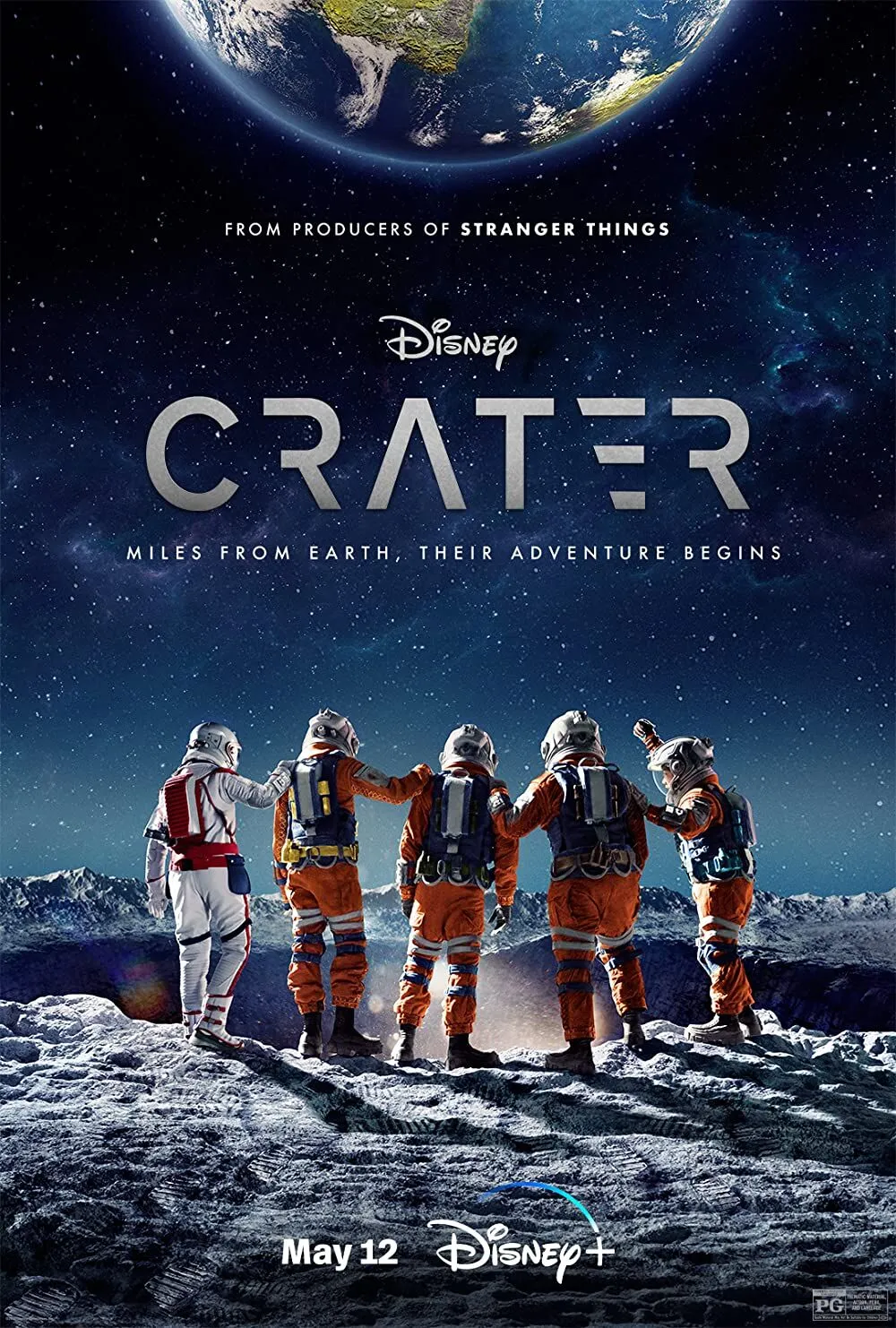
Official poster for Crater (2023) — Disney+ science fiction adventure

SELECTED WORK / PRODUCTION

Crater

Studio
Disney+
Released
May 11, 2023
SCANable role
3D Scanning
Director
Kyle Patrick Alvarez
  • Body Scanning
  • CG
  • Feature Film
  • Props
  • VFX

Crater is a 2023 American science fiction adventure film directed by Kyle Patrick Alvarez that premiered on Disney+ on May 12, 2023. Written by John Griffin, it stars Isaiah Russell-Bailey, Mckenna Grace, Billy Barratt, Orson Hong, Thomas Boyce, and Scott Mescudi. After the death of his father, a boy growing up on a lunar mining colony sets out with his four best friends to explore a legendary crater before permanently leaving the Moon for another planet.

SCANable was responsible for character and prop scanning on the Disney+ feature, delivering high-resolution 3D scans and photogrammetric data that gave the visual effects team an accurate foundation for digital doubles and CG asset work.


Costume as geometry, not as texture

A pressure suit is not clothing painted onto a body. It is a rigid and semi-rigid structure with its own volume, its own silhouette, and its own way of sitting on the person inside it.

Scanning a performer in costume records all of that directly. The helmet’s real proportions, the thickness of the pack, the way panels break across the shoulders — none of it has to be modeled from a reference photograph and none of it has to be guessed.

It also captures fit, which is the part that most often reads as wrong. A digital suit built independently of the actor tends to sit on the body rather than around it. A scanned one already fits, because it was measured on the person who wore it.

The moment the visor comes off

A helmeted performer in a wide shot forgives a great deal. The moment a face is visible through a visor, the tolerance collapses.

Face replacement means putting a digital likeness into coverage that is intercut with real photography of the same person, often within the same scene. There is no distance and no motion blur to hide behind — the audience is comparing directly.

That is why head scans and facial capture are treated as a separate discipline from full-body work, with tighter camera spacing, controlled lighting, and simultaneous exposure so nothing moves between frames.

Hardware that has to read as real at close range

Science fiction props are built to be handled. Consoles, rovers, tools, and helmets are all objects the camera gets close to, and all objects that eventually need CG equivalents for shots the practical version cannot do.

Scanning the built hardware means the digital version inherits the production design rather than reinterpreting it. Panel lines land in the same places, wear patterns match, and scale is consistent with the actor’s hand on the object.

Assets ship after retopology and texture and model preparation, so a vendor receives clean topology and sensible UV layout instead of a raw mesh that needs a week of cleanup.

Explore more feature film scanning, or see everything we capture.