

← Back to all work
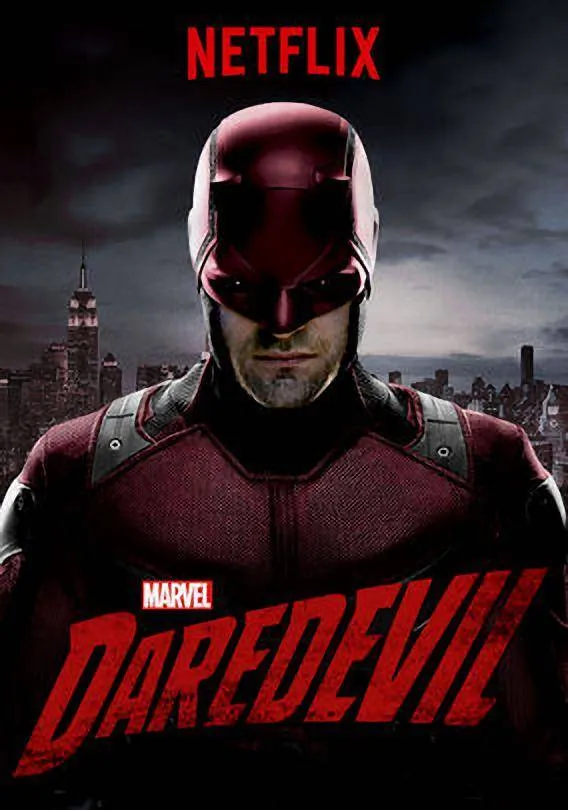
Poster for Marvel’s Daredevil (2015) — Netflix series from ABC Studios & Marvel Entertainment

SELECTED WORK / PRODUCTION

Marvel’s Daredevil Netflix Series

Studio
ABC Studios & Marvel Entertainment
Released
April 9, 2015
SCANable role
3D Scanning
VFX vendor
Shade VFX
  • 3D Projection
  • Animation
  • Architecture
  • Backgrounds
  • Body Scanning
  • CG
  • Camera Tracking
  • Environments
  • Motion Graphics
  • Shadows
  • Television
  • VFX
  • Vehicles

Marvel’s Daredevil is the 2015 Netflix series following blind attorney Matt Murdock, a lawyer by day and masked vigilante by night in Hell’s Kitchen. Blinded as a boy in a tragic accident but imbued with extraordinary senses, Murdock sets up practice in his old New York neighborhood, where he fights injustice both in the courtroom and on the streets. The dark, gritty first season of 13 episodes was released on Netflix on April 10, 2015.

SCANable partnered with visual effects company Shade VFX on the series, providing 3D scans of several sets and actors, including Vincent D’Onofrio (Wilson Fisk), Scott Glenn (Stick), Rosario Dawson (Claire Temple), Deborah Ann Woll (Karen Page), Tom Walker (Francis), Toby Leonard Moore (James Wesley), and several supporting players. The set scans drove camera tracking and matchmoving, while the actor scans supported additional VFX and the World on Fire sequences. SCANable worked specifically on episodes 5, 7, 8, 9, 12, and 13, though our scans may have been used elsewhere in the season.

A solve is a guess until it is measured

A camera solve derived only from image features is a guess with a confidence value attached. It can be a good guess, and it still drifts on exactly the shots that matter — long lenses, shallow depth of field, low light, fast handheld moves down a corridor.

Feeding the solver measured geometry of the actual space changes the problem entirely. Instead of inferring both the camera and the world from pixels, the world is known and only the camera is unknown.

Solves lock faster, hold through occlusion, and survive the plates that would otherwise come back for another pass. Set and location scanning supplies the known half.

Assets that hold across a season

A feature has one schedule. A thirteen-episode season has several, spread across months, with different directors, different units and different artists touching the same environments.

Continuity there is not really a creative concern. It is a data problem. A set scanned once, at a known scale, in a known coordinate frame, becomes a fixed reference that every later episode can be measured against.

Without one, each block re-derives the same geometry slightly differently, and the small differences accumulate into a world that quietly stops matching itself somewhere around the middle of the season.

Stylisation still starts from accurate geometry

Not every visual effects shot is aiming at photorealism. Some are explicitly interpretive — abstracted, rendered in ways no camera would ever produce.

That does not lower the geometric bar. A stylised render still has to occupy the same space as the live-action coverage it cuts against: the same room dimensions, the same actor proportions, the same camera path. When the underlying geometry is measured, the abstraction sits convincingly inside the real world and reads as a point of view. When it is approximated, it reads as a separate element pasted over the show.

Scans of performers and environments give that kind of work something true to depart from. Cyberscanning covers the performer half.

Further TV scanning work is worth a look, as is the full service list.