

SELECTED WORK / PRODUCTION
NASCAR/ESPN Sprint Cup: “Burnout”
- Released
- July 11, 2013
- SCANable role
- LiDAR Scanning/Vehicle Scanning/Modeling
- Director
- Nicolai Fuglsig
- VFX vendor
- The Mill
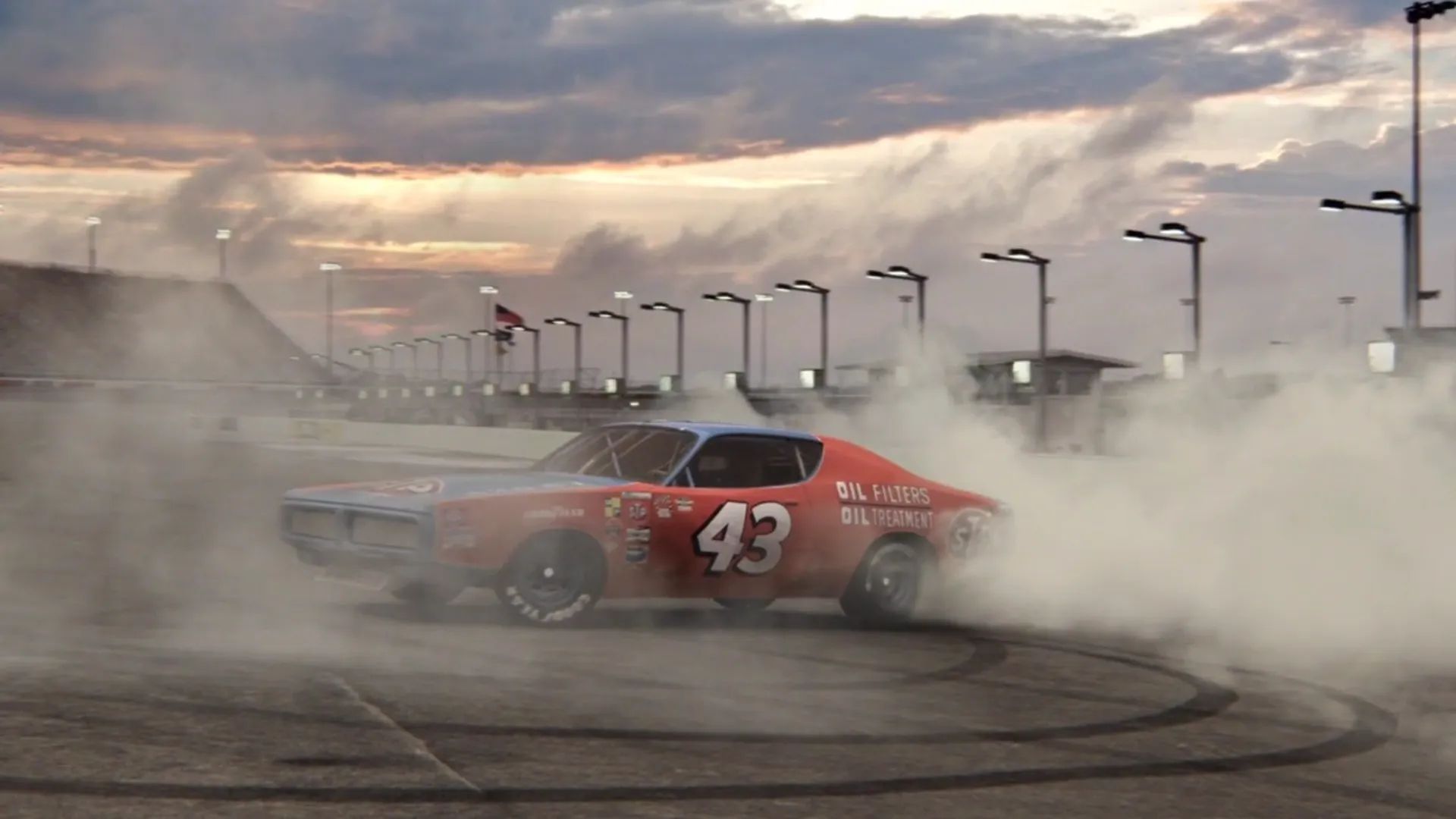
“Burnout” is a TV spot from NASCAR and ESPN’s first-ever joint marketing campaign, launched in 2013 to elevate the 10th Chase for the NASCAR Sprint Cup. Under the tagline “12 Drivers. 1 Champion.,” the multi-platform campaign — developed with creative agencies Wieden + Kennedy New York and Ogilvy and Mather — spotlighted NASCAR’s playoffs, in which the sport’s top 12 drivers compete for the Sprint Cup Series championship. The campaign’s spots featured five-time champion Jimmie Johnson alongside the likenesses of legends including Cale Yarborough, Richard Petty, and Dale Earnhardt Sr., spanning TV, print, radio, digital, and social executions across the 10-race postseason.
SCANable supported the campaign with LiDAR scanning, vehicle scanning, and 3D modeling, capturing stock cars and track environments as accurate point-cloud data. Our scans and models were used by the visual effects team at The Mill for camera tracking, CG crowd placement, and vehicle effects throughout the spot.
Vehicles are a hostile subject
Cars defeat naive capture. Gloss paint reflects the environment instead of showing its own surface, chrome shows the scanner back to itself, and glass either passes the beam straight through or throws it somewhere unhelpful.
Handling that is a matter of technique rather than equipment: controlling what the vehicle is reflecting, choosing positions that avoid specular returns, cross-polarizing where photogrammetric capture is doing the surface work, and treating the difficult materials as a separate pass instead of hoping they resolve in the main one.
A race car adds decals, compound curvature, and a livery that has to land in exactly the right place. Getting the geometry right is only half of the problem.
The track is a surface, not a backdrop
A speedway is neither flat nor simple. Banking changes continuously through a turn, the racing surface has a real profile, and the relationship between apron, wall, and grandstand is what makes footage read as that circuit rather than a generic oval.
Measuring it gives an effects team the ground that vehicles sit on, that tire smoke settles into, and that shadows fall across. Approximating it produces cars that skate instead of grip.
Terrestrial LiDAR handles the scale involved, and set and location scanning registers the result into the same coordinate space as the vehicle capture.
One measured car becomes a field
Motorsport imagery needs many vehicles. Productions get access to a few.
A single accurate scan can be duplicated across a field, re-liveried, damaged, and dressed differently — and because every copy shares correct dimensions, they interact with the track and with each other believably.
That only works if the source asset is built for it: clean topology, sensible UV layout, and materials separated so paint, decals, and glass can be varied independently. That is the job of modeling and asset preparation. The full service list covers the rest.
SELECTED WORK / GALLERY