

← Back to all work
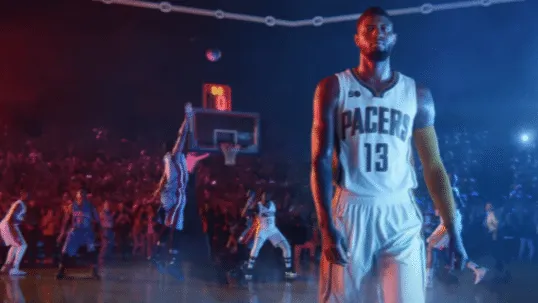
Still from Gatorade’s 2017 ‘Smooth Finish’ commercial featuring Paul George of the Indiana Pacers

SELECTED WORK / PRODUCTION

Gatorade and Paul George Team Up for Smooth Finish

Studio
TBWA\Chiat\Day
Released
April 18, 2017
SCANable role
LiDAR/3D Scanning and Modeling
Director
Hoffman Bros.
VFX vendor
a52
  • CG
  • Commercial/Advert
  • Environments
  • Set Extension
  • Stadiums
  • VFX

Gatorade’s 2017 “Smooth Finish” commercial features Paul George of the Indiana Pacers performing against the backdrop of a fully computer-generated arena. Rather than filming in the Pacers’ actual home venue, the spot’s visual effects team built a complete CG arena replacement, seamlessly blending the NBA star’s live-action performance with a digitally recreated stadium environment.

SCANable captured 3D scans of several popular and famous arenas — including Hinkle Fieldhouse at Butler University and Bankers Life Fieldhouse in the heart of Indianapolis, Indiana — for the commercial. The 3D scan data from both locations was rendered and provided the framework for the full arena replacement, giving the VFX artists an accurate photogrammetry foundation on which to build the CG stadium seen in the finished spot.

Two buildings, one asset library

Capturing more than one venue for a single spot is not redundancy. Real arenas each solve the same problem differently — one has a historic timber roof structure, another a modern bowl — and a CG environment assembled from measured examples inherits details nobody would think to invent.

The requirement is that both captures live in the same library, at the same scale, under the same conventions. Two datasets built to two different standards force the CG team to reconcile them before they can use either, which is work that should have been done once at capture.

Registering everything to a common real-world reference at the point of collection is what makes a multi-location library usable rather than merely large. It is a core part of how we approach set and location scanning.

When the environment is fully replaced, the scan becomes the design document

A spot that swaps the entire venue is not doing set extension. Nothing practical survives into the final frame except the performer.

That inverts the usual relationship. Normally scan data serves the plate; here the plate serves the environment, and the scan is the only thing establishing what the space is, how big it is, and where the camera sits inside it. Every lighting decision, every reflection, and every contact shadow on the athlete refers back to that geometry.

Which means the source data has to be good enough to be designed from, not just matched to.

Arenas are awkward things to measure

A basketball venue combines surfaces that a laser scanner reads easily with surfaces that fight it. Polished hardwood is close to a mirror at grazing angles. The upper structure is dark, high, and full of catwalks, rigging and lighting trusses that occlude one another from any single position.

Getting complete coverage means planning positions for the volume rather than the floor plan, and accepting that the ceiling takes more setups than the court does. The finished model is then reduced through retopology and render-ready builds so it can actually be lit and rendered inside a commercial’s schedule.

See more commercial projects, or review the services list.