

← Back to all work
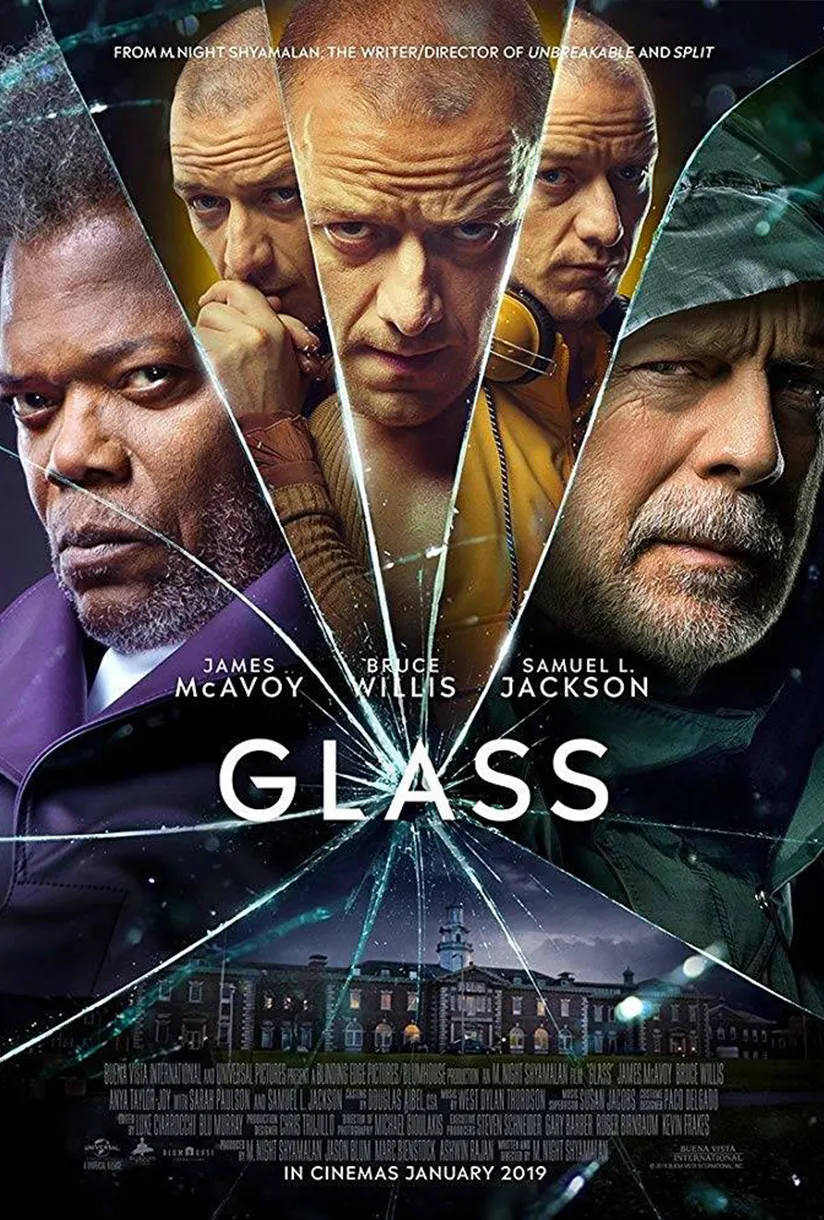
Official poster for Glass (2019) — M. Night Shyamalan’s Unbreakable trilogy finale

SELECTED WORK / PRODUCTION

Glass

Studio
Blinding Edge Pictures/Blumhouse Productions
Released
January 17, 2019
SCANable role
LiDAR/3D Scanning and Modeling
Director
M. Night Shyamalan
  • Body Scanning
  • Feature Film
  • VFX

Glass (2019) is M. Night Shyamalan’s superhero thriller from Blinding Edge Pictures and Blumhouse, the final installment of the Unbreakable trilogy. Written, produced, and directed by Shyamalan as a sequel to Unbreakable (2000) and Split (2016), the film sees Bruce Willis, Samuel L. Jackson, Spencer Treat Clark, and Charlayne Woodard reprise their Unbreakable roles, while James McAvoy and Anya Taylor-Joy return as their Split characters, joined by Sarah Paulson, Adam David Thompson, and Luke Kirby. David Dunn becomes locked in a mental hospital alongside his archenemy Mr. Glass and the multi-personality “The Horde,” contending with a psychiatrist out to prove the trio do not actually possess superhuman abilities.

SCANable performed LiDAR set scanning, 3D scanning, and modelling for the film, delivering accurate measured data to support the production’s visual effects work.

Things a human body will not do

Superhuman action is mostly things a human body will not do: impacts, falls, restraint against forces that do not exist, movement at speeds a person cannot produce.

Those cuts are carried by a digital double, and they intercut directly with real coverage of the same actor. The double is never seen in isolation — it is seen a frame after the real person. That is the standard it has to meet.

A digital double built from a measured scan meets it because it begins as the actor rather than as a resemblance of one.

What resolution actually means on a body scan

“High resolution” is not a polygon count. A dense mesh built from noisy data is a large file that is still wrong.

What matters is whether the captured surface corresponds to the real one — whether the silhouette, the proportions, and the fall of the clothing are measurements rather than estimates. Fine surface detail then sits on top of that, as texture and displacement, where it belongs.

An asset delivered after retopology and UV layout is usually lighter than the raw capture and considerably more useful, because it is clean topology carrying accurate detail rather than raw density carrying error.

The scan outlives the film

A trilogy is a long commitment to a set of characters, and a performer captured during one production becomes a record that does not degrade.

Scan data tends to have a second life: continuity across sequels, reference for later work, and an accurate account of how someone looked at a particular point in time. Productions rarely commission it for that reason. They are frequently glad afterwards that it exists.

See cyberscanning for how the capture is made.

Related feature film work sits in the portfolio, and the full service list explains the methods behind it.