

← Back to all work
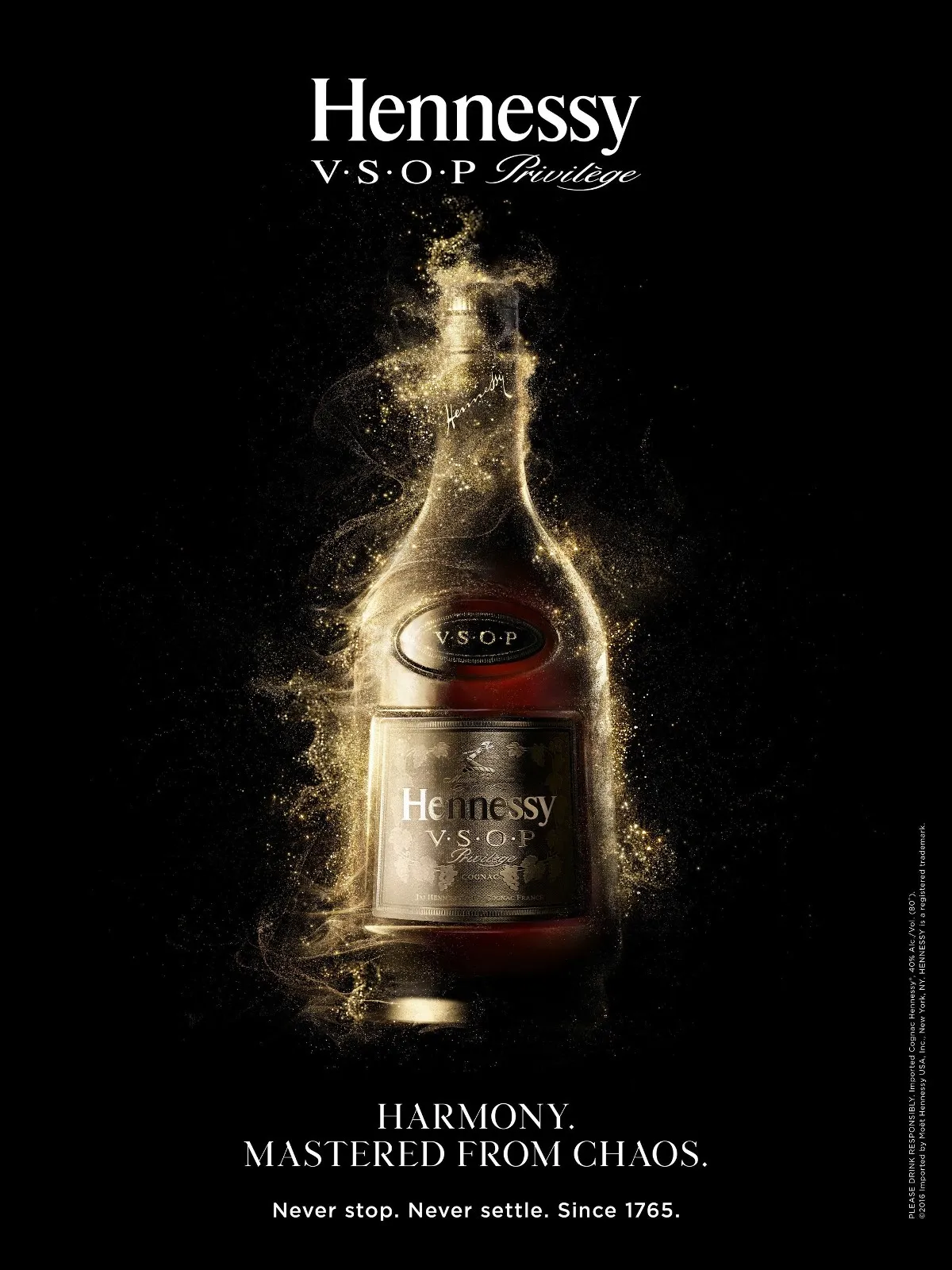
Key art for Hennessy V.S.O.P Privilège’s “Harmony. Mastered from Chaos” campaign (2016)

SELECTED WORK / PRODUCTION

Hennessy V.S.O.P Privilège Interactive Experience and Ad Campaign

Studio
Tool of North America
Released
June 29, 2016
SCANable role
3D/4D Scanning
Director
Ben Tricklebank
VFX vendor
Blacksmith
  • Animation
  • CG
  • Commercial/Advert
  • Environments
  • Particles
  • Point Cloud
  • VFX

Hennessy V.S.O.P Privilège’s “Harmony. Mastered from Chaos” is an interactive WebGL experience and ad campaign created by agency Droga5 NY. Launched June 30, 2016, the campaign pairs a responsive microsite with a 60-second spot directed by Ben Tricklebank of Tool of North America, transporting viewers to Cognac, France through every stage of the cognac’s creation — from storm-swept vineyards to the distillery, the cooperage, and the aging cellars — to tell the story of the remarkable consistency Hennessy’s masters achieve year after year. Active Theory built the interactive experience, Blacksmith handled post-production, Plan8 composed the music and sound design, and Leslie Odom Jr. of Broadway’s Hamilton provided the voiceover.

SCANable provided the campaign’s LiDAR 3D scanning and 4D depth capture, merging with live-action footage and binaural audio to render Hennessy’s environments as striking point clouds — visuals representing the forces of chaos and variation the craftspeople overcome to create every bottle.

When the point cloud is the picture

Most scanning is invisible in the finished frame. The cloud becomes a mesh, the mesh gets shaded, and the measurement disappears behind the render.

Here the measurement is the aesthetic. That inverts the priorities of the capture: density, distribution, and noise characteristics stop being intermediate concerns and become the look itself. Points that are unevenly spaced, positions that leave visible shadows in the cloud, and returns from surfaces that scatter badly are all decisions the final image will show. Capture has to be planned for how the data will read, not only for how accurate it is.

Depth that changes over time

A static scan describes a place. It cannot describe a process — liquid moving, flame in a rick yard, a craftsperson working, weather crossing a vineyard.

4D capture records depth as a sequence rather than a single instant, so motion is preserved as geometry rather than reconstructed from footage afterwards. That is what allows a moving subject to be rendered as a point cloud that behaves correctly in three dimensions instead of a flat effect applied to a plate. 4D capture is the service; CALVINN, our modular volumetric rig, is the hardware side of it.

Chaos reads as chaos only when the order underneath is real

Imagery about variation and disorder still has to be legible. Turbulence that is procedurally generated tends to look uniform, because a procedure has no reason to be irregular in the specific way a real place is.

Captured data carries that irregularity for free. The unevenness comes from the actual geometry of an actual vineyard, cooperage, or cellar, so the visual argument about mastering chaos is made with the real thing rather than a simulation of it.

Interactive delivery has its own budget

A WebGL experience runs in a browser on hardware nobody can specify in advance. Point counts that a render farm shrugs at will not survive a mid-range laptop.

Preparing capture data for that means decimating with intent — thinning where density carries no information, holding it where the silhouette or the motion depends on it — and structuring the result so it can be streamed rather than loaded whole. The measurement stays the source; what ships is a version of it sized to the platform.

See more brand and spot work, or read about what we do.