SELECTED WORK / PRODUCTION
Imaginary
- Studio
- Lionsgate
- Released
- March 7, 2024
- SCANable role
- 3D Scanning
- Director
- Jeff Wadlow
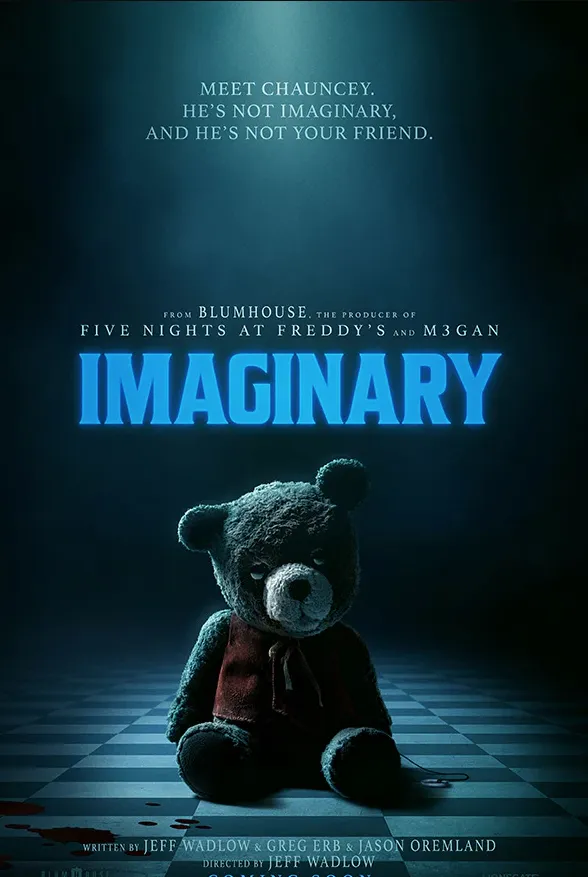
Imaginary (2024) is Lionsgate’s supernatural horror film directed and produced by Jeff Wadlow, co-produced by Jason Blum through his Blumhouse Productions banner and Tower of Babble. Written by Wadlow with the writing team of Greg Erb and Jason Oremland, the film stars DeWanda Wise, Tom Payne, Taegen Burns, Pyper Braun, and Veronica Falcon. In the story, a woman returns to her childhood home and discovers that her stepdaughter’s imaginary friend is more than imaginary.
SCANable provided 3D scanning for the production, capturing actors, environments, and props with photogrammetry to support the film’s visual effects and set extension work.

What a scan has to catch on the day
Makeup, appliances and practical effects exist for a few hours and then come off. Whatever a scan records inside that window is the entire reference the digital version will ever have.
That makes coverage decisions final rather than provisional. A capture that misses an angle, or records an appliance under lighting it cannot later be separated from, cannot simply be repeated once the performer is out of the chair. Photometric capture matters here specifically because prosthetic and applied surfaces respond to light very differently from skin, and the two have to be described independently if the asset is going to be relit. Our CyberSCAN™ arrays expose every camera in a single instant, which is what makes a one-shot window workable at all.
A house with a history
A film built around a childhood home makes the building itself a character — revisited across time, shot from angles that emphasize its geometry, and asked to feel both familiar and wrong.
Measuring the location gives every department the same version of it. Set and location scanning turns a house into a dataset that layout, set extension and clean-up all reference from, which keeps the space consistent whether it appears as memory, as present day, or as somewhere the camera should not be able to go.
Scale that is meant to be wrong
Horror manipulates proportion deliberately. A room that is slightly too large, a doorway that is slightly too small, a hallway that does not close the way it should.
Doing that convincingly requires knowing the true dimensions first. A deliberate distortion applied to measured geometry reads as unsettling. An accidental one reads as a mistake, and the audience blames the film rather than the character. Measurement is what separates the two, and it is the only thing that does.
Browse more film scanning work, or see the full range of services.