SELECTED WORK / PRODUCTION
Lennox “Robot – What Perfect Feels Like”
- Studio
- GSD&M
- Released
- April 10, 2015
- SCANable role
- 3D Scanning
- VFX vendor
- A52
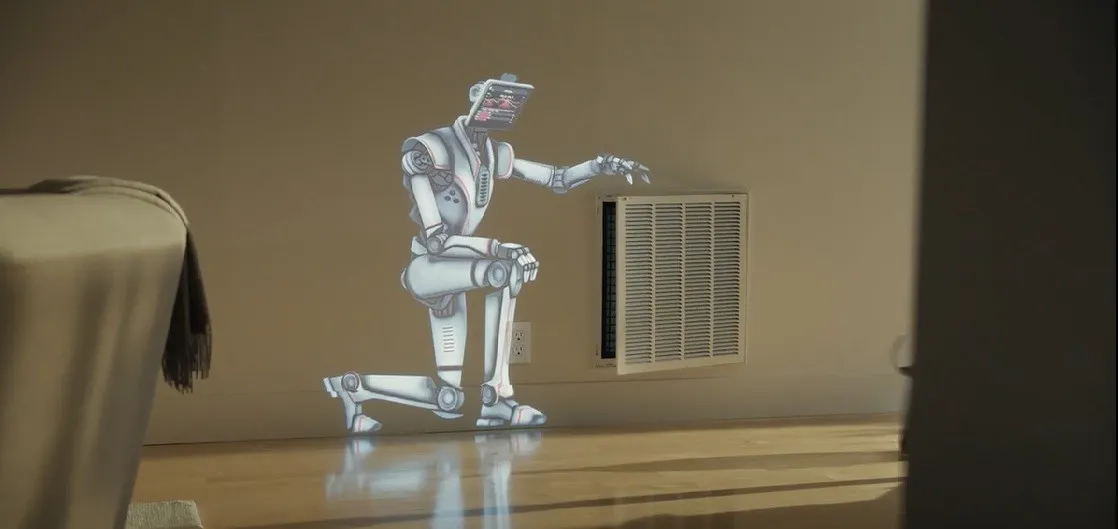
Lennox’s “Robot – What Perfect Feels Like” is a 2015 projection-mapped commercial for Lennox air conditioners that unleashes a giant robot on a real suburban home. Visual effects company A52 created computer-generated animations that were projected directly onto the house, then shot using traditional filming methods — turning the practical location into a real-time, live CG experience captured in camera.
SCANable performed 3D scans of the house, built models from the resulting data, and provided consulting services for the projection mapping, supplying A52 with the precise geometry its animations needed to register against the architecture.
A projector is a camera pointed backwards
A projector has a position, an orientation, a lens and a frustum — the same parameters as a camera, running in the opposite direction.
That means the digital scene has to contain a virtual projector standing where the real one will stand, aimed at a model that matches the real subject. Solve it once and every frame lands where it should. Get the position or the lens wrong and the error is uniform across the entire show, which is worse than a random error, because it looks deliberate.
Accurate site geometry is what allows that virtual setup to be worked out in advance rather than dialled in on the night.
Animating against measured surfaces
An animator building a giant machine that climbs a house needs to know where the house actually is.
Working against a scanned model, they can plant a foot on the real ridge line, let an arm pass behind the real chimney, and time an occlusion to a real eave. The animation is authored in the same space it will eventually be projected into, at the same scale.
Working against a rough proxy, all of that becomes guesswork that only gets discovered on location. A measured model turns a house on the other side of the country into something the animation team can address directly, weeks before anyone travels.
Consulting is part of the deliverable
Scan data on its own is a file. Making it useful to a projection-mapping crew is a separate piece of work.
Coordinate conventions, units, origin placement, decimation targets, which surfaces matter and which can be simplified away — those decisions determine whether the geometry drops straight into the workflow or costs a day of translation at the worst possible point in the schedule.
Advising on that is often worth as much as the capture itself, which is why we would rather be involved before the scanner comes out of the case than after. Our services are structured around that.
Browse more commercial projects, or read how CyberSCAN™ capture works.