← Back to all work
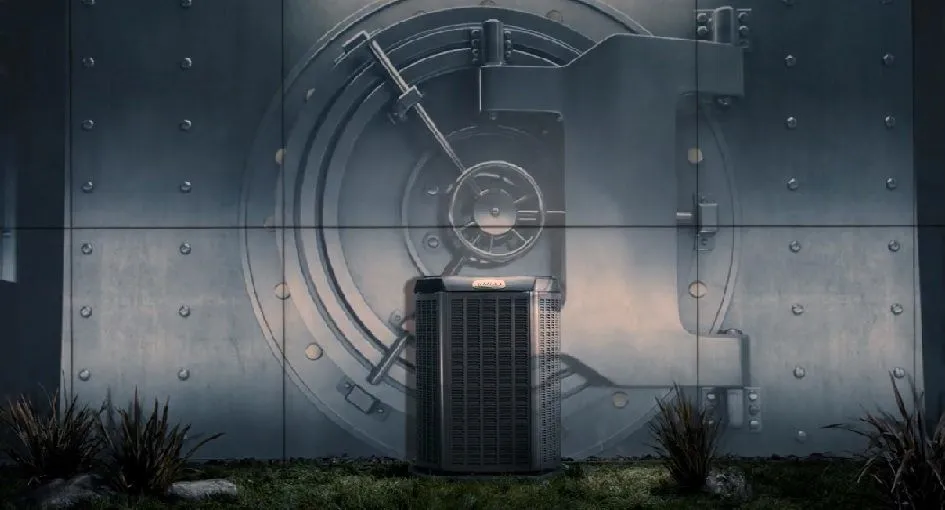
Still from the Lennox ‘Vault – What Perfect Feels Like’ projection-mapped commercial (2015)

SELECTED WORK / PRODUCTION

Lennox “Vault – What Perfect Feels Like”

Studio
GSD&M
Released
April 10, 2015
SCANable role
3D Scanning
VFX vendor
A52
  • 3D Projection
  • Animation
  • CG
  • Commercial/Advert
  • VFX

Lennox’s “Vault – What Perfect Feels Like” is a 2015 projection-mapped commercial for Lennox air conditioners that seals a real suburban home inside an impenetrable vault. Visual effects company A52 created computer-generated animations that were projected directly onto the house, then shot using traditional filming methods — turning the practical location into a real-time, live CG experience captured in camera.

SCANable delivered 3D scans and models of the house and consulted on the projection mapping, providing A52 with architecture-accurate geometry to lock its animations to.

How much error a projected edge can absorb

Almost none, when the edge is meant to read as a hard surface sealing over a building.

A soft, organic effect forgives misalignment. A geometric one — a panel, a seam, a door closing flush against a wall — does not. The audience does not need to know the dimensions to sense that something has drifted. A straight line that fails to sit on a straight edge reads as wrong instantly, and it keeps reading as wrong for as long as it is on screen.

That sets the accuracy target for the whole job. The model has to hold tolerance across the full width of the building, not only where the instrument happened to be standing.

An exterior is not a room

Interior scanning is a controlled exercise: fixed surfaces, stable light, short ranges, and something solid to register against in every direction.

Outdoors, the conditions push back. Sunlight competes with the instrument. Foliage moves between passes. Ranges are longer, so angular error grows with distance. The sky returns nothing at all, which removes a whole hemisphere of registration targets.

Terrestrial LiDAR handles it, but only with a scan plan built around what is actually visible from each position. It is the same discipline as enterprise survey work, applied to a shoot.

The location goes back to being a house

A stage can be revisited. A private residence used for a commercial cannot — the crew leaves, the permit closes, and the access simply ends.

Whatever was not measured while the team was on site is not recoverable afterwards at any price. That asymmetry is the argument for capturing more than the shot list strictly requires: the elevations nobody plans to project onto, the ground plane, the driveway, the neighbouring structures that end up in frame anyway.

Over-capturing costs an hour on the day. Under-capturing costs a return trip that may not be available.

See more location scanning projects, or explore the full service list.