

← Back to all work
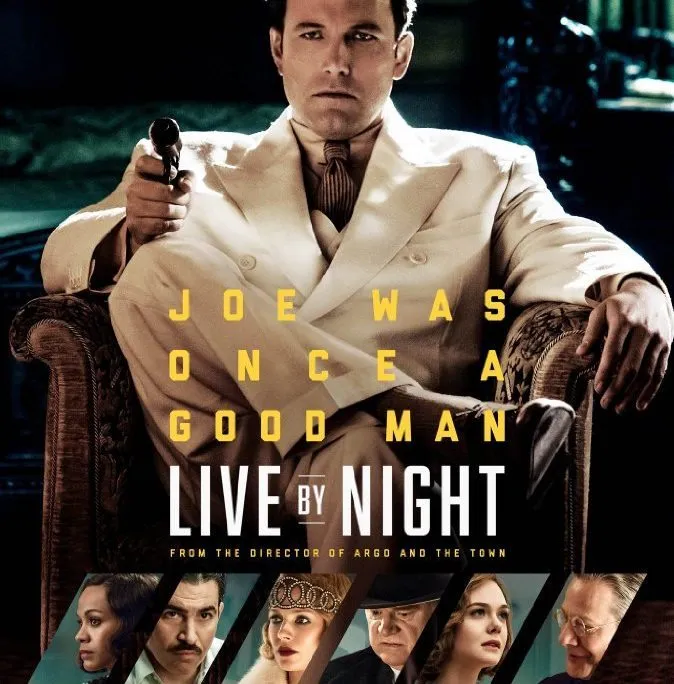
Official poster for Live by Night — Ben Affleck’s Prohibition-era crime drama for Warner Bros

SELECTED WORK / PRODUCTION

Live by Night

Studio
Warner Bros
Released
January 12, 2017
SCANable role
3D Scanning
Director
Ben Affleck
VFX vendor
Kiki Tree VFX
  • Beauty
  • Body Scanning
  • CG
  • Face Replacement
  • Feature Film
  • VFX

Live by Night is Warner Bros’ crime thriller written, directed by, and starring Oscar winner Ben Affleck, based on the best-seller by Dennis Lehane. Marking the Boston natives’ second collaboration after Gone Baby Gone, the film is set in the roaring ’20s, when Prohibition hasn’t stopped the flow of booze in gangster-run speakeasies. Joe Coughlin, son of the Boston Police Superintendent, crosses a powerful mob boss and is propelled up the ladder of Tampa’s steamy rum-running underworld. Produced by Leonardo DiCaprio and Jennifer Davisson under Appian Way and by Affleck and Jennifer Todd for Pearl Street Films, the film stars Elle Fanning, Chris Messina, Sienna Miller, Zoe Saldana, and Chris Cooper, with cinematography by Robert Richardson and a score by Harry Gregson-Williams. It was released on January 13, 2017.

SCANable provided 3D actor scans, LiDAR processing, and 3D modeling for the film’s visual effects.

The audience has spent a lifetime reading faces

Most digital work is graded against plausibility. A face is graded against a viewer who has spent a lifetime reading faces and notices error before they can name it.

That raises the requirement on the capture itself. Geometry has to be accurate at the millimetre scale across the brow, nose, and mouth, where a small deviation reads immediately as someone else. Pore-level surface detail has to survive into the final texture, because skin without micro-structure reads as plastic under any lighting.

None of that can be recovered later. If the scan is soft, every downstream step inherits the softness.

Skin has to relight, not just look correct once

A face plate is shot under whatever light the scene calls for. A digital face has to sit in that light convincingly and then hold up in the next setup, which is lit differently.

Cross-polarised photography separates what the surface actually is from how it happened to be lit at the moment of capture. That yields a clean diffuse response and a specular record kept apart from it, so the resulting texture can be relit rather than baked to one condition. Photometric capture is the discipline behind that separation, and it is why a properly captured head works across a whole film rather than one shot.

Period work has nothing to fall back on

A contemporary film can borrow from the world. Prohibition-era Boston and 1920s Tampa cannot be borrowed; every element is either built, dressed, found, or created digitally.

That makes measured data disproportionately valuable. Whatever was constructed practically becomes the standard everything else matches, and the only way to extend it accurately is to have its real dimensions on record. Approximating a period build produces set extensions that are almost right, which is the most visible kind of wrong.

Actor scans are a long-lived deliverable

A scanned cast is not a single-purpose asset. The same head and body data supports face replacement, stunt coverage, crowd work, and any shot the schedule adds after the unit has wrapped.

Capture happens while the cast is available, in the hair and wardrobe state the film requires. Everything then ships as clean, render-ready geometry for the vendor to build on. See digital doubles for the full workflow.

More film scanning work are in the portfolio, alongside the complete service list.