SELECTED WORK / PRODUCTION
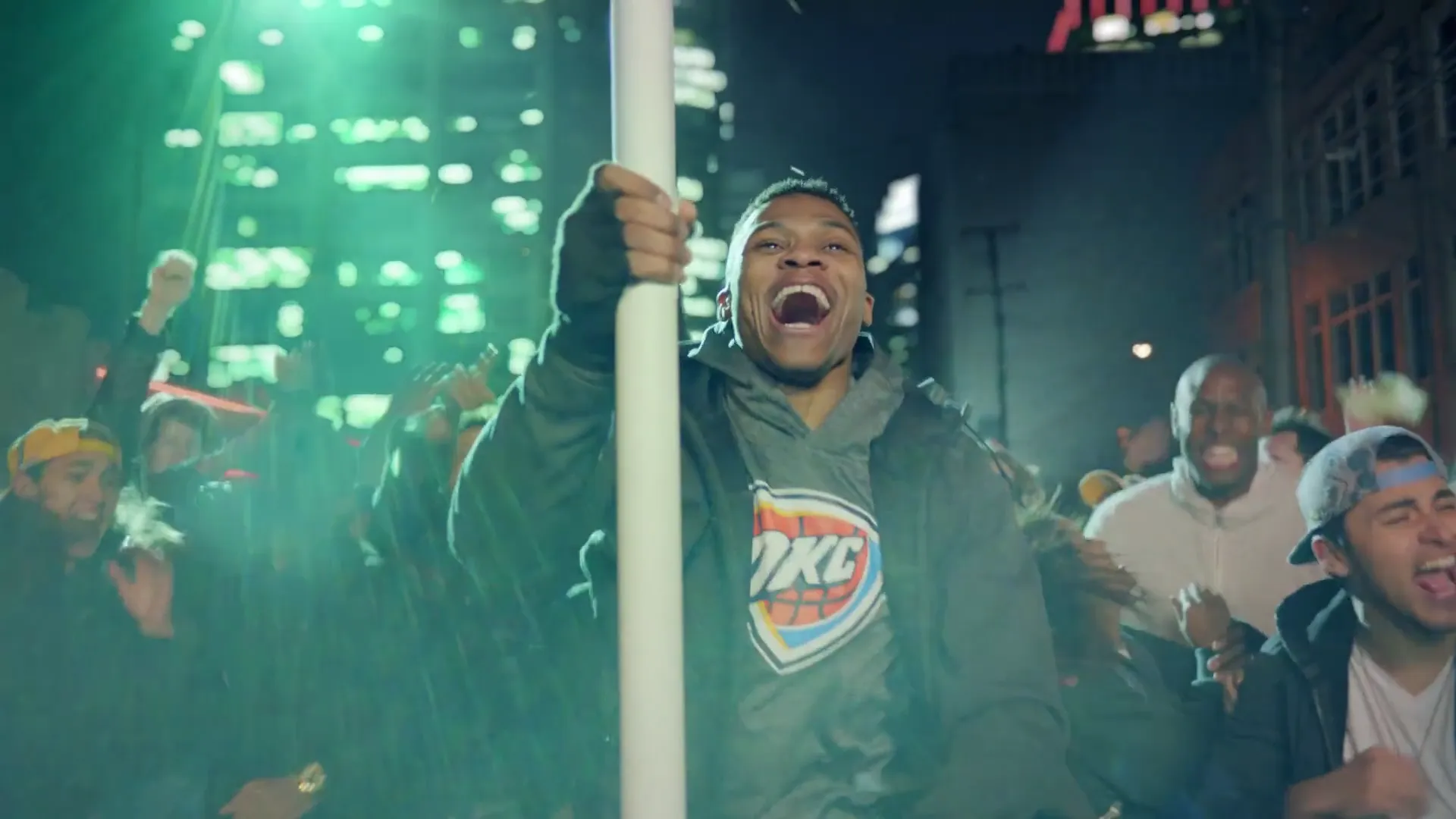
Mountain Dew ‘NBA Make An Introduction’ feat. Russell Westbrook
- Studio
- MJZ
- Released
- February 12, 2016
- SCANable role
- 3D Scanning
- Director
- Joaquin Baca-Asay
- VFX vendor
- a52
Mountain Dew’s ‘Make An Introduction’ is a 2016 NBA commercial produced by MJZ, featuring Russell Westbrook, Jimmy Butler, and Julius Randle. Built around the idea that basketball starts on the court but the game lives everywhere, the #DEWxNBA spot — directed by Joaquin Baca-Asay with visual effects by a52 — also features SuperMascot Rocky.
SCANable provided 3D scanning for the spot, delivering point cloud and photogrammetric data that supported camera tracking, CG backgrounds, and crowd placement in post-production.

A tracked camera needs the space, not just the plate
Matchmove software can solve a camera from image features alone, and on a clean shot it often does. The difficulty is everything that is not clean: a moving crowd, motion blur, repeating architecture, a long lens with almost no parallax.
Measured geometry removes the guesswork. When the surrounding volume has been captured, the solve is constrained by known distances rather than inferred ones, and the resulting camera holds through the shots where a feature-only track drifts.
That reference is also what lets an artist confirm a solve is correct rather than merely plausible. Our set and location scanning is the survey half of that job.
Architecture is the anchor for a CG background
Built environments are unforgiving subjects. Straight lines, right angles and repeated facade elements are exactly the features a viewer uses, unconsciously, to judge whether a frame is real.
A background extended or replaced digitally has to align with the real architecture at every edge of every cut. Approximated geometry can be made to work in one shot and will fail in the next one from a different angle.
Capturing the actual structures means the CG version inherits the real proportions, so the extension is a continuation of the plate rather than a separate thing sitting behind it.
Where a digital crowd has to stand
Crowd work is usually discussed in terms of the figures. The harder problem is the ground they occupy: kerb heights, road camber, step depth, the true distance from camera to the far side of a street.
Get that wrong and the figures sit at the wrong height, overlap incorrectly, or cast shadows that fall onto nothing. No amount of per-agent detail rescues a crowd standing on invented terrain.
Scanned environment geometry gives the crowd system a real surface to place onto, correctly scaled, so simulation and layout can be judged on performance instead of on whether the ground is right.
See more commercial and advertising work, or read about the services behind it.