← Back to all work
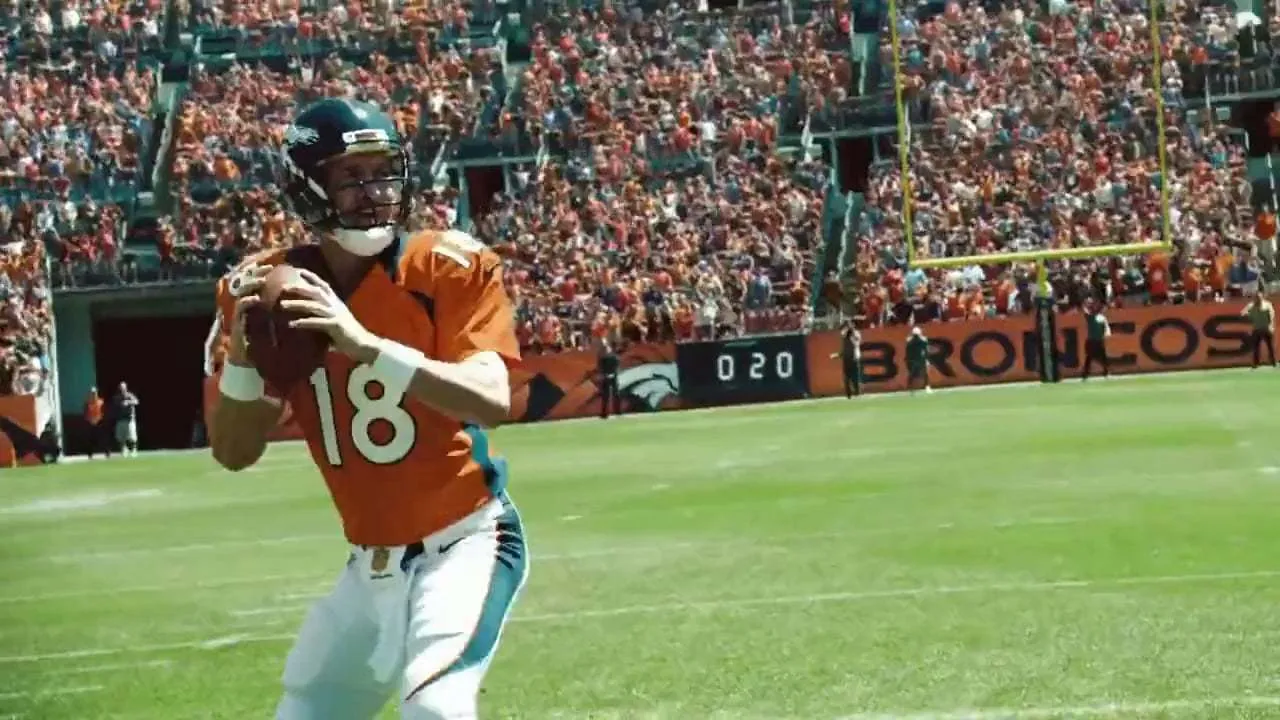
Poster for Nike’s ‘The Future is Fast’ commercial (2015) featuring Peyton Manning

SELECTED WORK / PRODUCTION

Nike ‘The Future is Fast’ feat. Peyton Manning

Studio
Stink
Released
December 7, 2015
SCANable role
3D Scanning
Director
Yann Demange
VFX vendor
a52
  • CG
  • Camera Tracking
  • Commercial/Advert
  • Crowd Placement
  • HDRI
  • Photography
  • Stadiums
  • VFX

‘The Future is Fast’ is Nike’s 2015 commercial featuring NFL stars Peyton Manning, Steve Young, Colin Kaepernick, Melvin Gordon, and DeMarcus Ware. Created by advertising agency Wieden + Kennedy Portland, the spot introduced Nike’s new tagline — The Future is Fast — set to ‘Hold On, I’m Comin’’ (1966) by soul duo Sam and Dave, written by Isaac Hayes and David Porter.

SCANable provided 3D scans of Sports Authority Field at Mile High in Denver, Colorado, and Ford Field in Detroit, Michigan, producing measured point cloud data used for camera tracking and to place the computer-generated crowds seen throughout the spot.

Two venues, one consistent asset library

A spot that cuts between stadiums in different cities is really a continuity problem. Each venue is captured on its own schedule, by its own access arrangement, in its own conditions — and the finished commercial has to feel like one continuous piece of work.

The way that holds together is convention. Both datasets registered to real-world units, both using the same up-axis and handedness, both organised and named the same way, both delivered at a comparable density.

When that discipline is applied at capture, artists move between venues without re-learning anything. When it is not, the second stadium costs twice what the first one did, entirely in reconciliation work.

Empty seats are the point

A stadium is scanned when it is empty, which is the opposite of how it will appear on screen. That is deliberate — the seating geometry, the tier structure and the sightlines can only be measured with nothing in the way.

Access to a working venue is narrow and rarely repeatable. The window is set by the stadium’s own calendar, not the production’s, so the capture plan has to cover everything the shot might need on the first visit.

That is a survey exercise as much as a VFX one, and it is why enterprise and survey-grade scanning sits alongside our film work rather than separately from it.

Lighting reference belongs with the geometry

Geometry says where things are. It says nothing about the sky above an open bowl, the colour of the floodlights, or how much bounce comes off a green field on an overcast afternoon.

HDRI panoramas and calibrated stills recorded at the same time as the scan carry that information forward. Paired with the measured environment, they let a lighting artist reproduce the venue’s actual conditions rather than approximate them, so CG crowds and elements sit in the plate’s own light.

The two datasets are far more useful together than either is alone, which is why set and location scanning treats them as one deliverable.

Browse more stadium and location work, or see the complete service list.