SELECTED WORK / PRODUCTION
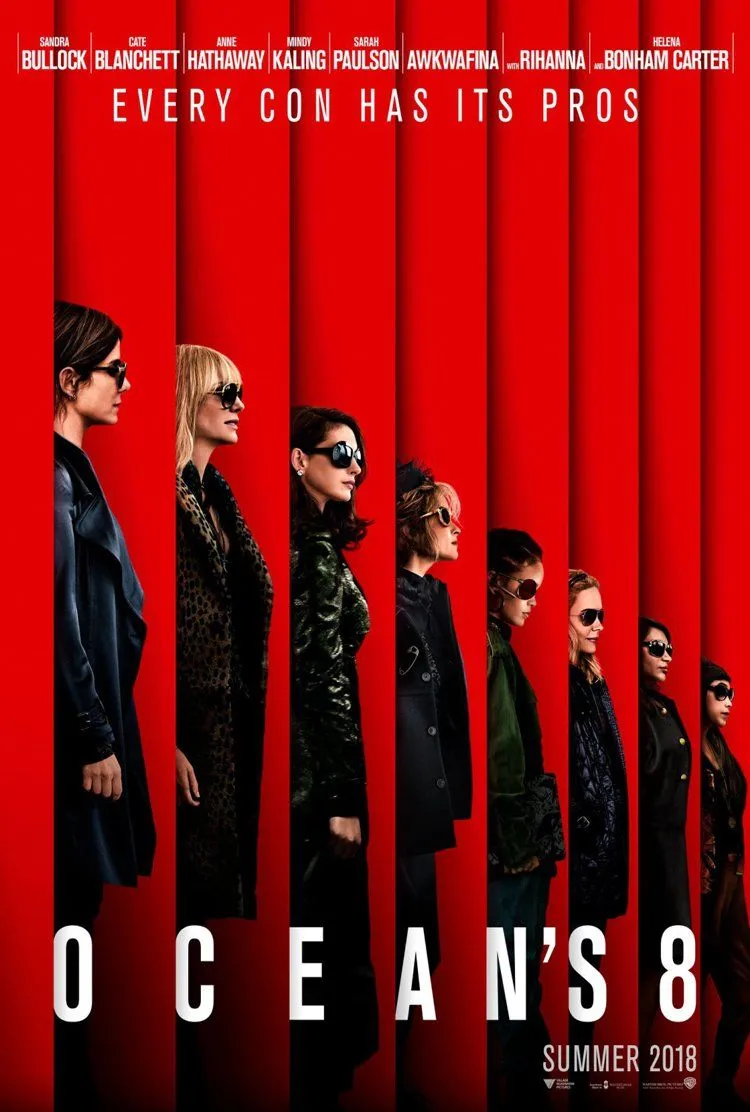
Ocean’s 8
- Studio
- Warner Bros. Pictures
- Released
- June 7, 2018
- SCANable role
- LiDAR/3D Scanning and Modeling
- Director
- Gary Ross
Ocean’s 8 is a 2018 Warner Bros. heist comedy directed by Gary Ross, a continuation and spin-off of Steven Soderbergh’s Ocean’s trilogy. Written by Ross and Olivia Milch, the film features an ensemble cast including Sandra Bullock, Cate Blanchett, Anne Hathaway, Mindy Kaling, Sarah Paulson, Rihanna, Helena Bonham Carter, and Awkwafina. It follows a group of women led by Debbie Ocean — sister of Danny Ocean — as they plan a sophisticated heist of the annual Met Gala at the Metropolitan Museum of Art in New York City.
SCANable performed LiDAR and 3D scans of sets, props, and other key items for the feature film, delivering modelled digital assets in support of the production’s visual effects.

Working inside a borrowed space
Some locations are not controlled, only permitted. Access is short, movement is restricted, and nothing can be moved, touched, or left behind.
Capture under those conditions is governed by the venue rather than by the crew. Equipment footprint stays small, scan positions are worked out in advance because there is no time to discover them on the day, and the team finishes to somebody else’s clock.
What comes out is the same thing a stage capture produces — a registered point cloud in real-world units — obtained without the option of a second visit.
One object, several copies
Heist stories put a single object at the centre of the frame and then require it to be handled, examined, swapped, and seen in places the practical prop was never taken.
Prop scanning solves that. The digital version is dimensionally the practical one, so it matches in shots where both appear and holds up in shots where only one does. Replicas, damage variants, and insert versions all descend from the same measured original instead of from a parallel modelling effort that has to be reconciled later.
Sets are built to be seen from one direction
Production design solves for the camera. A set that reads perfectly on screen may have no back, no ceiling, and walls that fly out between setups.
Scanning records what physically exists, which is why the capture and the finished digital environment are never the same object. The scan is the true part. Anything a shot needs beyond it gets built outward with the scan’s dimensions as its starting point, which is what keeps the finished environment consistent with the plate instead of merely similar to it.
Everything ships as clean, render-ready geometry.
Browse more feature film scanning, or see the full service list.