← Back to all work
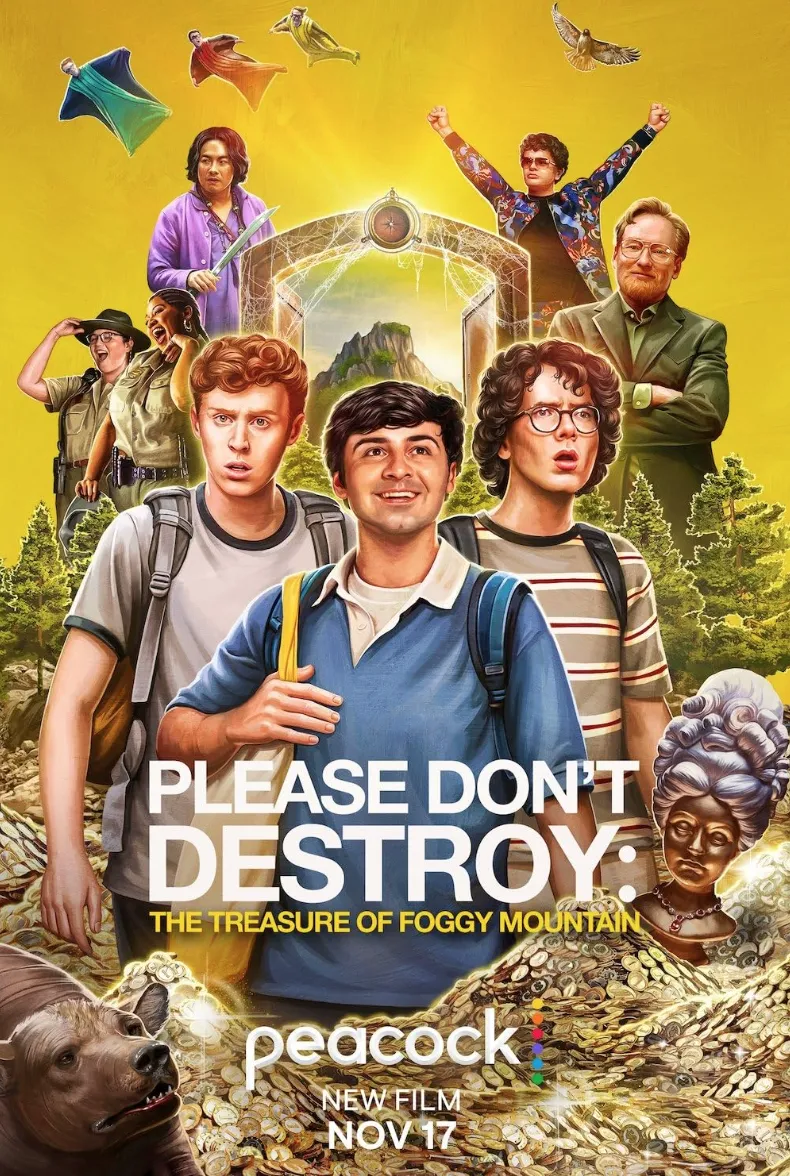
Official poster for Please Don’t Destroy: The Treasure of Foggy Mountain (2023) — Universal Pictures

SELECTED WORK / PRODUCTION

Please Don’t Destroy: The Treasure of Foggy Mountain

Studio
Universal Pictures
Released
November 16, 2023
SCANable role
3D Scanning
Director
Paul Briganti
  • Backgrounds
  • Body Scanning
  • CG
  • Feature Film
  • Props

Please Don’t Destroy: The Treasure of Foggy Mountain is a 2023 Universal Pictures comedy written by and starring the troupe Please Don’t Destroy. Directed by Paul Briganti and produced by Judd Apatow and Jimmy Miller, the film follows a fictionalized version of the group — Martin Herlihy, John Higgins, and Ben Marshall — as they set out to find a legendary lost treasure using a compass they found as kids. Bowen Yang, Meg Stalter, X Mayo, Nichole Sakura, Cedric Yarbrough, Sunita Mani, and Conan O’Brien also star.

SCANable provided 3D scanning services for the production, capturing talent and props through photogrammetric capture to support the film’s computer-generated visual effects and background work.

The built version is the definitive version

When a prop is fabricated for camera, it becomes the definitive version of that object. Everything digital that follows — a duplicate, a destroyed variant, a version thrown across a room — has to match it, not merely resemble it.

Prop scanning captures the built article as it exists on the day: the actual proportions, the surface wear, the paint the scenic department applied that morning.

That removes an entire class of continuity problem. Nobody is reverse-engineering an object from a photograph taken under different light, and nobody discovers in a review session that the CG version is subtly the wrong size.

Where the real cave becomes a digital one

Adventure comedy lives on that boundary. A real cave mouth continues into a digital cavern. A real object behaves in a way no real object could. A stunt starts practically and finishes in CG.

Every one of those transitions is a match problem, and every match problem is easier when both halves derive from the same measurements.

Scan data is what makes the two halves share a coordinate space. The digital extension is not modeled to look like the practical build — it is modeled from it, which is a different and far more reliable thing. Our set and location scanning supplies the spatial half of that.

The scan outlives the production

A capture made for one sequence tends to be used for several. Reshoots, additional photography, marketing renders, and trailer work all draw on the same library, often months after principal photography wrapped.

Objects and performers captured properly the first time remain usable for all of it. Objects captured badly, or not at all, become a re-shoot conversation.

This is the quiet argument for scanning more than the shot list strictly requires. Scanning is cheap while the crew, the cast, and the props are all in one place. It is impossible once they are not. Assets ship retopologized and render-ready so they stay useful rather than becoming an archive nobody can open.

More film scanning work is in the portfolio, and the service list has the full picture.