SELECTED WORK / PRODUCTION
Samsung ‘The Anthem’ – Rio 2016 Olympic Games
- Studio
- Leo Burnett USA
- Released
- July 20, 2016
- SCANable role
- 3D LiDAR Scanning
- VFX vendor
- a52
‘The Anthem’ is Samsung’s Rio 2016 Olympic Games commercial, a celebration of global unity inspired by lyrics from national anthems around the world. Saluting those who dare to defy barriers of borders, culture, and language to unite as one, the #DoWhatYouCant spot — with visual effects by a52 — positioned Samsung as a proud sponsor of a world without barriers, capturing the shared humanity on display when nations gather for the Games.
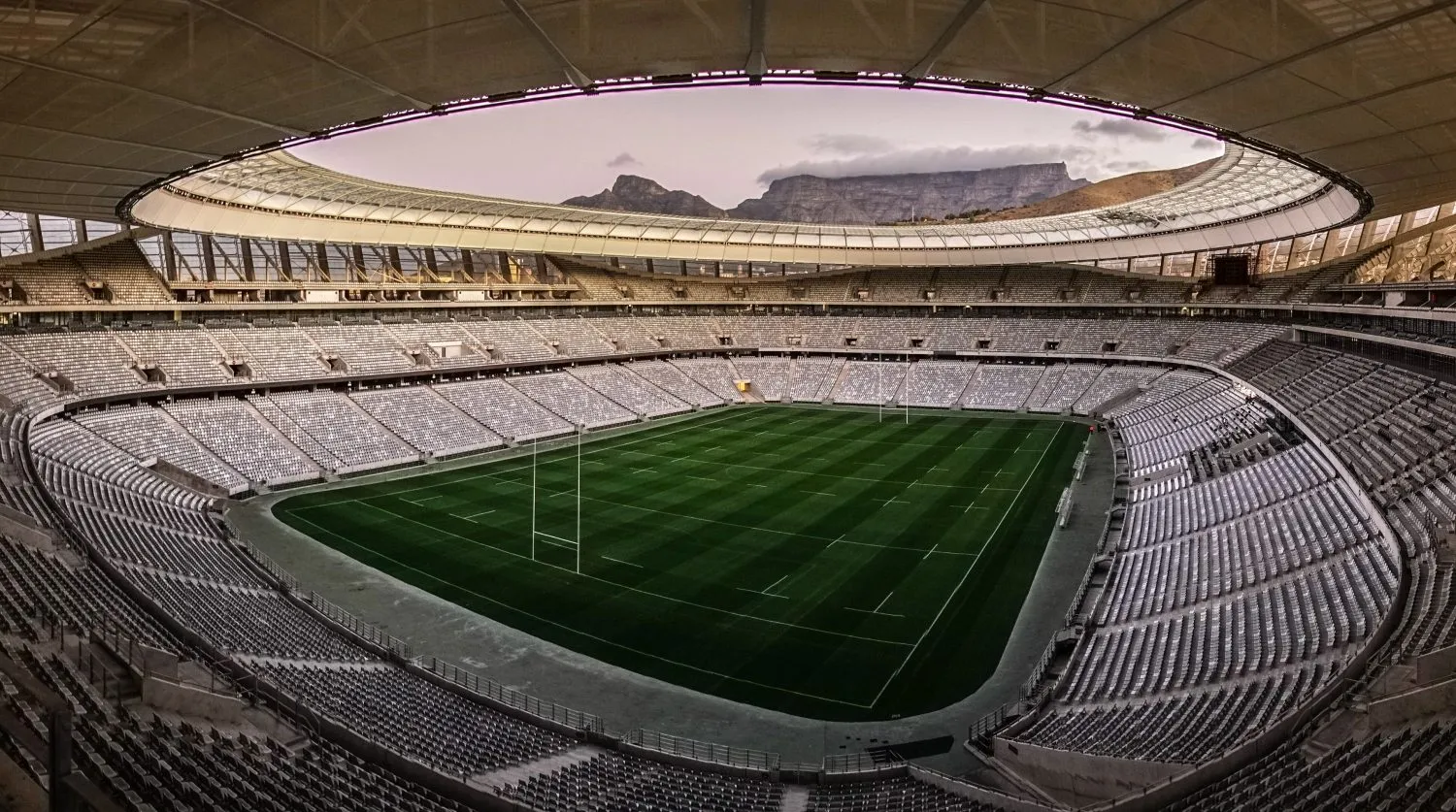
SCANable performed a detailed 3D laser stadium scan (LiDAR) of the interior of Cape Town Stadium in Cape Town, South Africa — home of the 2010 FIFA World Cup — and created a production-ready mesh of the venue used in the commercial’s visual effects work.

A stadium is a survey subject, not a large room
Interior architecture at stadium scale behaves differently from a set. The geometry repeats, the volume is curved and tiered, and the distances involved mean a small angular error at one scan position becomes a visible misalignment at the far side of the bowl.
Capturing it accurately is a survey exercise. Scan positions are planned for coverage of a continuous curved surface rather than walked room by room, targets are placed so registration can be checked rather than assumed, and the whole cloud is tied to a single coordinate frame. That is the discipline our enterprise survey work is built on, applied to a venue instead of a facility.
Sightlines decide what a scanner can record
A terrestrial scanner records only what it can see. Overhangs, upper tiers, roof structures, and the undersides of seating decks are all shadowed from ground level, and no amount of additional positions on the concourse recovers them.
Those gaps get filled from above. Aerial photogrammetry covers roof geometry, upper structure, and the outer envelope that terrestrial positions cannot reach, and the two datasets register into the same space so the venue arrives as one continuous model rather than two partial ones.
From point cloud to something a compositor can use
A registered point cloud is a measurement, not an asset. Nobody lights a billion points or tracks against them comfortably.
The useful deliverable is a mesh: decimated intelligently so structural edges survive while flat surfaces simplify, cleaned of stray returns and people who walked through the scan, and organised so seating, structure, and field can be handled separately. Modeling and mesh preparation is where a survey product becomes a production asset.
Real venues carry information nobody writes down
An accurate venue mesh is what lets a digital crowd sit at the correct height in the correct seats at the correct distance from the field. It is also what lets a virtual camera match a real one, and what gives added elements a surface to cast shadows onto.
None of that is available from photographs. A stadium’s true dimensions exist only in a survey of it, which is why set and location scanning tends to be booked before anyone knows exactly which shots will need it.
See more stadium and venue projects, or the complete list of services.
SELECTED WORK / GALLERY