← Back to all work
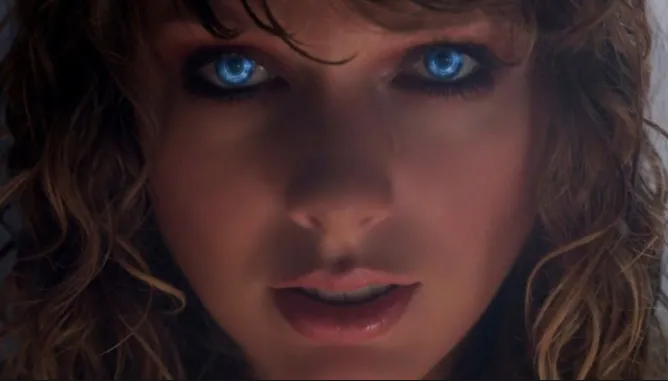
Poster for Taylor Swift’s ‘Ready for It’ music video (2017) — Big Machine Records

SELECTED WORK / PRODUCTION

Taylor Swift – …Ready for It?

Studio
Big Machine Records
Released
October 25, 2017
SCANable role
LiDAR/3D Scanning
Director
Joseph Kahn
  • Body Scanning
  • CG
  • Camera Tracking
  • Environments
  • Music Video
  • Set Extension
  • VFX

‘Ready for It’ is Taylor Swift’s 2017 music video from Big Machine Records, directed by Joseph Kahn and built around a CG digital double of the artist. The heavily effects-driven video blends live-action photography with computer-generated environments and character work from start to finish.

SCANable captured a detailed 3D full-body scan of Taylor Swift in Los Angeles, California, along with numerous facial expressions, and delivered a rig-ready 3D digital double used throughout the video. The team also captured 3D LiDAR scans of the old Hawthorne Mall and the hallway set, supplying spatial reference for camera tracking and computer-generated visual effects.

Placing CG inside a real space

Camera tracking recovers the movement of a real camera through a real space so that CG elements can be placed into it. Solved from the image alone, a track can be entirely plausible and still wrong in scale, and everything attached to it inherits the error.

Measured geometry removes the ambiguity. When the environment exists as a point cloud in real units, the solve has something to lock to, and objects placed into the scene sit at the right size and the right distance without being nudged by eye.

That is what set and location scanning contributes to a tracked shot.

Set extension and the join

Extension work is judged almost entirely at the seam. Everything else in the frame can be beautiful and the shot still fails along the line where the practical build stops and the digital one begins.

The join holds when both sides share dimensions — when the CG wall continues the real wall at the real angle and the real height, with perspective that agrees because the geometry agrees. Built outward from measured point cloud data, that agreement is a property of the asset rather than something an artist has to keep correcting.

A double that has to move

A digital double in a music video is not a statue placed in a frame. It is animated, and animation exposes anything the geometry got wrong.

That changes the delivery. Topology has to flow with the anatomy so deformation behaves, the mesh has to be clean enough to rig, and UVs have to survive being stretched. A raw capture satisfies none of that, which is why retopology and render-ready modelling is part of the work rather than a step bolted on afterwards.

The scan supplies the likeness. The build makes the likeness usable.

Face and body are not the same capture

A full-body scan and a head scan are different problems solved by the same array at different densities.

The body needs correct proportion, posture, and the way clothing falls. The face needs resolution an order of magnitude finer, because it will be seen closer and judged harder. Treating both as one uniform capture either wastes effort on a shoulder or under-samples a cheekbone.

Capturing each at the density it actually needs is what makes a single asset hold up in a wide shot and a close-up. Cyberscanning is the technique underneath it.

The portfolio holds further commercial and advertising work; the full service list sets out what else we do.