← Back to all work
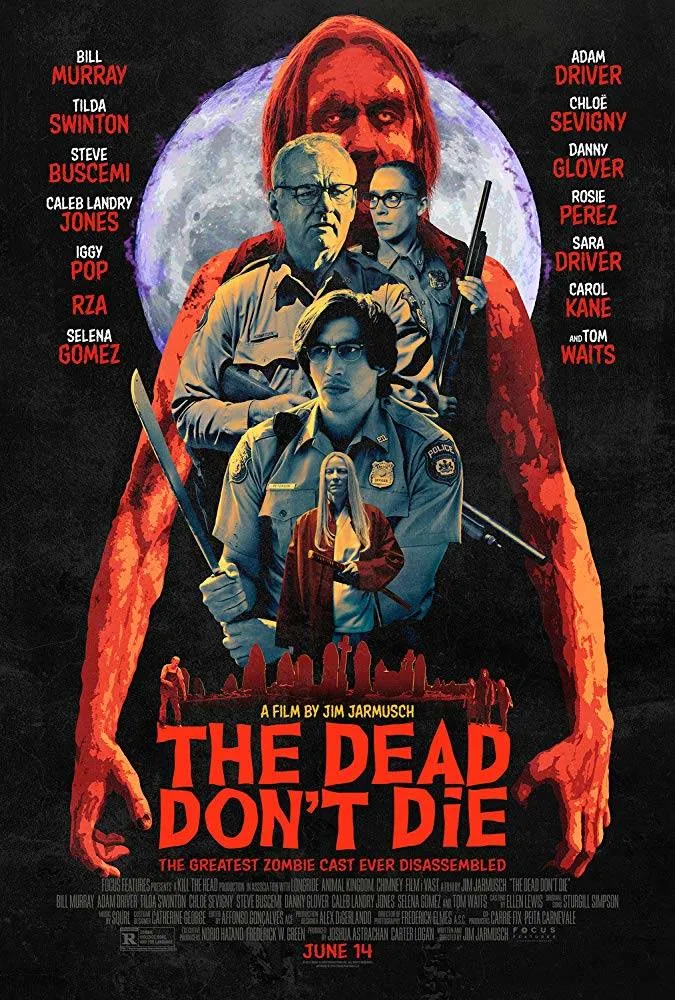
Official poster for The Dead Don’t Die (2019), directed by Jim Jarmusch — Animal Kingdom

SELECTED WORK / PRODUCTION

The Dead Don’t Die

Studio
Animal Kingdom
Released
June 13, 2019
SCANable role
LiDAR/3D Scanning and Modeling
Director
Jim Jarmusch
  • Body Scanning
  • Feature Film
  • VFX

The Dead Don’t Die (2019) is Jim Jarmusch’s star-studded zombie film from Animal Kingdom, starring Bill Murray, Adam Driver, and Tilda Swinton. Written and directed by Jarmusch, it assembles the greatest zombie cast ever disassembled — Chloë Sevigny, Steve Buscemi, Danny Glover, Caleb Landry Jones, Rosie Perez, Iggy Pop, Sara Driver, RZA, Selena Gomez, Carol Kane, Austin Butler, Luka Sabbat, and Tom Waits — and opened in theaters on June 14, 2019.

SCANable performed 3D scans of the film’s principal zombies and of Tilda Swinton, capturing high-resolution photogrammetric data to support the production’s visual effects work.

Makeup becomes geometry the moment it goes on

Prosthetic and character makeup is a sculptural process. Appliances add volume, alter a profile, and change the shape of a face in ways that no photograph of the clean performer can predict.

Which means the scan has to happen in makeup, on the day, in the state the camera will see. A capture of the actor without the appliance describes a different head, and any digital work built from it will disagree with the practical version in exactly the places the audience is looking.

The dependency runs the other way too: once the look is captured, the makeup department has a dimensional record of a build that will be reapplied, altered, and eventually thrown away.

The character, not the actor

Body scanning for a genre film is often assumed to be about likeness. Here the target is the look — a specific combination of appliance, wardrobe, paint, and condition that constitutes the character.

A digital version of that has to reproduce the design decisions, not just the performer underneath them. Where an appliance ends and skin begins, how a costume has been distressed, how the silhouette has been altered: all of it is part of the asset, and all of it is only knowable by capturing the finished look.

This is why photogrammetric capture happens on set rather than in advance. Our Mobile CyberSCAN™ Studios deploy to the production so performers are scanned in full character between setups.

Gloss is the enemy of clean texture

Latex appliances, greasepaint, and anything wet are strongly specular. Photographed directly, they return blown highlights that bake into the texture and cannot be removed afterwards.

Cross-polarized capture suppresses those highlights and records the true diffuse color of the surface underneath, with a matched specular pass describing the sheen separately. The result is a texture set that can be lit rather than one that arrives pre-lit and fights every environment it is placed in.

For makeup-heavy subjects that separation is not a refinement, it is the difference between a usable asset and a reference image. See photometric capture for how it is recorded, and cyberscanning for the array capture it sits on top of.

Browse more film scanning work, or read through everything we offer.