

← Back to all work
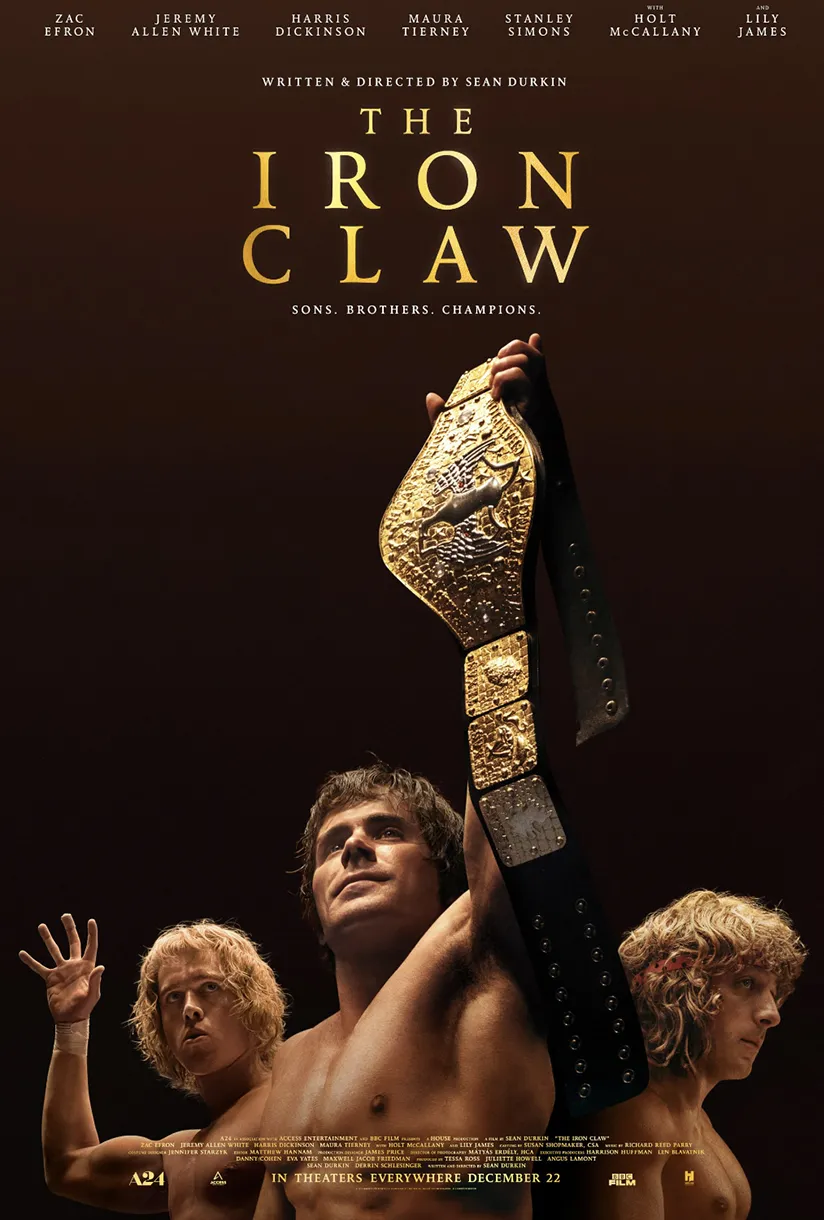
Official poster for The Iron Claw (2023) — A24/Lionsgate wrestling drama starring Zac Efron

SELECTED WORK / PRODUCTION

The Iron Claw

Studio
A24/Lionsgate
Released
December 21, 2023
SCANable role
3D Scanning
Director
Sean Durkin
  • Backgrounds
  • Body Scanning
  • CG
  • Camera Tracking
  • Environments
  • Feature Film
  • Props

The Iron Claw is a 2023 biographical wrestling drama from A24 and Lionsgate, written and directed by Sean Durkin and starring Zac Efron. The film follows the Von Erichs, a family of professional wrestlers “cursed” by tragedy, depicting the struggles of Fritz Von Erich’s sons to achieve the success for which their father groomed them, from 1979 to the early 1990s. Jeremy Allen White, Harris Dickinson, Maura Tierney, Stanley Simons, Holt McCallany, and Lily James co-star in the film, which takes its title from the family’s signature in-ring move.

SCANable provided 3D laser scanning of sets, props, and environments for the film, delivering terrestrial LiDAR and photogrammetric capture used for camera tracking and visual effects support.

Recreating a world that no longer exists

A film set across 1979 to the early 1990s is working against the present tense of every location it shoots in. Arenas get refurbished. Signage changes. Seating is replaced. Whole buildings come down.

Period work therefore splits into two jobs: capture what remains, and rebuild what does not. Both depend on measurement. A CG replacement for a demolished venue is only convincing if it matches the proportions of the surviving structure it is cut against, and proportions cannot be recovered from photographs alone.

Measured point clouds give the art and VFX departments a common truth to work from, rather than two departments independently estimating the same building.

Scale and coordinates across a long shooting schedule

A production of this shape shoots across many venues over many weeks. Each one produces its own scan data, and each dataset is useless in isolation if it arrives in its own arbitrary units and origin.

Establishing scale and coordinate conventions at the start, and holding them across every capture, is what allows an asset built for one location to be reused, compared, or combined with another.

The alternative is a post-production team spending days re-registering data by hand — an expensive, error-prone way to recover something that costs nothing to get right on the day.

Reference data is the unglamorous half

Not every scan on a film becomes a hero asset. A large share of it exists so that a matchmove artist can solve a shot, a compositor can place a background, or a modeler can confirm a dimension.

That reference data never appears on screen in any recognizable form, which is exactly why it gets cut first and missed most. A camera track solved against measured room geometry locks quickly. A camera track solved against guesses drifts, and the drift shows up in the shots nobody flagged as difficult.

Props matter here too. The practical ring, the belts, the gym equipment — capturing the built article gives the VFX team geometry that matches the objects the audience already saw in close-up, delivered as clean, render-ready models rather than raw scan data.

See more feature film work, or read about our 3D scanning services.