

SELECTED WORK / PRODUCTION
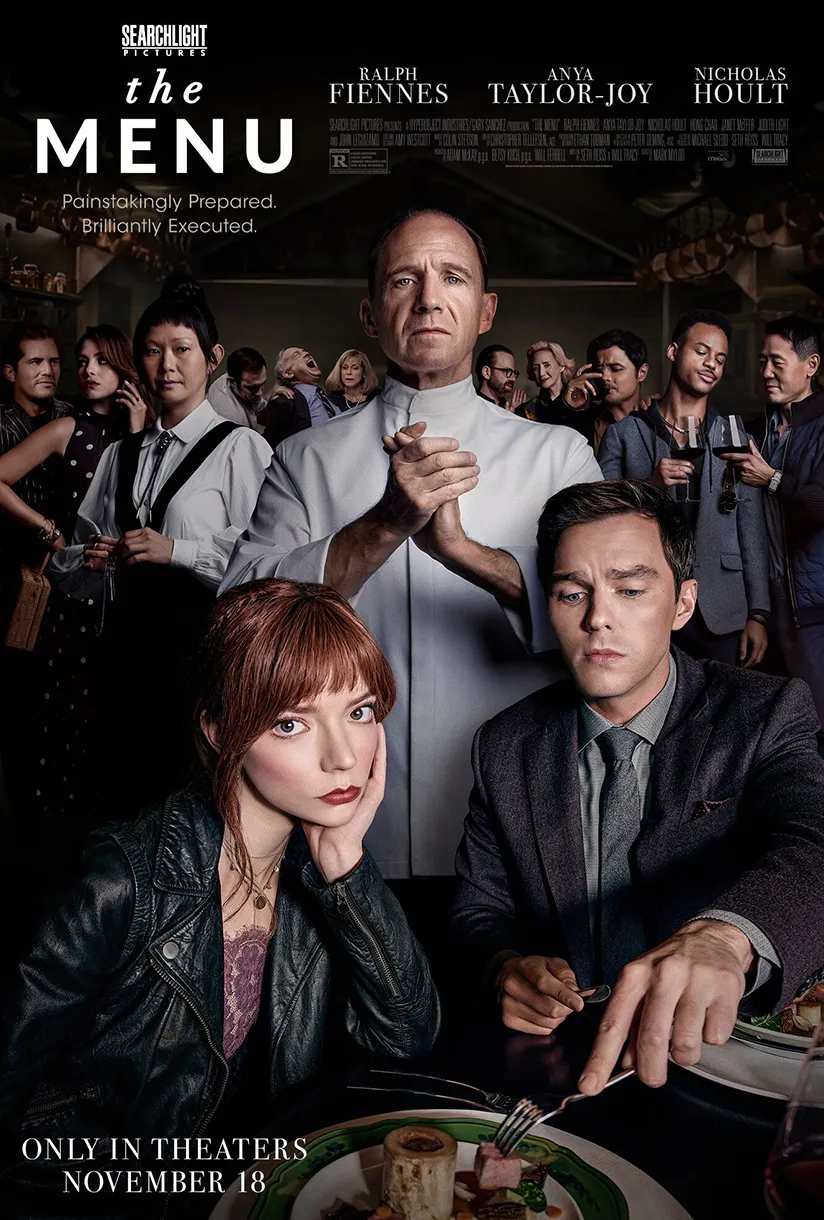
The Menu
- Studio
- Searchlight Pictures
- Released
- November 17, 2022
- SCANable role
- 3D Scanning (Ground and Aerial)
- Director
- Mark Mylod
The Menu is Searchlight Pictures’ 2022 comedy horror film starring Ralph Fiennes as a celebrity chef and Anya Taylor-Joy as one of his diners. Directed by Mark Mylod, written by Seth Reiss and Will Tracy, and produced by Adam McKay, Betsy Koch, and Will Ferrell, the film features Hong Chau as the chef’s assistant alongside Nicholas Hoult, Janet McTeer, Reed Birney, Judith Light, and John Leguizamo as guests at his exclusive restaurant. It premiered at the Toronto International Film Festival on September 10, 2022, opened in the United States on November 18, and grossed over $79 million on a $30 million budget to positive reviews.
SCANable provided ground and aerial 3D scanning for the production, capturing environments through terrestrial LiDAR and aerial photogrammetry to support the film’s visual effects.
Where terrestrial scanning stops and aerial begins
A laser scanner on a tripod is the right instrument for a building, a room, or a stretch of ground it can see. Its limits are line of sight and reach — it cannot see roofs, it cannot cross water, and its accuracy falls away with distance.
Aerial photogrammetric capture picks up precisely there. Flown coverage produces terrain, shoreline, tree canopy, and roof geometry across an area no ground survey could cover in a reasonable number of days.
Neither method is a substitute for the other. The useful deliverable is both, registered together, so the fine detail near the camera and the broad shape of the landscape behind it belong to the same measured space.
An isolated location has to be complete in every direction
A story that strands its characters somewhere depends on that place feeling closed. The audience needs to believe there is nothing beyond it and no way off it.
That belief is fragile in exactly one way: if the environment is only accurate where the camera happened to point, the first shot that looks somewhere unexpected breaks it.
Capturing an environment as a whole rather than shot by shot removes that failure mode. Coverage exists for angles nobody planned, which is what makes late shot additions and reshoots possible without a return trip.
Backgrounds built on measured terrain
Digital matte and background work has a reputation as a painting discipline. In practice the painting is the last step, and the step before it is geometry.
A background projected onto real terrain moves correctly when the camera moves, holds up on a long lens, and can be relit to match the time of day the scene ended up being shot at. A background painted flat does none of those things.
Measured environment data is what makes the difference. It also survives editorial changes — when a shot is extended, reframed, or replaced, the underlying geometry is still valid and only the treatment on top of it has to change.
Explore more feature film projects, or see the full service list.
SELECTED WORK / GALLERY