

SELECTED WORK / PRODUCTION
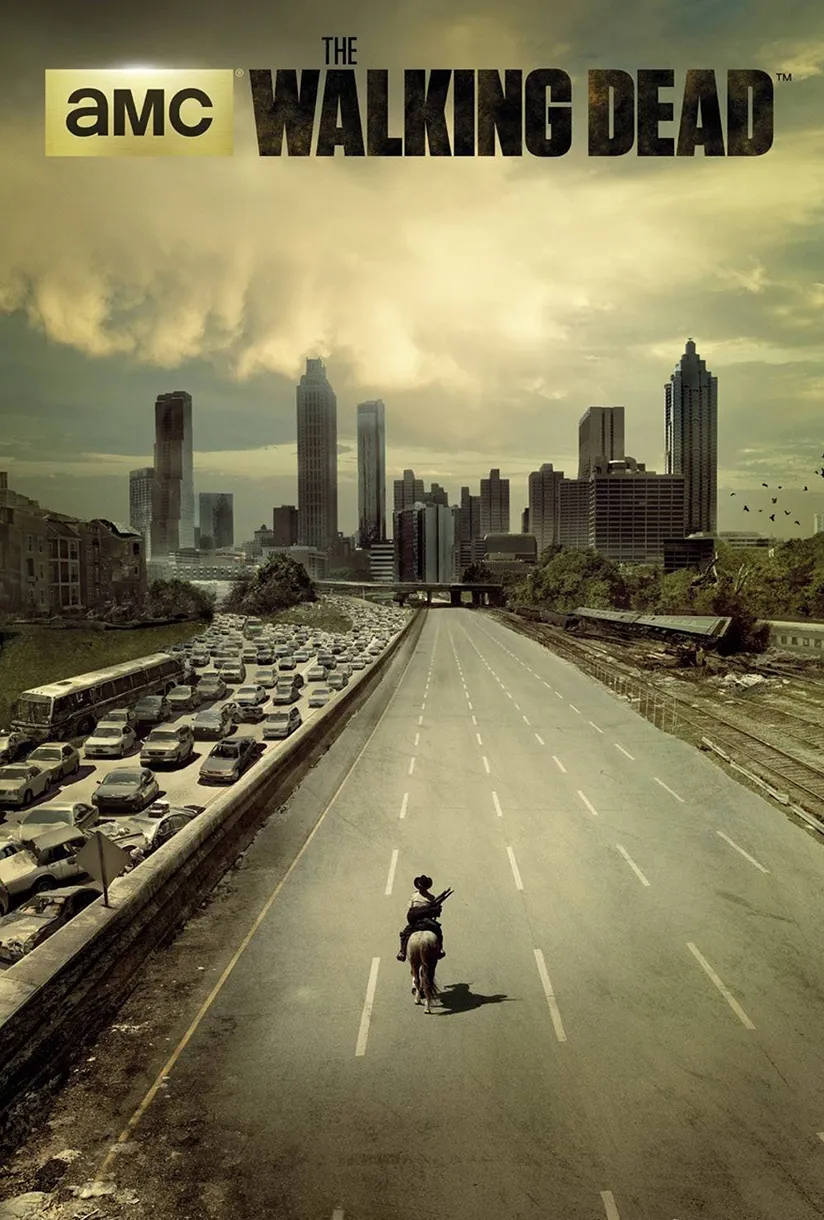
The Walking Dead
- Studio
- Stalwart Films
- Released
- October 10, 2015
- SCANable role
- LiDAR/3D Scanning and Modeling (Ground and Aerial)
The Walking Dead is AMC’s post-apocalyptic horror series based on the comic book by Robert Kirkman, Tony Moore, and Charlie Adlard. The ensemble series follows survivors of a zombie apocalypse living under near-constant threat from the mindless “walkers” — and from rival human communities whose own laws and morals often lead to hostile conflict. Andrew Lincoln played lead character Rick Grimes until his departure during the ninth season, with long-standing cast members including Norman Reedus, Melissa McBride, Lauren Cohan, Steven Yeun, Chandler Riggs, and Danai Gurira. The series ran through eleven seasons, concluding with “Rest in Peace” on November 20, 2022 — the 177th episode overall.
SCANable performed 3D scans and delivered render-ready models of sets, actors, props, and other items for the production, combining terrestrial LiDAR, photogrammetry, and aerial photogrammetric capture in support of the show’s visual effects and set extensions.
Where the ground survey runs out
Ground-based laser scanning is the right instrument for interiors and for anything a tripod can be set up near. It stops at the edge of what a person can walk to.
Open country, rooflines, large exterior builds, and the approach roads around them are captured from above. Aerial photogrammetry fills that gap, producing terrain and structure geometry across an area terrestrial LiDAR would take days to cover, and reaching the parts of a build that are only visible from the air.
Both datasets land in the same coordinate space. That is what makes them usable together rather than side by side.
Registering two datasets into one model
Ground and air are only useful together if they resolve into a single coordinate space. Two individually accurate datasets that disagree about where the ground plane sits are worse than one.
That agreement is planned at capture time rather than repaired afterward: overlapping coverage, shared control points, and enough common structure for the two methods to lock to each other.
What ships is one continuous point cloud and mesh of the location at real-world scale — not a folder of separate surveys a VFX team has to reconcile before it can start work.
Extending an exterior past the last dressed frame
Post-apocalyptic exteriors are built outward. Practical dressing runs as far as the budget and the location permit, and everything past that line is added in CG.
The join holds when the extension is modeled out from measured geometry, because it inherits the real site’s dimensions, grade, and horizon line rather than approximating them. Nothing gets eyeballed into position.
Continuity across a long-running series
A feature captures once and finishes. A series returns to the same standing sets across seasons, with different directors, different units, and months in between.
Assets built from measured geometry hold across that span because they are not interpretations that drift. The version of a location used in one season is dimensionally identical to the version used three seasons later, and a performer scanned early remains a usable asset for as long as the show needs them.
That consistency is invisible when it works and expensive when it fails.
Everything digital has to agree with the build
Props and set dressing are made once by the art department, and everything digital that follows has to agree with them.
Prop scanning makes the physical object the authority. The digital version inherits its real proportions instead of approximating them from photographs, so when it is duplicated, damaged, or destroyed on screen it still reads as the same object the audience saw in the previous shot.
Our set and location scanning covers the spatial half of that work, and delivery runs through retopology and render-ready modelling.
The measured record outlives the shoot
Locations get released. Standing sets get struck. Practical dressing comes down the week after the unit moves on.
A scan is the only version of that place that survives at full accuracy, and it keeps earning after the episode wraps — for reshoots, for pickups, for a shot the schedule pushes deep into post, and for any later production that needs the geography again.
Nobody can go back and measure a location that no longer looks like itself. That is the entire argument for capturing it while the crew is still standing there.
Browse more television work, or see the full range of services.
SELECTED WORK / GALLERY