SELECTED WORK / PRODUCTION
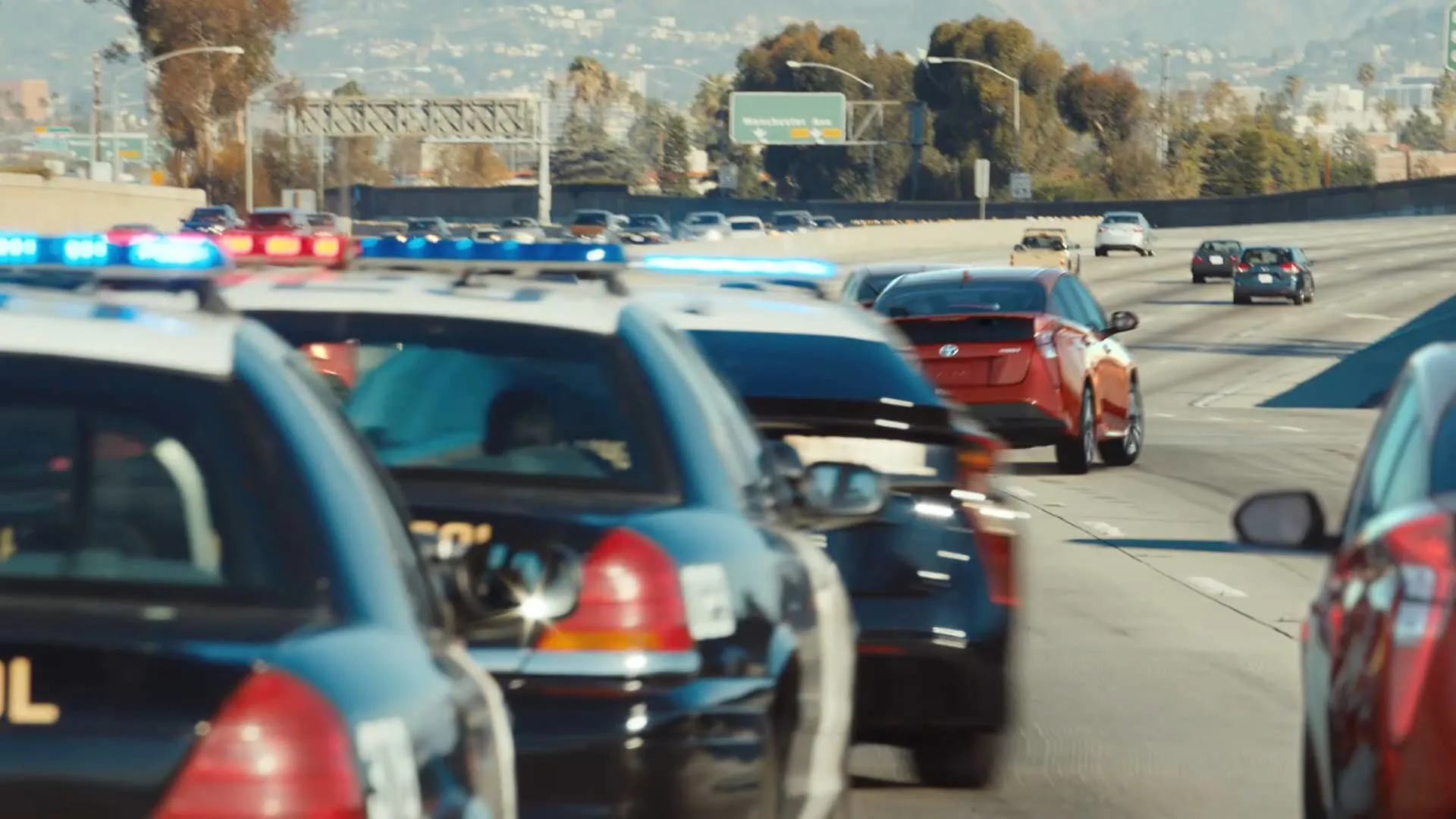
Toyota Prius “Vanished” – Super Bowl 50
- Studio
- Park Pictures
- Released
- February 6, 2016
- SCANable role
- LiDAR/3D Scanning and Modeling
- Director
- Lance Acord
- VFX vendor
- a52
Toyota’s “Vanished” Super Bowl 50 spot for the Prius is a hilarious car-chase romp about four bungling bank robbers stuck with a Prius getaway car. Created by Saatchi & Saatchi L.A. and helmed by top director Lance Acord of Park Pictures, the spot follows the “Prius 4” through a farmers’ market and onto the freeway as their getaway goes viral and the car suddenly becomes cool — packing in references to the Prius’s speed, quietness, and automatic braking along the way.
SCANable provided LiDAR/3D scanning and modeling for the spot, capturing environments to support post-production camera tracking and the commercial’s visual effects.

A chase happens along a route, not on a set
Most environment capture concerns a bounded space — a room, a stage, a building. A pursuit sequence covers a corridor of a city: a market, a stretch of street, a run of freeway, each connected to the next by continuity the audience assembles automatically.
That changes the capture plan. The work is to record a long, linear environment consistently, so geometry from one end of the sequence shares scale and orientation with geometry from the other. When a cut moves the action half a mile, the digital world has to move with it and still agree with itself.
Coverage from above where the ground cannot reach
Roadways, rooftops, overpasses, and the general shape of a route are poorly served by scanning from street level. Ground positions see facades and very little else, and the surfaces a vehicle actually travels across get recorded at a grazing angle where accuracy is worst.
Aerial photogrammetry covers what terrestrial positions cannot — road surface, roof planes, and the layout of a whole block as a single coherent dataset. Registered against ground-level scanning, it produces one continuous environment instead of a set of disconnected fragments.
Vehicle work makes the environment do the convincing
Whether a car in a given shot is practical or digital, what sells it is its relationship to the world around it: the reflections crossing the body, the shadow it casts on the road, the way the ground moves past it at the correct rate.
All three are functions of the environment being geometrically correct. Reflections need surrounding surfaces at the right distance, shadows need a road that is actually where the road was, and a matchmoved camera needs measured space to solve against. This is why environment capture is often the most valuable thing on a vehicle spot, even when the vehicle itself is the subject.
A fixed air date runs the schedule backwards
A Super Bowl spot has a delivery date that cannot move. Everything else in the schedule is calculated back from it, which means post has no room to absorb a problem that originates on the shoot.
The way to protect that is to capture completely while the locations are available and hand over data that needs no interpretation — registered, correctly scaled, and delivered as usable geometry rather than a raw cloud. Our set and location scanning is planned around that reality.
Browse more commercial work, or see everything we do.