

← Back to all work
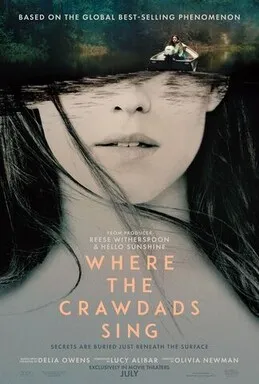
Official poster for Where the Crawdads Sing (2022) — Sony Pictures

SELECTED WORK / PRODUCTION

Where the Crawdads Sing

Studio
Sony Pictures
Released
July 14, 2022
SCANable role
3D Scanning
Director
Olivia Newman
  • Backgrounds
  • CG
  • Feature Film
  • VFX

Where the Crawdads Sing is Sony Pictures’ 2022 mystery drama based on Delia Owens’s 2018 novel, starring Daisy Edgar-Jones. Directed by Olivia Newman from a screenplay by Lucy Alibar, and produced by Reese Witherspoon and Lauren Neustadter, the film follows Kya, an abandoned yet defiant girl who raises herself to adulthood in a North Carolina marshland and becomes a naturalist — until the town’s hotshot is found dead and she stands trial as the prime suspect. Taylor John Smith, Harris Dickinson, Michael Hyatt, Sterling Macer Jr., Jojo Regina, Garret Dillahunt, Ahna O’Reilly, and David Strathairn co-star.

SCANable provided 3D scanning for the production, capturing photogrammetric data in support of the film’s visual effects and CG background work.

Beautiful is not the same as correct

A skilled environment artist can build a convincing landscape from photographs. The result is often beautiful. What it is not is correct, and on a film where the landscape is effectively a character, the difference matters.

Sculpted geometry embeds the artist’s reading of the reference — a slope interpreted a few degrees off, a bank set a metre too high, a treeline placed where it composed well rather than where it stood.

Geometry derived from photogrammetric capture carries no interpretation. It is a record of what was there, at the scale it was there, and everything built on top of it inherits that correctness rather than having to be talked into it.

Natural subjects have no repeating logic

Architecture is forgiving. Walls are flat, corners are square, and a modeller who gets one bay right can reason their way to the next.

A marsh offers none of that. Water lines, root systems, reeds, silt banks, and canopy have no modular structure to exploit and no symmetry to fall back on. Every square metre is genuinely different from every other, and an audience that has spent ninety minutes looking at real footage of that place notices immediately when a frame stops obeying its rules.

This is the case where capture is not a shortcut around modelling. It is the only method that produces the right answer at all.

What a background is actually asked to do

A CG background is rarely the subject of the shot. It is the thing that has to be unremarkable while something else happens in front of it, and that is a harder brief than being spectacular.

It has to hold at whatever focal length the day required. It has to sit at the correct distance so that depth of field falls off believably. It has to match plates shot at different times under different light.

Every one of those requirements is easier to meet when the underlying geometry is dimensionally true, and all of them get harder when it is a good guess. Delivery is finished with retopology, UV layout, and render-ready builds so the vendor receives assets shaped for the shot rather than raw capture data.

See more feature-film capture work, or browse the full list of services.