

← Back to all work
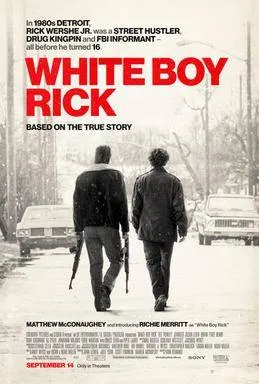
Official poster for White Boy Rick (2018) — Columbia Pictures

SELECTED WORK / PRODUCTION

White Boy Rick

Studio
Columbia Pictures
Released
September 13, 2018
SCANable role
LiDAR/3D Scanning and Modeling
Director
Yann Demange
  • CG
  • Feature Film
  • VFX

White Boy Rick is Columbia Pictures’ 2018 biographical crime drama about Richard Wershe Jr., who became the youngest FBI informant ever at age 14. Directed by Yann Demange and written by Andy Weiss with Logan and Noah Miller, the film based on a true story stars Richie Merritt alongside Matthew McConaughey, Bel Powley, Jennifer Jason Leigh, Brian Tyree Henry, Rory Cochrane, RJ Cyler, Jonathan Majors, Eddie Marsan, Bruce Dern, and Piper Laurie. It premiered at the Telluride Film Festival on August 31, 2018, was released in the United States by Sony Pictures Releasing on September 14, 2018, and grossed over $25 million to mixed reviews.

SCANable performed terrestrial LiDAR scanning and 3D modelling for the film in support of its visual effects.

Laser scanning does not depend on light

A LiDAR scanner carries its own light source and measures the return. It works in an unlit interior, at night, in a space nobody has time to relight for the benefit of a survey.

Photogrammetry cannot. It needs illumination, and it needs that illumination even enough that the same surface looks the same from every angle.

On a production working through night exteriors and dim practical interiors, that difference decides which instrument goes where. Most jobs use both — terrestrial LiDAR for volume and distance, photogrammetric capture for surface detail wherever the light allows it.

The cost of going back

The expensive part of scanning a location is rarely the scanning. It is access: permits, scheduling, travel, and the hours of a crew already committed elsewhere.

The marginal cost of one more scan position while the team is already standing there is small. The cost of returning is not. So the discipline is to over-capture: data that turns out to be unnecessary costs almost nothing, and data that turns out to be missing costs a trip, a compromise, or a shot.

Measurement, not approximation

Scanning for film borrows its methods from survey work, and it is worth being explicit about why.

A point cloud is a set of measurements with a known accuracy, taken in a defined coordinate system, and verifiable against itself. That is a different category of thing from a model that looks about right. It is what lets a visual effects team place a CG element at a real distance and a real size and know it is correct rather than judge it by eye.

The same rigour underpins our enterprise survey work, and it is what 3D scanning for film inherits.

Browse more feature film work.