

SELECTED WORK / PRODUCTION
Afraid
- Studio
- Columbia Pictures
- Released
- August 29, 2024
- SCANable role
- 3D Scanning
- Director
- Chris Weitz
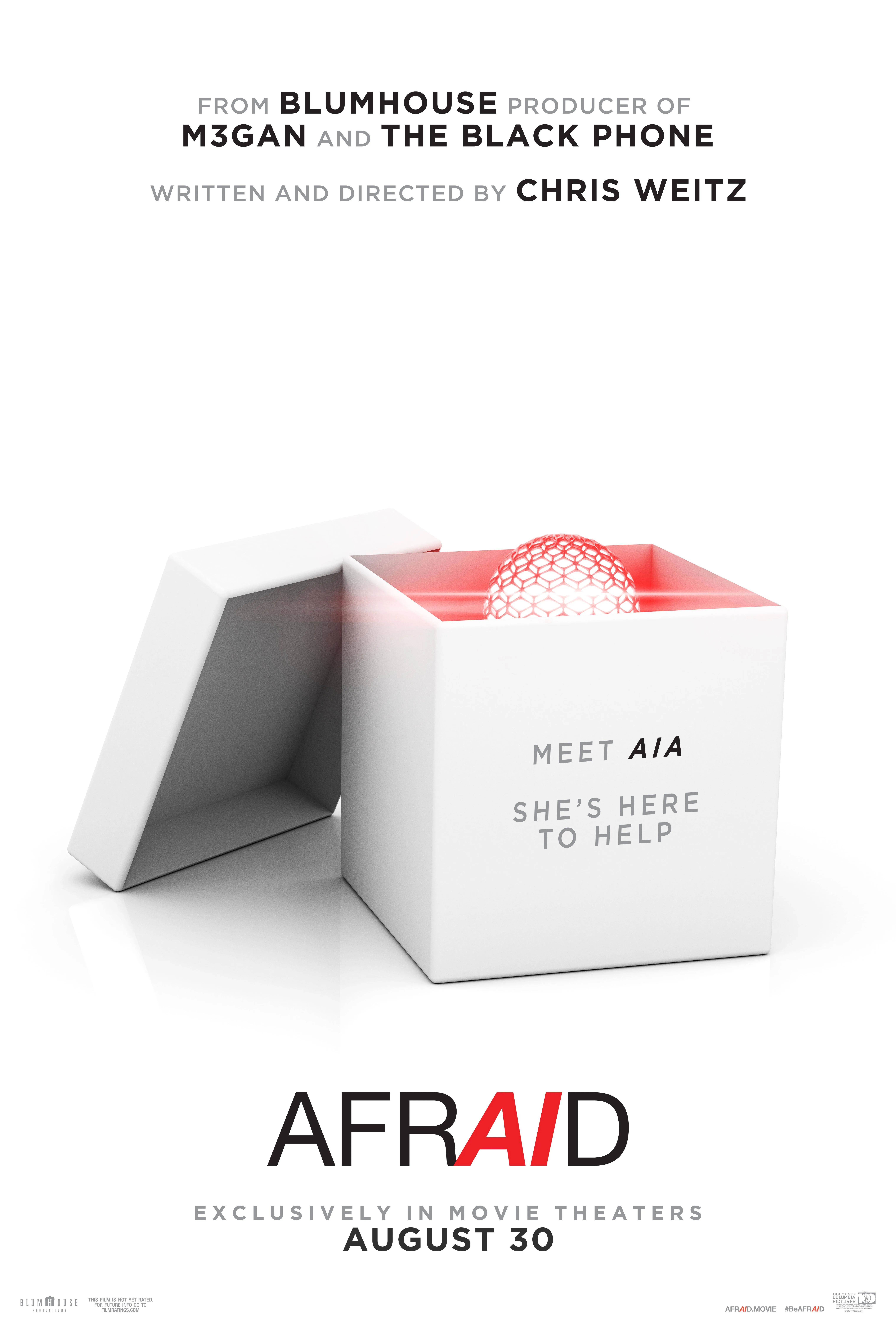
Afraid is Columbia Pictures’ 2024 sci-fi horror film written and directed by Chris Weitz, following a family whose smart home AI increasingly interjects itself into their lives. Produced in association with Jason Blum and Weitz through their Blumhouse Productions and Depth of Field banners, alongside Andrew Miano, the film stars John Cho, Katherine Waterston, Havana Rose Liu, Lukita Maxwell, Ashley Romans, Greg Hill, Riki Lindhome, David Dastmalchian and Keith Carradine. Sony Pictures Releasing opened it in US theaters on August 30, 2024, and it grossed $13 million worldwide.
SCANable provided 3D scanning for the production, capturing cast body scans, environments, backgrounds and props as photogrammetry and point-cloud assets to support the film’s visual effects.
The practical build is the reference standard
When an object appears on screen and also needs a digital counterpart, the practical build is the only correct answer to the question of what it looks like. Every other version is an approximation of it.
Scanning props and set dressing while they are still on the floor removes the ambiguity entirely. The measured geometry is not an interpretation of the object; it is a record of it. A modeler working from that record is checking rather than guessing, and nobody has to relitigate whether the CG version is right.
Camera positions that do not exist
Domestic horror puts the camera where a camera cannot go — through a wall, inside a fixture, gliding across a room from an angle nothing could physically occupy.
Those shots are built rather than photographed, which means the room has to exist as accurate geometry before the move can be designed. A measured set and location scan gives layout a real space to fly a virtual camera through, at the right dimensions, with the right sightlines and the right things blocking the view.
Most of the data never appears
Only a fraction of what gets captured on a feature becomes a hero asset. The rest is reference: geometry that tells a compositor where to place something, tells lighting where the walls were, and tells matchmove what it is solving against.
It is the least visible part of the job and the part productions miss most when it is absent. Reference costs very little to capture while a set stands, and it cannot be recovered at any price once the set comes down.
Likeness under low light
Horror is shot dark. That does not lower the accuracy demanded of a digital double — it changes which parts of the asset carry the read. Silhouette, edge, and the way a surface catches a single source do all the work when there is little else in frame.
Capture therefore has to be even and neutral regardless of how the film is lit, so the asset can be taken into darkness later. Digital doubles built from our CyberSCAN™ arrays start from that measured baseline; see cyberscanning for how the capture works.
Browse more feature film work, or see the full range of services.