

← Back to all work
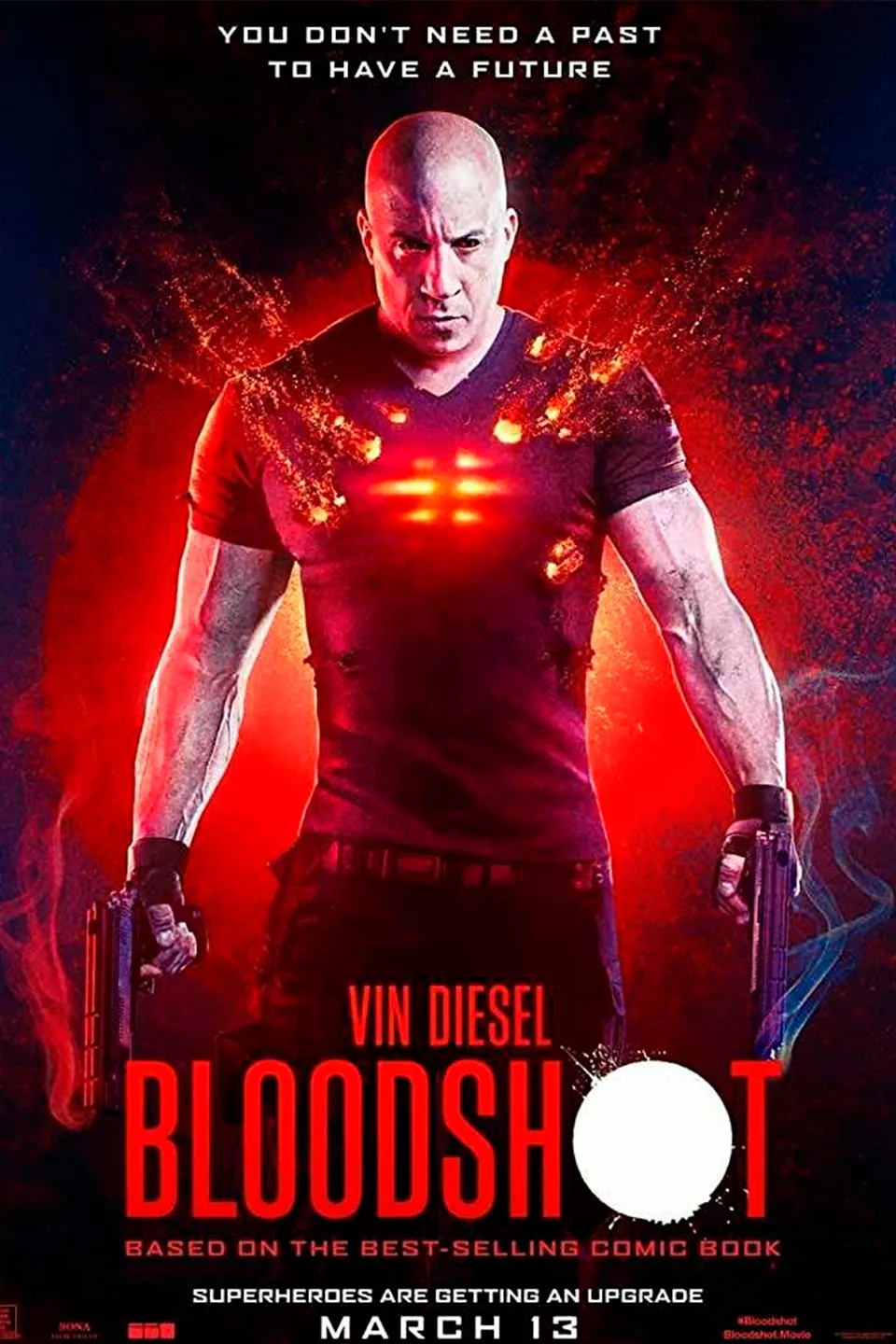
Official poster for Bloodshot (2020) starring Vin Diesel — Columbia

SELECTED WORK / PRODUCTION

Bloodshot

Studio
Columbia
Released
March 12, 2020
SCANable role
LiDAR/3D Scanning and Modeling
Director
David S. F. Wilson
  • Body Scanning
  • Feature Film
  • VFX

Bloodshot is the 2020 superhero film starring Vin Diesel as a nanotech-enhanced super-soldier, based on the Valiant Comics character of the same name. After he and his wife are suddenly assassinated, Marine Ray Garrison is reborn by a team of scientists and enhanced with nanotechnology into a superhuman, biotech killing machine. When his memories flood back and he remembers the man who killed them both, he breaks out of the facility hellbent on revenge — only to discover there’s more to the conspiracy than he thought. Directed by David S. F. Wilson in his feature directorial debut from a screenplay by Jeff Wadlow and Eric Heisserer, and intended as the first installment in a Valiant Comics shared cinematic universe, the film also stars Eiza González, Sam Heughan, Toby Kebbell and Guy Pearce. Sony Pictures Releasing opened it in US theaters on March 13, 2020.

SCANable provided LiDAR and 3D scanning with modeling for the production, including full-body photogrammetric capture to support the film’s visual effects work.

Stylized transformation still starts from a real body

A character who regenerates, dissolves, or rebuilds himself is a fully CG proposition in the moments it happens. What decides whether those moments land is the state the character returns to.

If the restored body is a modeler’s interpretation of the performer, every transformation reads as a cut to a different actor. If it is the performer, measured, the effect reads as something happening to him.

That is why the most heavily stylized character work depends on the least stylized capture. The invented material is anchored to a body the audience has already accepted, which is what digital doubles built from real geometry provide.

Action a body could not survive

Action of this kind generates coverage no human can perform: impacts at speeds that would injure, falls from heights that are not survivable, and sequences staged in environments that were never built.

Those shots are cut directly against live-action coverage of the same character, often within the same second of screen time. The double has to withstand that comparison at full frame rate, in the same lighting, from the same lens.

A capture that is dimensionally correct — height, mass distribution, limb proportion, silhouette — gives the animation and simulation departments something they can drive hard without it deforming into a different person.

What a full-body scan actually has to contain

Likeness is not just the face. A performer is recognizable by shoulder line, stance, the way weight sits, and the specific proportion of torso to limb. Get the head right and the body wrong and the shot still fails, just more slowly.

Simultaneous array capture records the whole subject in one instant, so the pose is internally consistent and nothing has to be reconciled between passes. That approach is the foundation of cyberscanning, and our Mobile CyberSCAN™ Studios deploy it on location so leads are scanned between setups rather than on a separate travel day.

Everything ships after retopology and render-ready preparation.

See more film scanning work, or look through the full service list.