← Back to all work
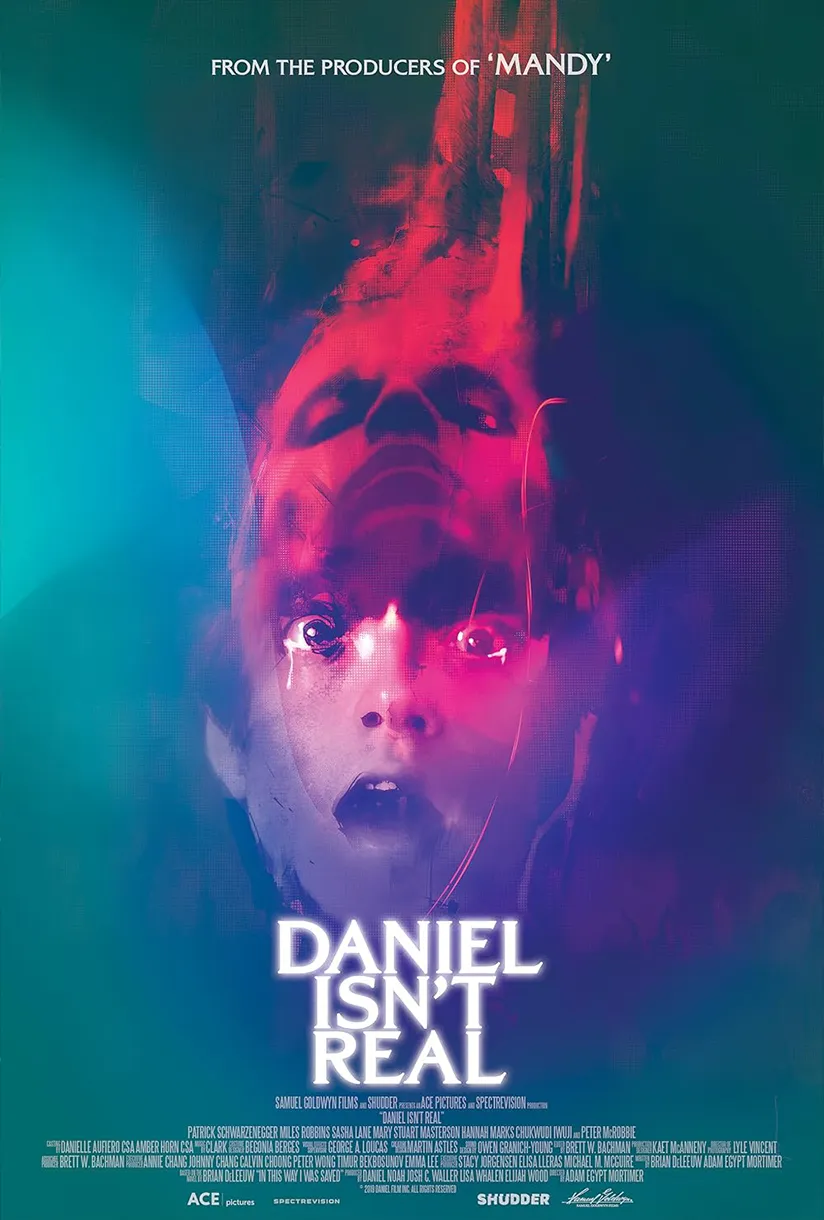
Official poster for Daniel Isn’t Real (2019) — SpectreVision thriller

SELECTED WORK / PRODUCTION

Daniel Isn’t Real

Studio
SpectreVision
Released
December 5, 2019
SCANable role
LiDAR/3D Body Scanning
Director
Adam Egypt Mortimer
  • Body Scanning
  • Feature Film
  • VFX

Daniel Isn’t Real is a 2019 American thriller from SpectreVision, directed by Adam Egypt Mortimer from a screenplay by Mortimer and Brian DeLeeuw. Based on DeLeeuw’s novel In This Way I Was Saved, the film stars Miles Robbins, Patrick Schwarzenegger, Sasha Lane, Mary Stuart Masterson, and Hannah Marks, and had its world premiere at South by Southwest on March 9, 2019.

SCANable performed LiDAR and 3D actor scanning for the film, capturing the cast in high resolution to support the production’s visual effects with accurate digital doubles built from photogrammetric capture.

Building a second character on a real body

A film whose antagonist is a person only one character can see puts unusual weight on physical credibility. Whatever is added has to look like it occupies the same room, under the same lens, as the performer standing next to it.

That is why stylized and impossible characters are so often built on measured human geometry. A real body carries proportion, asymmetry, and surface behaviour that nobody invents convincingly from scratch. Departing from it is then a design decision rather than an accident.

Measured geometry against sculpted geometry

A modeller working from photographs is interpreting. A full-body scan is a measurement.

The difference shows up in the places an artist would not think to check — how a shoulder sits when the arm hangs, the exact volume of a jaw, the small asymmetry between the two sides of a face. Audiences do not identify those things consciously. They notice when they are wrong.

Photogrammetric capture removes that entire class of error before an asset reaches an artist. What follows — scan cleanup, retopology, texturing — becomes craft applied to correct data rather than craft compensating for guesswork.

Capture now, decide later

Scanning happens while a film is shooting. The effects work is designed in detail afterwards.

That sequencing is the argument for capturing more than the current shot list requires. A cast member scanned during production stays available to the pipeline for the rest of post. A cast member who was not becomes a reshoot request, a schedule problem, or a compromise on screen.

Our Mobile CyberSCAN™ Studios exist for that reason — the array travels to the production, so a scan costs a slot in the day rather than a travel day. Everything ships after retopology, UV layout, and render-ready builds.

Browse more film scanning work, or read how cyberscanning works.