

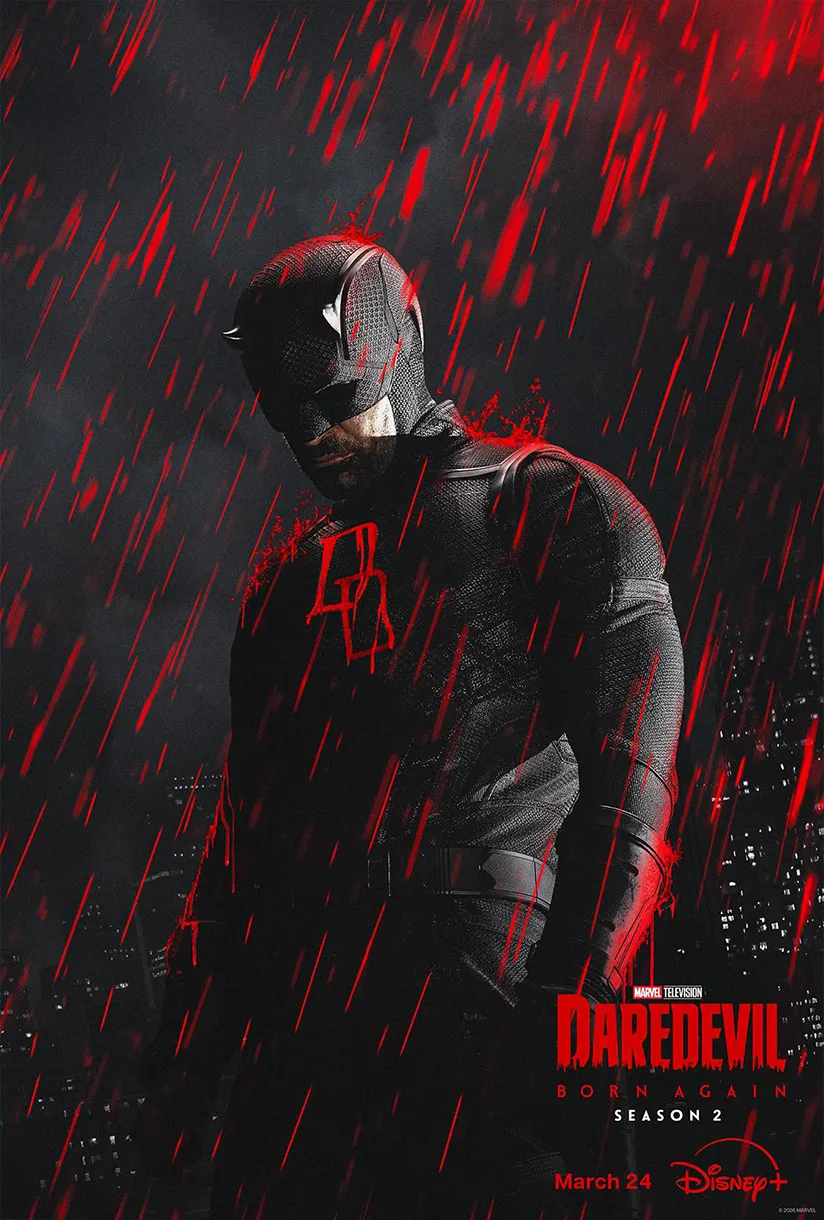
SELECTED WORK / PRODUCTION
Daredevil: Born Again S2
- Studio
- Disney+
- Released
- March 23, 2026
- SCANable role
- 3D Scanning
Daredevil: Born Again Season 2 is Marvel Television’s Disney+ series continuing Matt Murdock’s fight against Wilson Fisk, which premiered in March 2026. Based on the Marvel Comics character Daredevil, the season sees the blind vigilante gathering allies to resist Fisk — now mayor of New York City — and his Anti-Vigilante Task Force. Set in the Marvel Cinematic Universe and sharing continuity with the franchise’s films and series, Born Again is a revival and continuation of Marvel Television and Netflix’s Daredevil (2015–2018), produced by Marvel Studios under its Marvel Television label with Dario Scardapane as showrunner and Justin Benson and Aaron Moorhead as lead directors.
SCANable was responsible for scanning props, characters, vehicles, and sets for the season, providing the high-resolution 3D scanning and photogrammetric capture data behind digital doubles, set extensions, and seamless visual effects work.
One city, assembled from several places
A season set in a single city is almost never shot in a single place. Exteriors, interiors, and stage builds come from different addresses, and the audience is asked to read them as one continuous world.
That illusion is maintained in the data. When every location, prop, and performer is captured into the same coordinate convention at the same scale, an asset from one shooting unit drops into a shot from another with nothing to reconcile.
When they are not, someone in post spends the season converting between conventions, and every conversion is an opportunity for a set to end up subtly the wrong size. Consistency at capture time is cheaper than consistency enforced afterward.
Stylized characters built on real bodies
A costumed character is not a creature invented from nothing. It is a specific performer, in a specific suit, moving a specific way.
Building that asset outward from a scan of the actual actor in the actual costume preserves the things an audience recognizes without being able to name them: the proportions of the body underneath, how the suit sits at the shoulder, where it creases when the figure turns.
The alternative — sculpting an idealized version and hoping it intercuts — produces a double that looks correct in a turntable and wrong the moment it is placed beside real coverage of the same character. Digital doubles are held to the second standard, not the first.
Props and vehicles the camera gets close to
Hero props are handled, examined, and photographed at close range. Picture vehicles appear practically in one shot and digitally in the next.
Both are objects the audience has already seen in detail, which means the digital version cannot be an approximation. Scanning the practical article captures its real proportions and surface, so the CG version is the same object rather than a resemblance of it.
Vehicles add their own difficulty. Gloss paint, chrome, and glass return unreliable data to most capture methods, and getting usable geometry off them is a matter of technique rather than equipment.
Capture that keeps pace with the season
Episodic production does not pause for data collection. Our Mobile CyberSCAN™ Studios go to the unit, so cast can be captured in costume between setups and sets can be scanned before strike.
Everything is delivered after retopology, texturing, and render-ready builds. The cyberscanning page explains how the simultaneous-array capture works.
Related series and television work sits in the portfolio, and the full service list explains the methods behind it.