

← Back to all work
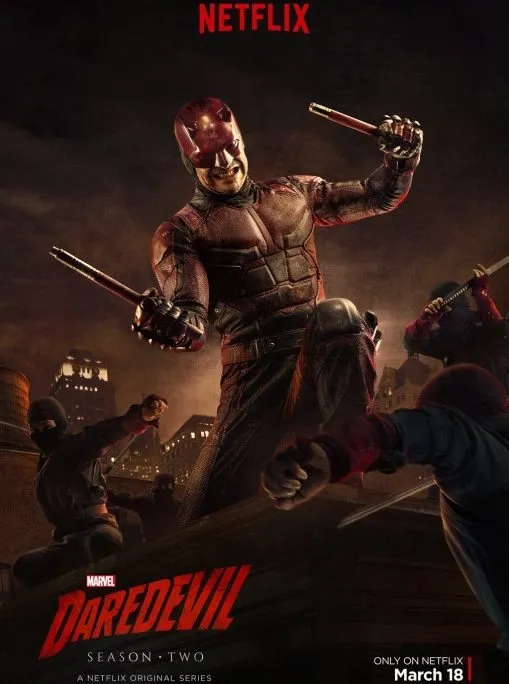
Poster for Marvel’s Daredevil Season 2 (2016) — Netflix series

SELECTED WORK / PRODUCTION

Daredevil Season 2

Studio
ABC Studios & Marvel Entertainment
Released
March 17, 2016
SCANable role
3D Scanning
VFX vendor
Shade VFX
  • Body Scanning
  • CG
  • Camera Tracking
  • Crowd Placement
  • Environments
  • Face Replacement
  • Point Cloud
  • Props
  • Set Extension
  • Shadows
  • Television
  • VFX

Daredevil Season 2 is the 2016 Netflix series pitting Matt Murdock against Frank Castle, reborn as The Punisher, and old flame Elektra Natchios. Just as Matt believes he is bringing order back to Hell’s Kitchen, new forces rise: Castle, a man seeking vengeance who takes justice into his own hands, and Elektra’s dangerous return. Matt must balance his duty to his community as a lawyer with his life as the Devil of Hell’s Kitchen, facing a life-altering choice that forces him to understand what it truly means to be a hero.

SCANable again partnered with visual effects company Shade VFX, providing 3D scans of several sets and actors, including Charlie Cox (Matt Murdock / Daredevil), Peter Shinkoda (Nobu), Vincent D’Onofrio (Wilson Fisk), Scott Glenn (Stick), Rosario Dawson (Claire Temple), Deborah Ann Woll (Karen Page), Tom Walker (Francis), and Toby Leonard Moore (James Wesley). The set scans were used for camera tracking and matchmoving, while the actor scans supported additional VFX shots.

Face replacement is the hardest test a scan faces

Most digital doubles are asked to work at distance, in motion, or partly obscured. Face replacement is the exception. It puts scanned geometry directly next to the performer’s own coverage, at the size the audience is already studying.

There is no forgiving margin. Proportion, the set of the jaw, the way the brow sits over the eye — all of it is checked by every viewer automatically, whether they can name what is wrong or not.

That standard is set at capture. A likeness that is soft or subtly distorted cannot be recovered by a modeller downstream, which is why digital doubles begin as measurements rather than sculpts.

Shadows are geometry before they are light

A CG element that does not interact with its surroundings reads as a sticker. The interaction is mostly shadow: what the element occludes, what occludes it, and how the shadow bends across the real surfaces it lands on.

Producing that correctly requires the surrounding geometry, not just a plate. A shadow cast onto approximated floor and wall geometry will fall at the wrong angle or break at the wrong edge.

Point cloud data from the actual set gives the lighting artist real surfaces to cast onto, which is often the difference between an element sitting in the frame and hovering in front of it.

Set extension where the practical build stops

Practical sets end where the budget ends. Hell’s Kitchen exteriors, rooftops and stairwells all extend beyond what was constructed, and the join has to be invisible.

Extensions modelled outward from measured geometry match at the seam because they share the built set’s exact dimensions rather than an estimate of them. Our set and location scanning supplies that dimensional record.

One location, months of shooting, several vendors

Episodic work spreads a single location across months of shooting, multiple directors and several vendors. A set may be dressed differently, lit differently, or partially rebuilt between blocks.

An accurate scan taken once becomes the fixed reference all of those passes agree with. Without it, each episode reconstructs the space slightly differently, and the world drifts across the season in ways nobody can point to but everybody feels.

See more television work, or browse the full range of services.