← Back to all work
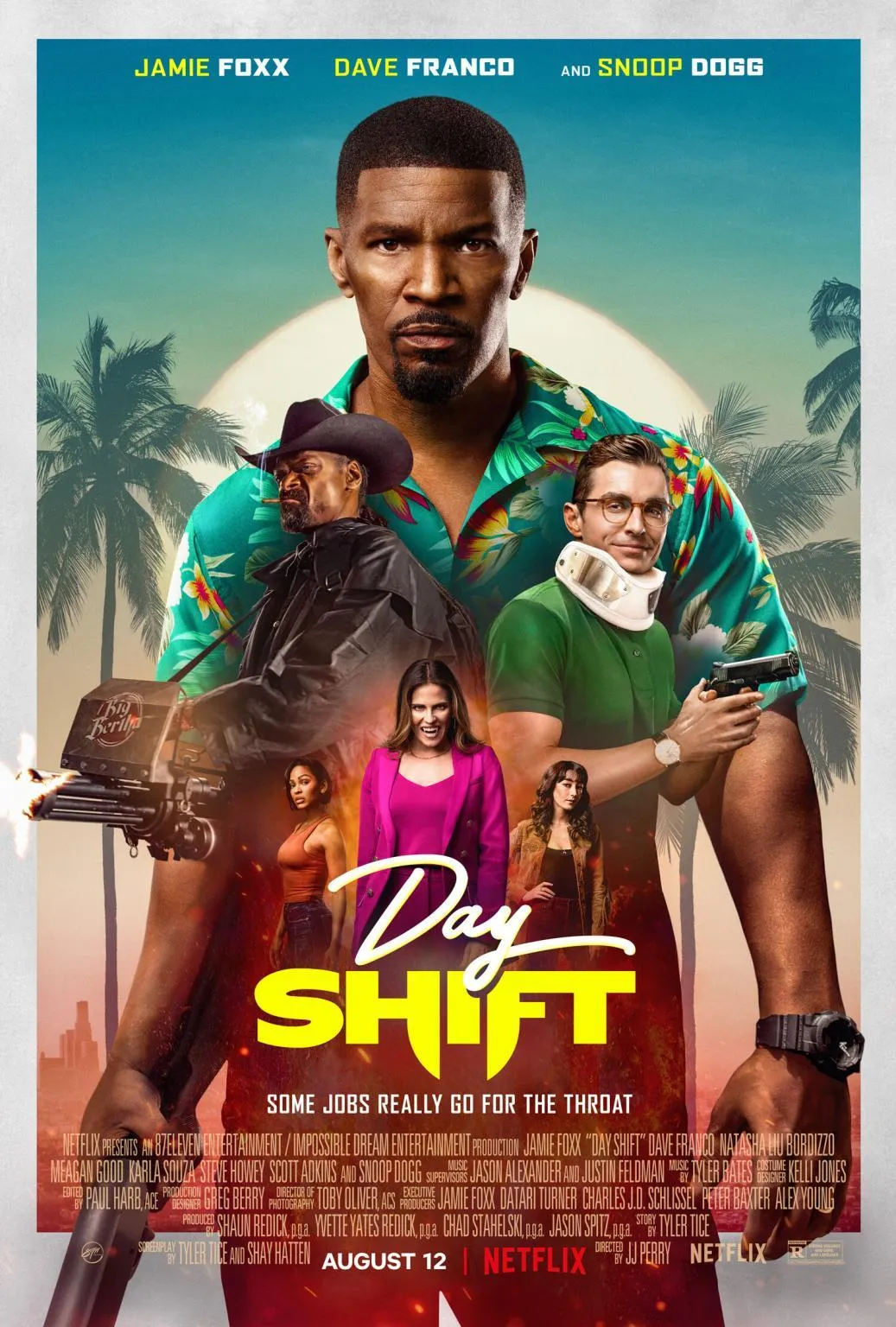
Official poster for Day Shift (2022) — Netflix film directed by J.J. Perry

SELECTED WORK / PRODUCTION

Day Shift

Studio
Netflix
Released
August 11, 2022
SCANable role
3D Scanning
Director
J.J. Perry
  • Body Scanning
  • CG
  • Feature Film
  • Point Cloud
  • Set Extension
  • VFX

Day Shift is a 2022 Netflix feature film directed by J.J. Perry, which premiered on the streaming platform on August 12, 2022.

SCANable provided LiDAR and 3D laser scanning of several sets, delivering point-cloud data used for camera tracking and matchmoving, along with 3D body scans of actors used for additional visual effects. The combination of accurate environment capture and digital-double-ready talent capture gave the film’s VFX team a reliable 3D foundation for set extensions and CG work throughout the production.


A matchmove is only as good as the room

Camera tracking solves for where the lens was and how it moved. Software can infer a great deal of that from the plate alone, and on a clean, feature-rich, slowly moving shot it will often get there.

Action photography is not that shot. Handheld coverage, motion blur, hard practical lighting, reflective surfaces, and long lenses all strip away the features a solver depends on, and a solve that has run out of information does not fail loudly — it drifts.

Handing the matchmove team a measured scan of the actual set changes the problem. Instead of inferring the geometry and the camera at the same time, they already know the geometry and only have to solve the camera. The track locks, and it stays locked through the parts of the shot where the plate stops helping.

One dataset, two departments

The same environment scan that stabilises a track is also the geometry the set-extension work is built on, and that overlap is not incidental — it is what keeps a shot internally consistent.

When tracking and extension are derived from separate approximations of the same space, small disagreements between them surface as sliding: the added element is correct in one frame and marginally wrong in the next.

When both come from a single measured source, the added element is locked to the same coordinates the camera was solved against. It cannot slide relative to the plate, because there is nothing for it to slide against.

Why every camera fires at the same instant

Body scanning has a quieter failure mode. A capture method that sweeps across a subject, or that takes several passes to cover it, is recording a person who is still breathing and still making micro-adjustments.

The result is not obviously broken. It is slightly soft in exactly the places likeness lives — the set of the jaw, the corners of the eyes, the line of the shoulders — and every hour of cleanup spent recovering that detail erodes it further.

Our arrays trigger every camera simultaneously, so the subject is frozen in a single instant and there is nothing to reconcile. That is the core of cyberscanning as a method, and it is what makes the resulting digital doubles intercut with the real coverage instead of standing out from it.

Browse more feature-film capture work, or see everything we offer.