

← Back to all work
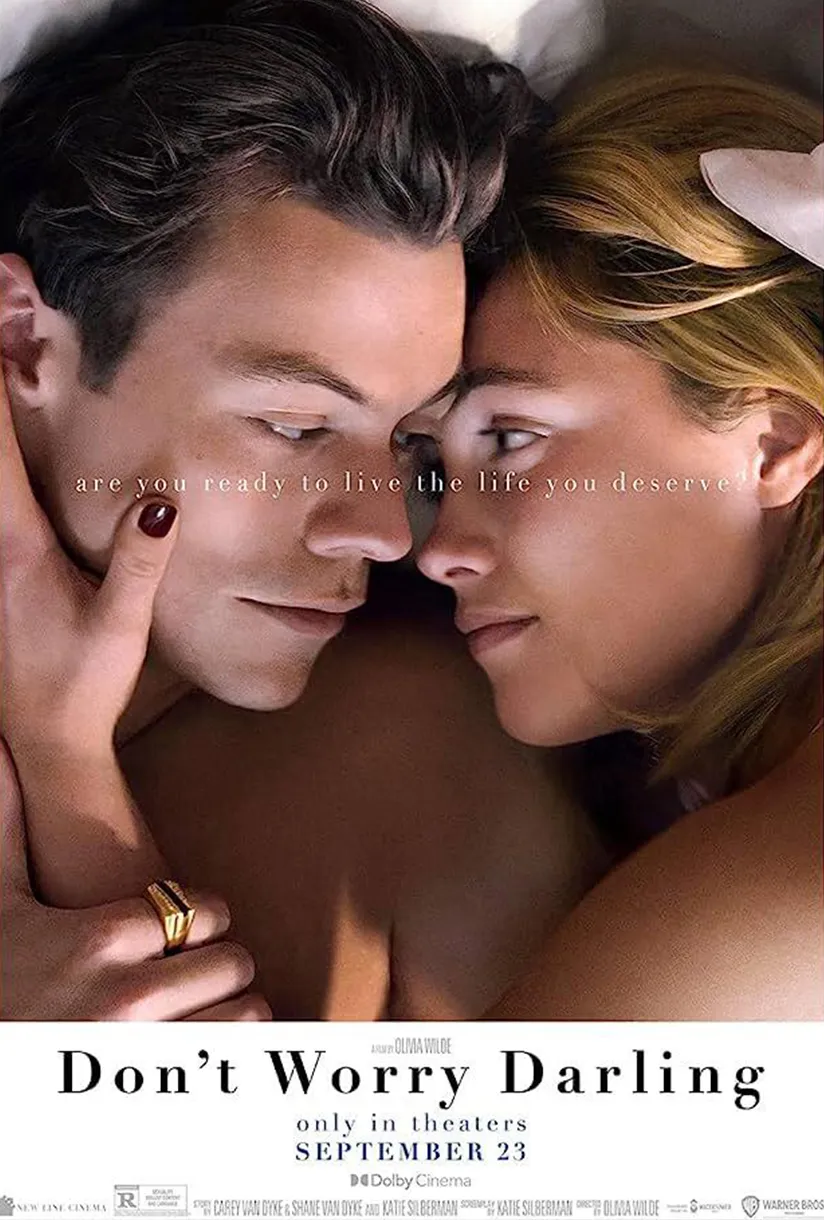
Official poster for Don’t Worry Darling (2022) — Warner Bros. film directed by Olivia Wilde

SELECTED WORK / PRODUCTION

Don’t Worry Darling

Studio
Warner Bros.
Released
September 22, 2022
SCANable role
3D Scanning
Director
Olivia Wilde
  • Backgrounds
  • Body Scanning
  • CG
  • Feature Film
  • Props
  • VFX

Don’t Worry Darling is a 2022 psychological thriller directed by Olivia Wilde and starring Florence Pugh, released theatrically by Warner Bros. Pictures. Written by Katie Silberman from a story by Carey Van Dyke, Shane Van Dyke, and Silberman, the film also stars Harry Styles, Wilde, Gemma Chan, KiKi Layne, Nick Kroll, and Chris Pine, following a housewife in an idyllic company town who begins to suspect a sinister secret kept by the man who runs it. After premiering at the 79th Venice International Film Festival, it opened in the United States on September 23, 2022, grossing $87 million on a $35 million budget, with critics praising Pugh’s performance, the cinematography, and the production design.

SCANable provided 3D scanning for the production, capturing cast members and props as high-resolution photogrammetric data to support the film’s visual effects team with digital doubles and CG asset work.

A period silhouette is a shape, not a surface

A period silhouette is not a surface treatment. A full skirt, a structured shoulder, a cinched waist — those are shapes with volume, weight, and a way of falling that a modeled approximation gets subtly wrong.

Capturing a performer in costume records the garment as it actually sits on that body, with the drape the costume department built and the fitting produced. The fold pattern is real because it was measured, not authored.

That shows up immediately in a wide shot. A digital double in a sculpted costume reads as a figure wearing a shape; one built from a full-body scan in wardrobe reads as the person the audience just watched in close-up.

The look only exists on the day

Hair, makeup, and styling are set for a shooting block and then reset. The exact state of a character on a given day of photography is not reproducible later from stills.

A scan taken between setups records that state in three dimensions — the hairline as dressed, the makeup as applied, the costume as worn. It is the closest thing a production gets to freezing a look.

Our Mobile CyberSCAN™ Studios exist for this reason. They deploy to the production, so capture fits into the day rather than competing with it.

A controlled world is unforgiving of approximation

A film built on precise production design sets a high floor. Every surface, colour, and line has been deliberately chosen, and the audience is trained to read that world as consistent.

Anything added in CG has to obey the same rules, and sits correctly only if the measured elements it attaches to are accurate to begin with.

Approximation survives in chaotic frames. It does not survive in composed, symmetrical, deliberately ordered ones.

Reference data is most of the job

Not every capture becomes a hero asset. A large share of scan data on a feature exists so that something else can be placed, scaled, tracked, or lit correctly.

Props scanned on set become the dimensional truth for any digital duplicate or replacement. Cast scans become the fit reference for anything that has to interact with a performer.

Everything ships after retopology, UV layout, and render-ready builds — assets a vendor can use rather than raw data it has to rescue.

See more feature film projects, or read about how cyberscanning works.