

SELECTED WORK / PRODUCTION
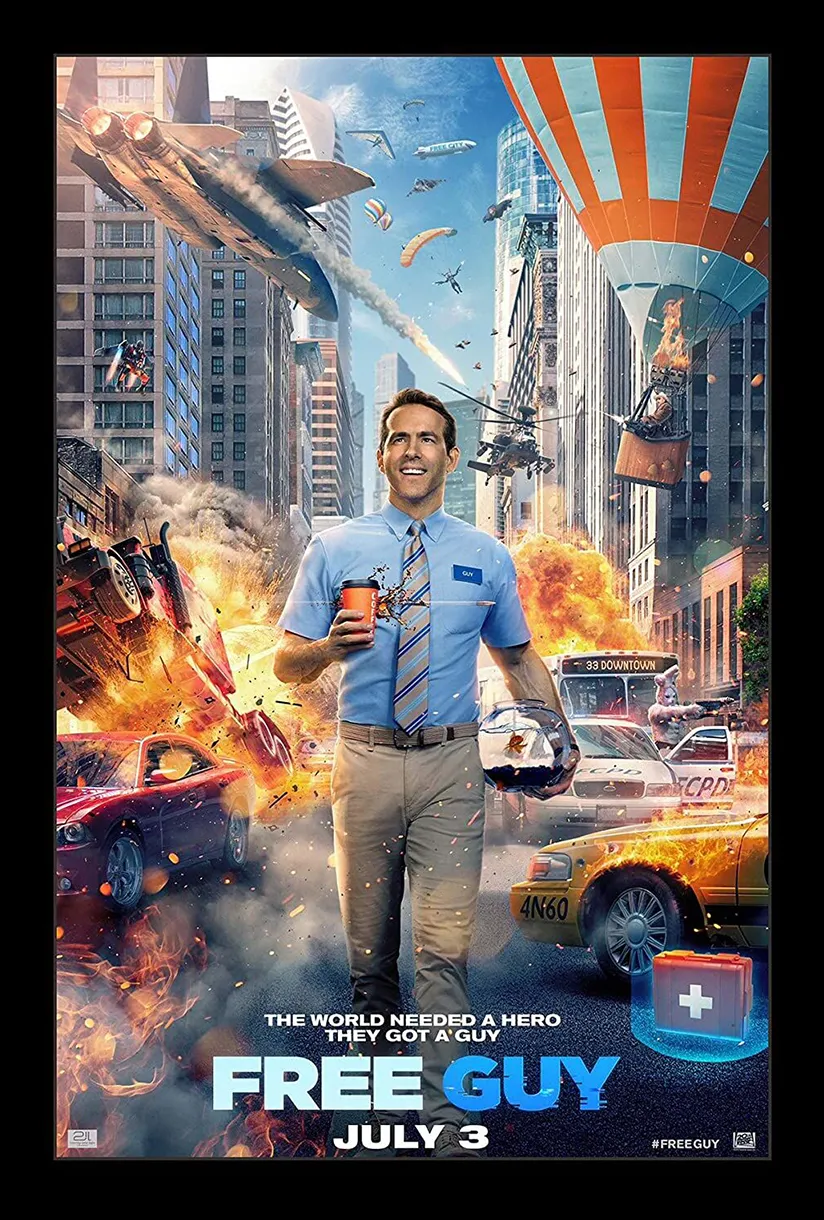
Free Guy
- Studio
- 20th Century Studios
- Released
- August 12, 2021
- SCANable role
- 3D Scanning
- Director
- Shawn Levy
Free Guy is a 2021 action comedy from 20th Century Studios starring Ryan Reynolds as a man who discovers he is a non-player character in an online game. Directed and produced by Shawn Levy from a screenplay by Matt Lieberman and Zak Penn, the film also stars Jodie Comer, Lil Rel Howery, Utkarsh Ambudkar, Joe Keery, and Taika Waititi, as Reynolds’ character partners with a real player to find evidence that a gaming company’s CEO stole the player’s source code. Free Guy was released in the United States on August 13, 2021.
SCANable provided 3D scanning for the production, capturing cast members as high-resolution body scans. Our photogrammetry data supported the film’s visual effects teams with digital doubles and CG character work for its game-world spectacle.
A film where the CG character is the lead
Most films use digital doubles for shots the actor cannot be in. This one is built on a premise where the digital version of a person is part of the subject matter — a character discovering he exists inside a game.
That changes the requirement. The double is not a background element the audience glances past; it is carrying scenes. It has to hold up in close coverage, under scrutiny, next to plate photography of the same performer.
Digital doubles at that standard start from measured capture rather than a sculpt. Geometry derived from the actual body is the only version that intercuts.
Comedy raises the bar rather than lowering it
There is an assumption that a light-toned film is forgiving of imperfect effects. The opposite is true in one specific way: comedy depends on timing and on the audience staying with the performance.
A digital character that reads as slightly wrong pulls a viewer out of the moment, and a viewer who has been pulled out does not laugh. Photorealism is what keeps the joke intact.
Capturing an ensemble
A cast of this size, on a compressed schedule, cannot travel to a fixed scanning facility one at a time. The economics do not work and the schedule does not permit it.
Our Mobile CyberSCAN™ Studios deploy to the production, so an actor steps out of a scene, scans in full wardrobe and makeup, and steps back in. What the VFX team receives is the character as photographed rather than a body that then has to be dressed digitally.
Why every camera fires at once
A capture method that sweeps around a subject, or takes several passes, requires the person to hold perfectly still for the duration. Human beings cannot. They breathe. They settle. They shift a shoulder.
That motion becomes soft or doubled geometry, usually around the features that carry the most likeness. Repairing it by hand is precisely where a face stops looking like that person.
A single instantaneous capture eliminates the problem rather than correcting for it. That is what cyberscanning means as a technique, and it is why the resulting assets need so little cleanup.
Game-world environments and CG spectacle
A film set substantially inside a rendered world puts an unusual proportion of its running time in CG environments. In those shots the performer — real or digital — is the element the audience uses to judge whether anything is real.
That makes character capture the load-bearing part of the effects program. Everything else can be stylized; the human cannot.
Scan data ships through in-house retopology, texturing, and render-ready asset builds, scaled and named to the production’s convention. For shows needing relightable assets that survive extreme lighting changes, our photometric and OLAT capture goes further.
The portfolio holds further film scanning work; the full service list sets out what else we do.