

SELECTED WORK / PRODUCTION
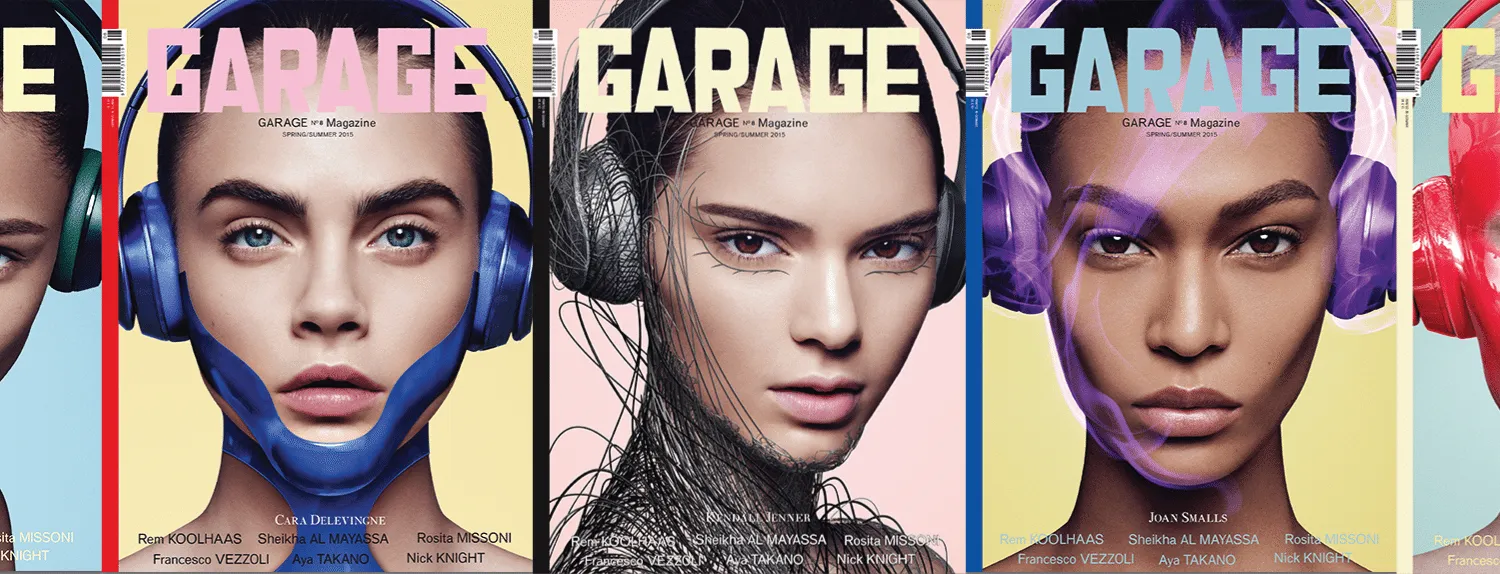
Garage Magazine Spring/Summer No. 8 [Augmented Reality]
- Studio
- Chaos Fashion
- Released
- February 10, 2015
- SCANable role
- 3D Scanning
- VFX vendor
- The Mill
Garage Magazine’s Spring/Summer No. 8 is a 2015 issue with augmented reality covers that made its five supermodel cover stars leap off the page. Viewed through the Garage app, the covers animated with sound by Alex da Kid, blending makeup artistry by Pat McGrath with visual effects by The Mill, while inside the book an AR fashion editorial shot by Nick Knight — conceived with fashion director Charlotte Stockdale — hid three-minute films behind the page. A limited-edition cover featured a bust of Karen Elson, carved in Carrara marble from a 3D scan and “restored” to classical color by artist Francesco Vezzoli.
SCANable provided the 3D body scanning behind the issue, capturing Cara Delevingne, Kendall Jenner, Joan Smalls, Lara Stone, Binx Walton, and Karen Elson. Our photogrammetric capture gave The Mill and the magazine’s collaborators accurate digital doubles for the animated covers and the sculpted Elson bust.
From scan data to carved marble
Most scans end up in a renderer. A few end up back in the physical world.
A bust cut from a 3D scan is a fundamentally different delivery problem. There is no shader to hide behind and no compositing pass to soften a mistake — the geometry is the finished object, cut once, in a material that does not permit revision.
That raises the standard for the surface itself. Holes, spikes and reconstruction artefacts that would sit invisibly under a texture map become defects in stone. Scan cleanup and render-ready modelling is the step between a raw capture and something a machine can be trusted to cut.
Augmented reality has a real-time budget
A print cover is a fixed image with effectively unlimited render time behind it. An AR cover is a real-time scene running on whatever phone the reader happens to be holding.
Everything about the asset changes under that constraint. Polygon counts have to come down without the silhouette shifting, texture resolution has to fit in memory, and the model has to survive being drawn dozens of times a second rather than once overnight.
Building for real time is a discipline shared with virtual production: the geometry has to be accurate and cheap simultaneously, and those two requirements pull against each other.
Likeness has to survive print and animation
A recognisable face is a hard target. A famous one is harder still.
The tolerance for error is set by the audience’s familiarity with the subject, not by the resolution of the output. Readers who know a face from a hundred photographs will detect a wrong nose bridge or a jaw a few millimetres too wide, even in a heavily stylised treatment, and even at thumbnail size on a phone.
Measured capture is the only dependable defence. A digital double built from scan data starts from the person’s actual proportions instead of from an artist’s reading of a reference photograph.
Browse more fashion and augmented reality work, or read how CyberSCAN™ capture works.
SELECTED WORK / GALLERY