

← Back to all work
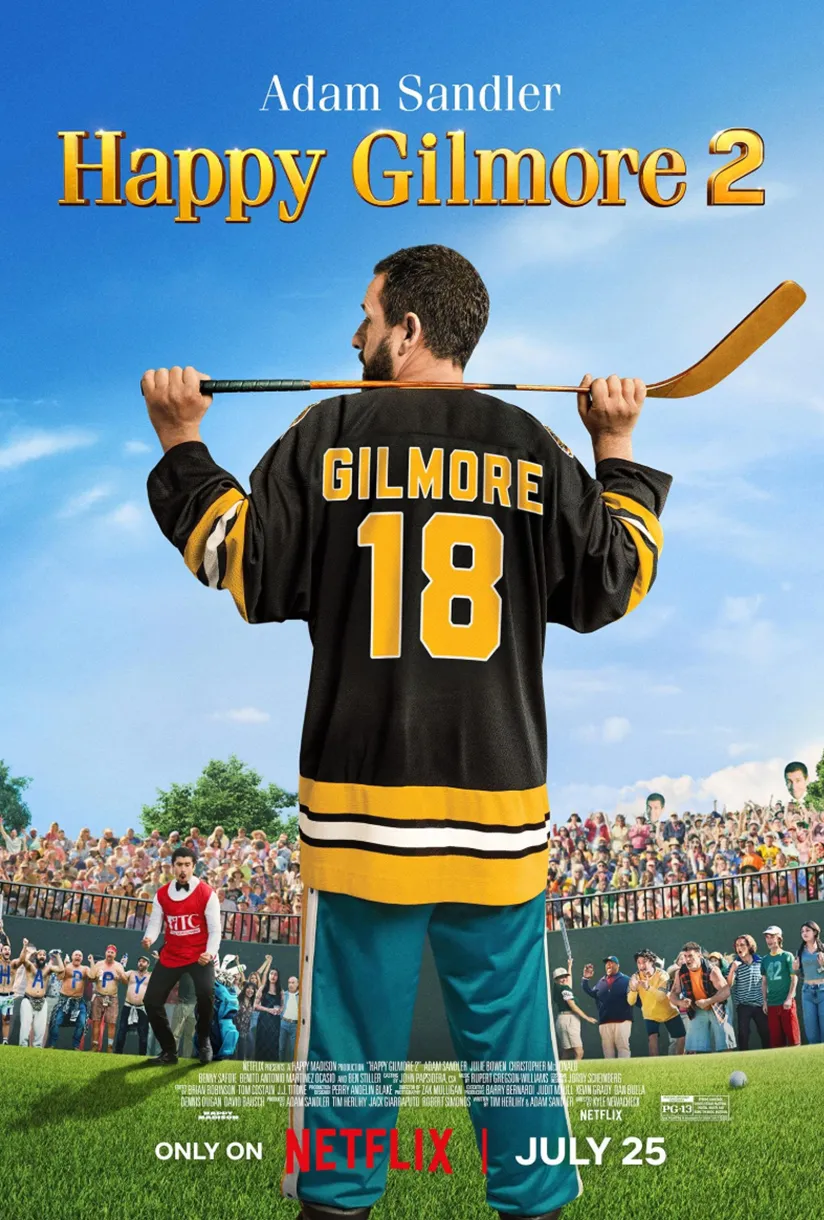
Official poster for Happy Gilmore 2 (2025) on Netflix

SELECTED WORK / PRODUCTION

Happy Gilmore 2

Studio
Netflix
Released
July 24, 2025
SCANable role
3D Scanning
Director
Kyle Newacheck
  • Aerial Photogrammetry
  • Backgrounds
  • Body Scanning
  • CG
  • Environments
  • Feature Film
  • Point Cloud
  • Props
  • VFX

Happy Gilmore 2 (2025) is Netflix’s comedy sequel that brings the beloved world of Happy back to life with practical golf stunts and subtle visual effects. Directed by Kyle Newacheck, the film blends practical stunts with digital enhancements that amplify comedic timing, exaggerate physics-defying trick shots, and digitally de-age select characters for flashback sequences. Seamless crowd replication during high-stakes tournaments and digitally recreated golf course environments elevate the film’s nostalgic charm while pushing its slapstick humor to new creative heights — a visually polished comedy that honors the original while embracing modern filmmaking techniques.

SCANable provided location scanning, full-body and prop capture, and aerial photogrammetry for the sequel, delivering registered point-cloud and photogrammetric data the visual effects team used to build backgrounds and digital environments.

Hundreds of acres, one tripod at a time

A golf course is not a set. It is hundreds of acres of rolling ground, tree lines, water, and sightlines that run to the horizon.

Terrestrial LiDAR is the right instrument for that landscape up to a point. From a tripod, every scan position sees the world from roughly human height, and a rise in the fairway hides everything behind it. Adding positions helps, but the far side of a course is a long walk from the near side.

Aerial photogrammetry covers what the ground cannot — fairway contour, bunker edges, cart paths, and canopy read cleanly from above. Flown and terrestrial data registered into one coordinate space describe a landscape a camera can move through freely. Aerial photogrammetry and set and location scanning get planned together for exactly this reason.

Galleries built from people who were really there

Digital crowds fail on repetition. An audience will not count figures, but it notices when the same silhouette appears four times in a row along a rope line.

Scanning real background performers gives a crowd system genuine variety — actual human proportion, actual weight distribution, actual clothing that hangs the way fabric hangs. The system then places and animates bodies that were measured rather than modeled, which is what keeps a tournament gallery from reading as wallpaper.

Those captures are the same digital doubles pipeline used for principals, run at volume.

The audience has already seen the real one

Clubs, bags, carts, and signage all appear practically somewhere in the film before they appear digitally. The audience has already been shown the real object, at close range, in good light.

A CG duplicate therefore has a fixed target it must hit. Photogrammetric capture of the practical item removes the guesswork: correct proportions, correct wear, correct surface. Everything ships after retopology, texturing, and render-ready builds, scaled and named to the production’s convention.

Comedy runs on effects nobody notices

Physical comedy is a timing discipline. A gag lands in a specific number of frames, and anything that pulls attention to the mechanics of the shot costs the laugh.

An exaggerated trick shot works only if the ball travels through a space that is dimensionally true — correct distances, correct ground plane, correct relationship between the swing and where the ball lands. Measured environment data is what lets the impossible part of the shot sit inside a believable one.

More feature film projects is in the portfolio, or see the full service list.