

SELECTED WORK / PRODUCTION
Jack Daniels Virtual Reality Experience
- Studio
- Mill+
- Released
- July 12, 2016
- SCANable role
- LiDAR/3D Scanning and Modeling
- Director
- Bowe King, Rama Allen
- VFX vendor
- The Mill
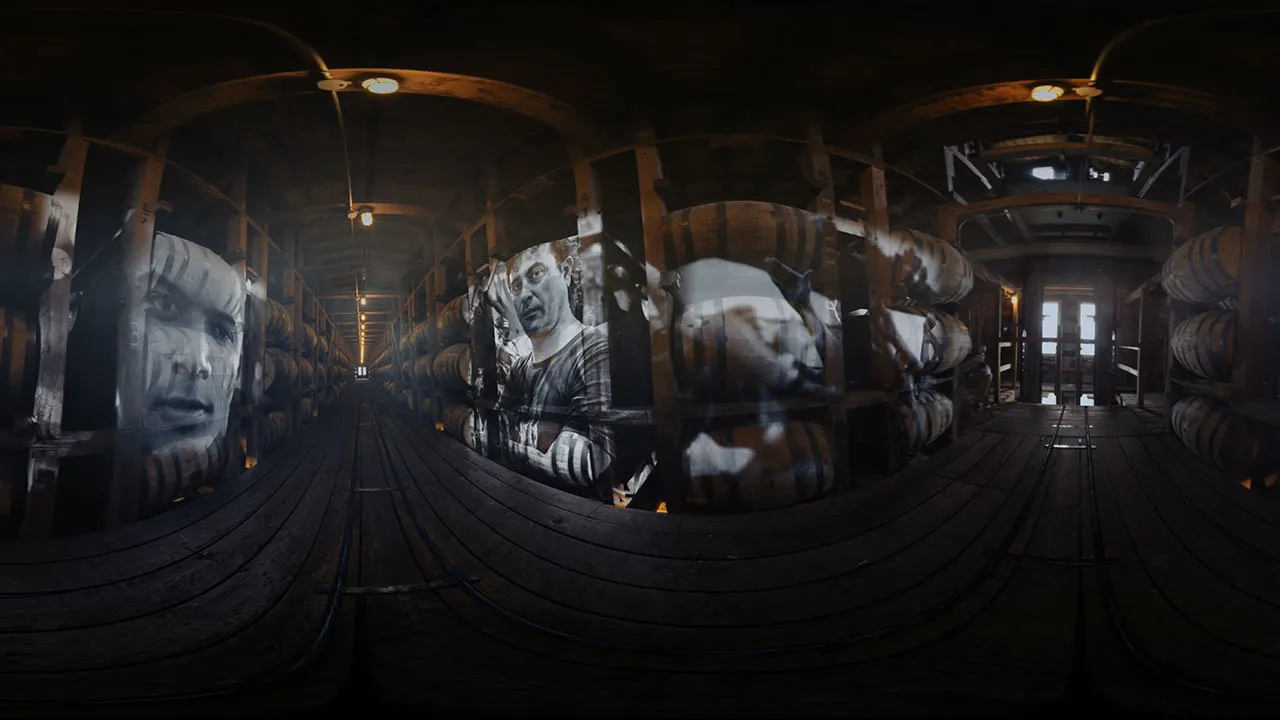
The Jack Daniel’s VR Experience, created by The Mill and FCB/RED, is a fully immersive 360-degree virtual reality tour of America’s first registered distillery. Co-directed by Mill+ director Bowe King and Executive Creative Director Rama Allen, the 2016 experience transports fans to the hallowed grounds of the distillery — the blazing inferno of the rick yard, the rolling hills of Lynchburg, and the top of the famous barrel house. For the project, The Mill developed “mixed time,” a highly stylized cinematic technique combining real-time and frozen elements in a single shot, paired with ambient surround sound. The experience screened on YouTube 360 and Gear VR headsets at Jack Daniel’s activations including Lollapalooza, Life is Beautiful, and Chicago Open Air.
SCANable provided LiDAR 3D scanning and modeling for the production, capturing the distillery environments as precise digital data used to rebuild these sensory-rich locations in virtual reality.
A viewer who can look anywhere will look everywhere
Traditional coverage protects a production. The frame is chosen, and whatever sits outside it does not have to exist.
Immersive work removes that protection. A viewer in a headset can turn toward the ceiling, the floor, the wall behind them, or the thing in the far corner nobody thought about, and every one of those directions has to hold up. That changes what capture means: the requirement is a complete environment rather than the parts of it a camera happened to face.
Working buildings are not sets
A distillery is an operating industrial site. Surfaces are wet, dark, hot, and reflective; access is constrained by the work going on around it; and nothing about the space was arranged for a scanner.
Capture there is planned around those conditions rather than against them. Positions are chosen for coverage of awkward volumes — rick yards, barrel houses, cellar rows receding into darkness — and registration is verified on site, because a return visit to a working facility is not a small ask. Our set and location scanning is built for locations that do not pause for a production.
Where a mesh struggles to describe a place
Some subjects resist polygons. Foliage, rows of barrels receding into shadow, volumetric haze, and heavily textured aged surfaces are all things a mesh describes at enormous cost and still not convincingly.
Gaussian splatting takes a different approach, representing a captured space as a field of oriented primitives that reproduce appearance and parallax directly. For immersive playback, where the viewer moves their head and expects the world to respond, that is often a closer match to what the eye wants than a modelled reconstruction. Neural rendering extends the same idea to view-dependent behaviour like reflection and translucency.
Location data outlives the format it was captured for
Formats move quickly. A 360 experience made for one generation of headsets is delivered against that generation’s resolution, framerate, and playback constraints.
The measured environment underneath is not tied to any of that. Scan data captured for an immersive piece can be revisited later for a spot, a stage background, or an LED volume plate, because it is a record of a real place rather than a render of one.
More immersive and environment projects are in the portfolio, alongside the full service list.