

← Back to all work
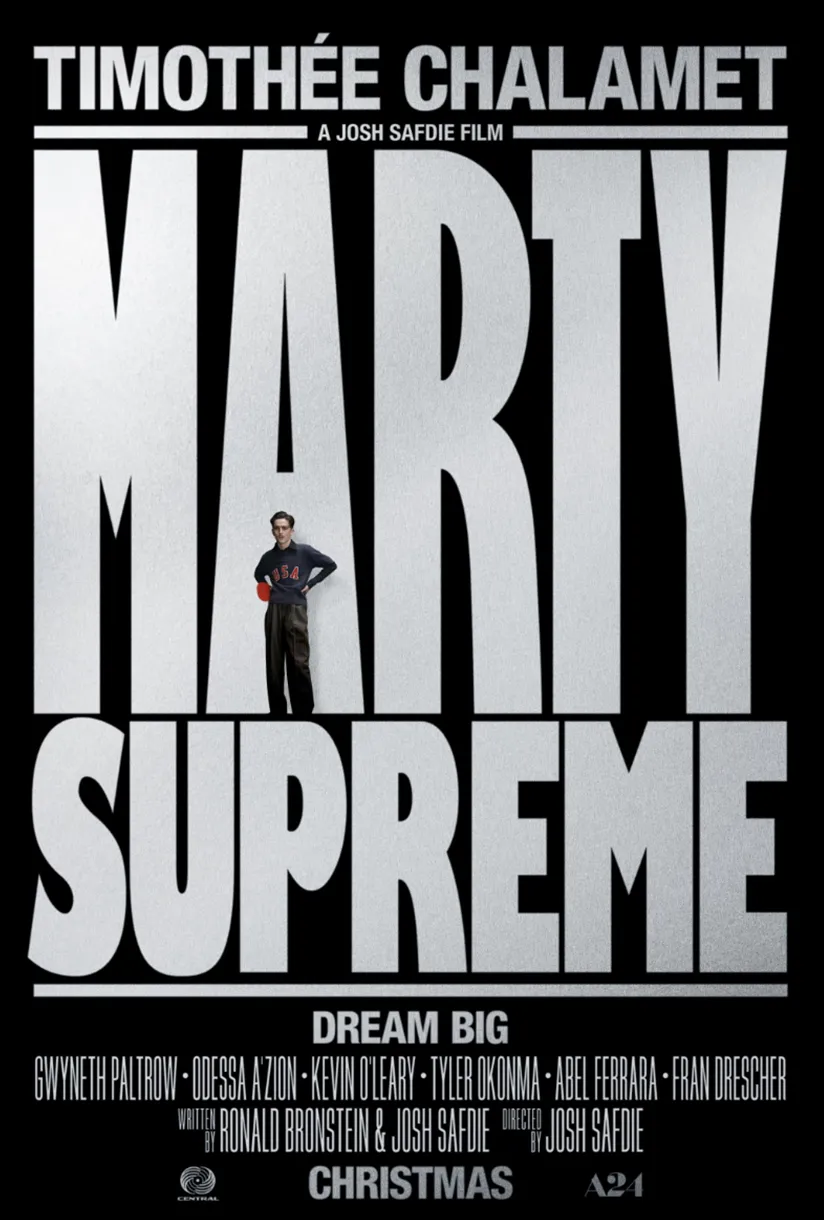
Official poster for Marty Supreme (2025), A24’s ping-pong drama starring Timothée Chalamet

SELECTED WORK / PRODUCTION

Marty Supreme

Studio
A24
Released
December 24, 2025
SCANable role
3D Scanning
Director
Josh Safdie
  • Body Scanning
  • CG
  • Feature Film
  • Props
  • VFX

Marty Supreme is A24’s original, fictionalized sports drama set in the world of 1950s ping-pong, starring Timothée Chalamet and released on December 25, 2025. Directed and co-written by Josh Safdie with Ronald Bronstein, the film follows Marty Mauser (Chalamet), a cocky young man with bold dreams of ping-pong fame who goes “to hell and back in pursuit of greatness.” The supporting cast includes Gwyneth Paltrow, Odessa A’zion, Kevin O’Leary, Tyler Okonma (Tyler, the Creator), and Fran Drescher. Budgeted at around $70 million, the film’s visual effects were handled by Folks VFX.

SCANable provided 3D scanning for the production, capturing performers and props through photogrammetric capture to deliver digital doubles and reference assets for the film’s visual effects work.

Hero objects at arm’s length

Most props are seen briefly, at distance, or in a hand that is moving. A few are the subject of the shot.

When an object is what a film is about, the camera returns to it, holds on it, and shows it from angles a modeler would never think to check. Every asymmetry, every manufacturing mark, every bit of wear becomes information the audience has already absorbed by the time a digital version appears.

Scanning the practical article captures all of it as measurement rather than description. The CG version is then the same object, not a careful copy of one — which matters most in exactly the shots where the object is being looked at hardest.

Objects that are no longer manufactured

Period productions build or source things that have no modern equivalent, and those items are often unique, fragile, or borrowed.

Once such an object exists on set, the window to record it is short. A scan preserves its geometry and surface at full resolution while it is available, which means a digital duplicate can be produced later without the original ever being needed again — for a shot where it breaks, multiplies, or has to behave in a way the real one cannot.

That is a different proposition from photographing it. A photograph documents an appearance; a scan documents a shape.

Performers captured in character

A scan of an actor in a T-shirt is a scan of an actor. A scan of an actor in period hair, wardrobe, and makeup is a scan of the character.

The distinction is practical. A digital double is going to cut against real coverage, and it has to carry the same silhouette the audience just saw — the same haircut, the same cut of trouser, the same shoes and how they sit. Adding those afterward means rebuilding by hand what could have been measured.

Capturing in costume is why our Mobile CyberSCAN™ Studios go to the production, so cast can be scanned as they appear on the day, between setups, without leaving the stage.

Doubles for a game played at speed

Sport on film is fast, close, and largely bare-armed. There is no costume hiding the geometry and no distance softening it.

That raises the standard a digital double has to meet — proportion, muscle definition, and posture all have to survive intercutting with real photography of the same performer. Our arrays fire every camera simultaneously so the body is sampled in a single instant, with no drift from breathing to clean up afterward; the cyberscanning page explains the method.

Everything is delivered after retopology, UV layout, and texturing, scaled and named to the receiving vendor’s spec.

Additional feature film scanning is collected in the portfolio, next to the full service list.