

SELECTED WORK / PRODUCTION
Roommates
- Studio
- Netflix
- Released
- April 16, 2026
- SCANable role
- 3D Scanning
- Director
- Chandler Levack
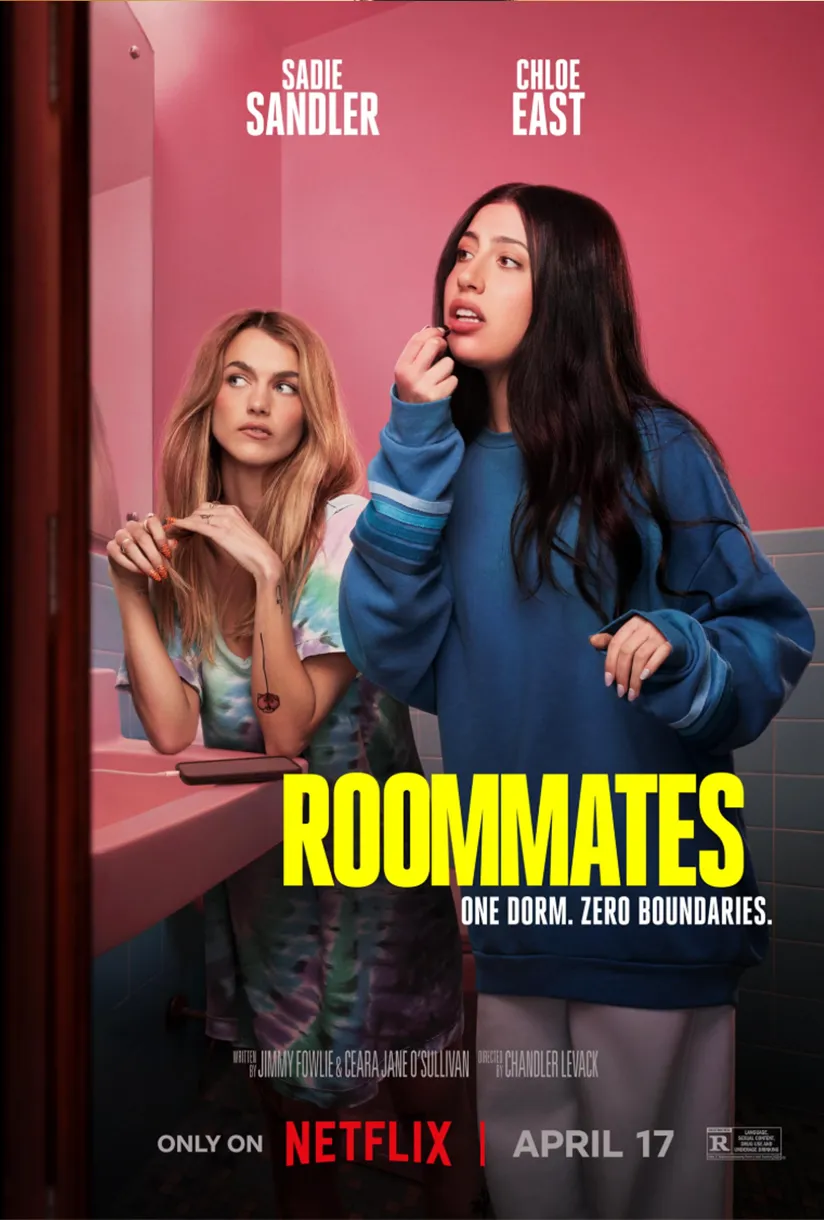
Roommates is a 2026 Netflix comedy starring Sadie Sandler and Chloe East, directed by Chandler Levack. Written by Jimmy Fowlie and Ceara O’Sullivan, the film follows two college freshmen — one naive, the other cool and confident — who become roommates and face the obstacles of living in the same dormitory.
SCANable supported the film’s visual effects by capturing high-resolution 3D scans of practical sets and character performances. Using photogrammetry and LiDAR workflows, the team precisely documented environments and actors, producing accurate digital assets that enabled seamless set extensions and digital doubles while preserving the natural look and scale of each scene. By delivering clean, production-ready data, SCANable helped streamline the VFX pipeline and maintain a high level of realism throughout the film.
Making the seam disappear
A set extension fails at one place: the line where the practical build stops and the digital continuation starts.
Everything else can be forgiven. A slightly wrong texture reads as a lighting choice. A slightly wrong seam reads as a mistake, because the eye is very good at detecting a discontinuity in a straight line — a ceiling that changes pitch, a corridor whose walls stop being parallel, a floor that shifts plane.
Extending outward from measured point-cloud geometry removes the problem at its source. The digital continuation is not matched to the practical set by eye; it inherits the practical set’s exact dimensions, so the two are the same object. Our set and location scanning is what supplies those dimensions.
Short windows and a moving schedule
Scanning almost never gets a dedicated day. It gets the gaps: a lunch break, the hour between a set being finished and being lit, the stretch after wrap before strike begins.
Working inside those windows is a planning discipline, not a speed contest. It means knowing in advance which positions give full coverage of a space, what has to be captured before dressing changes, and what can wait. It means being set up before the window opens and clear before it closes.
The alternative is a request months later for data that no longer exists, which costs the production far more than the capture would have.
Interiors that repeat
Institutional architecture is built from repeated units. A dormitory is a corridor of near-identical rooms; a campus building is a stack of near-identical floors.
That repetition is an opportunity and a trap. Measured once, a unit can be duplicated, mirrored, and re-dressed to populate far more of the building than was ever constructed. But if the measurement is slightly off, the error repeats with it, and a small discrepancy in one room becomes an obviously wrong hallway.
Accurate capture of the practical build is what makes the repetition invisible. Assets are prepared through retopology, UV layout, and texturing so a single measured room can be reused without visible tiling.
Doubles for a small-cast comedy
Even a film with modest effects generates shots the performers cannot practically be in — a stunt, a gag, a plate that needs a figure added.
Digital doubles captured on location cover those cases without pulling cast back for reshoots.
Browse more film scanning work, or see everything we do.