

← Back to all work
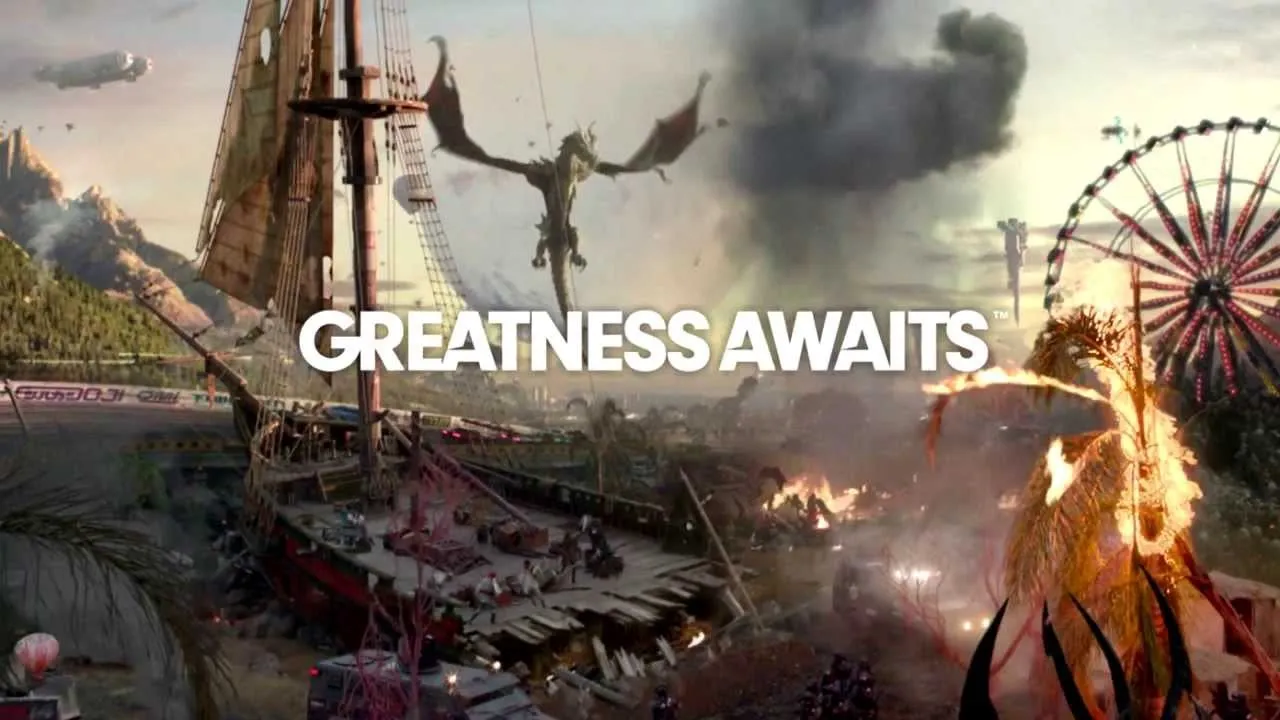
Poster for Sony PlayStation ‘Greatness Awaits’ commercial (2013) — MJZ

SELECTED WORK / PRODUCTION

Sony PlayStation: “Greatness Awaits”

Studio
MJZ
Released
June 10, 2013
SCANable role
LiDAR Scanning/Modeling
Director
Rupert Sanders
VFX vendor
The Mill
  • Architecture
  • Backgrounds
  • Body Scanning
  • CG
  • Camera Tracking
  • Commercial/Advert
  • Crowd Placement
  • Environments
  • Point Cloud
  • Props
  • Set Extension
  • Shadows
  • VFX
  • Vehicles
  • Video Games

‘Greatness Awaits’ is Sony PlayStation’s 2013 commercial directed by Rupert Sanders for MJZ, with visual effects by The Mill and agency BBH. The agency’s first spot for PlayStation follows a hero down the street and around the corner into a world that is all things PlayStation — snippets of easter eggs giving way to a crater where a dragon, F22 Raptors, spaceships, Corvettes, and a host of other game elements come to life. Designed as one continuous camera move with a handheld feel from director of photography Greig Fraser, the spot packed in as many PlayStation games as possible, with production designer Dominic Watkins transforming an empty car park into a PlayStation wonderland and The Mill compositing the massive single shot from thousands of elements.

SCANable provided LiDAR scanning and 3D modeling for the production, delivering high-resolution point-cloud data of the location used for camera tracking, set extension, and the seamless integration of the spot’s computer-generated worlds.

A continuous take leaves nowhere to hide

A spot designed as one unbroken camera move removes every escape route a visual effects team normally relies on. There is no cut to conceal a change in scale, no new angle to re-establish a track, no chance to absorb drift between shots.

The solve has to hold for the entire move, which means the tracking data needs an anchor more reliable than image features alone.

Measured geometry of the location provides it. Constraining a solve to surveyed points keeps the camera locked to the real world for the full duration instead of accumulating error along the way.

Measuring a set built to be replaced

Production design frequently builds only what the camera needs at the start of a move. Beyond that boundary, the world is going to be digital.

The practical build is what everything else grows out of. Scanning it records the exact dimensions the extension has to meet, so the join lands where the design intended rather than where an artist estimated.

That is what makes set extension hold up in a wide frame: both halves share one set of dimensions, and neither is guessing at the other.

Where this kind of work happens now

A spot like this was assembled in post from thousands of separate elements. A comparable brief today is as likely to be shot against an LED volume, with the environment rendered live behind the camera.

The dependency is unchanged. A volume needs environment content that is dimensionally correct, or the parallax between the wall and the physical foreground breaks the moment the camera moves.

Scan data feeds that pipeline directly, which is why virtual production support runs on the same capture discipline. Assets ship after render-ready preparation.

See more advertising and brand work, or the full service list.